Custom PBX vs 3CX vs FreePBX: Which to Choose
If you run your own phone system rather than renting a cloud PBX, three routes come up again and again: 3CX, FreePBX, or a PBX built for you on Asterisk and FreeSWITCH. Each is the right answer for some organisations and the wrong one for others. This guide compares them honestly on licensing, cost, features, multi-tenancy, integrations and operations.
Quick answer
Should you choose 3CX, FreePBX or a custom PBX?
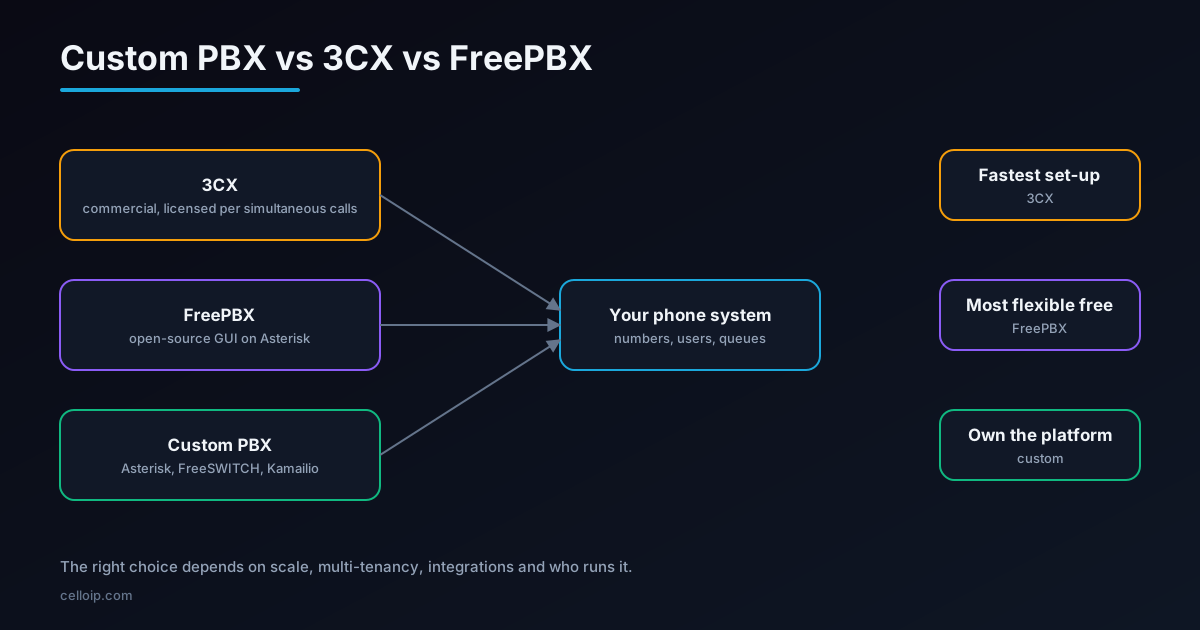
3CX is commercial PBX software licensed per simultaneous calls: quick to set up, polished, with its own apps, but you work within its features. FreePBX is a free, open-source web interface for Asterisk with optional paid modules: flexible and low-cost if you have Asterisk skills. A custom PBX built on Asterisk, FreeSWITCH and Kamailio is designed around your own features, tenants and integrations, and you own the code. Choose 3CX for a standard office phone system, FreePBX for a flexible single-company system on a budget, and custom when the PBX is your product, multi-tenant, very large or deeply integrated.
The three options
3CX
Commercial PBX software for Windows or Linux, self-hosted or with a hosting partner, with its own desktop, mobile and web apps. Licensed annually by edition and simultaneous calls.
FreePBX
An open-source web interface that manages Asterisk, maintained by Sangoma. Free under the GPL, with optional commercial modules for extra features.
Custom PBX
A phone system or platform built for you on open-source engines such as Asterisk, FreeSWITCH and Kamailio, with your own portals, features and integrations. You own the code.
All three can run your business calls well. The differences show up in how much you can change, how costs grow, how many organisations one system can serve, and who keeps it running. If you are also weighing a rented cloud PBX, see our cloud PBX vs custom PBX guide.
Side by side
| Factor | 3CX | FreePBX | Custom PBX |
|---|---|---|---|
| Licence | Commercial, annual per system | Open source (GPL) plus optional paid modules | Open-source engines; you own your code |
| How cost grows | With simultaneous calls and edition | Mostly hosting and your time | Hosting and maintenance; no per-seat fees |
| Time to first calls | Hours to days | Days | Weeks to months |
| Ease of administration | Polished, guided | Flexible, needs Asterisk knowledge | Whatever you design |
| Apps for users | Included | Via third-party softphones or paid modules | Custom-branded apps if you build them |
| Custom features | Within 3CX's options and APIs | Wide, through Asterisk and custom modules | Unlimited |
| Multi-tenancy | One organisation per instance | One organisation per system | Built in, with reseller tiers if needed |
| Scale | Sized by licence | Limited by one Asterisk server and design | Designed for your scale, clustered |
| Integrations | Built-in CRM connectors and APIs | Asterisk interfaces (AMI, ARI, AGI) | Anything, built to your systems |
| Vendor dependence | High: product and pricing decisions are 3CX's | Moderate: Sangoma for commercial modules | Low: open-source engines |
| Who runs it | You or a 3CX partner | You or a partner | You or your development partner |
| Best for | Standard office telephony | Budget-conscious single-company systems | Providers, platforms, large or integrated systems |
3CX: strengths and limits
3CX is a complete product: install it, add extensions and trunks through a guided web console, and users get desktop, mobile and web apps the same day. It suits companies that want a familiar office phone system without building anything.
| Strengths | Limits |
|---|---|
| Fast to deploy, with guided set-up | Features, roadmap and pricing are decided by 3CX |
| Included apps and web client | Licensing grows with simultaneous calls and edition |
| Built-in integrations with common CRMs | Deep customisation is limited to its APIs |
| Large partner network for support | One organisation per instance; not built for providers selling to many tenants |
3CX sells annual licences by edition and number of simultaneous calls, with hosting billed separately. Published prices for small systems start at a few hundred dollars a year, but editions, prices and the status of the free tier have changed recently and sources disagree, so take current figures from 3CX's own price list.
FreePBX: strengths and limits
FreePBX gives Asterisk a web interface for extensions, trunks, routes, IVRs, queues and voicemail. It is free under the GPL, runs on Debian in its current version, and has a large community. Sangoma sells commercial modules for features such as advanced endpoint management and some call-centre functions.
| Strengths | Limits |
|---|---|
| No licence fee for the core system | Needs Asterisk and Linux skills to run well and securely |
| Full access to Asterisk underneath | Designed for one organisation per system |
| Large community and many guides | Some features depend on commercial, closed-source modules |
| Works with almost any SIP phone or trunk | The interface can be limiting for complex or unusual call flows |
FreePBX is a strong choice for an IT team that is comfortable with Asterisk and wants a capable phone system without licence fees. Keep it patched and never expose it to the internet without proper security: see our VoIP toll-fraud prevention guide.
Custom PBX: strengths and limits
A custom PBX uses the same open-source engines that power many commercial products, Asterisk for rich call features, FreeSWITCH for high-density media and multi-tenancy, and Kamailio or OpenSIPS for SIP routing at scale, with your own portals, APIs and apps on top.
| Strengths | Limits |
|---|---|
| Built around your features, tenants and workflows | Higher upfront cost than buying a product |
| No per-seat or per-call licence fees | Takes weeks to months to build |
| Multi-tenant, reseller tiers and billing if you need them | Needs a team, in-house or a partner, to maintain it |
| Scales out across servers and regions | Every feature has to be specified and built |
| Deep integration with your CRM, billing and apps | |
| You own the code and the roadmap |
Our custom PBX development page describes what we build, and Asterisk vs FreeSWITCH explains how to choose the engine.
What about FusionPBX?
FusionPBX is to FreeSWITCH roughly what FreePBX is to Asterisk: an open-source web interface. Unlike FreePBX, it is built for multi-tenancy, with domains for each customer, which is why many hosted PBX providers start with it. Many providers then customise it heavily or replace parts with their own portals as they grow. See our FusionPBX development page.
Cost over time
The three routes spend money at different times. 3CX spreads cost over annual licences; FreePBX shifts it to your team's time; a custom PBX concentrates it in the build and then mostly hosting and maintenance.
| Cost item | 3CX | FreePBX | Custom PBX |
|---|---|---|---|
| Software licence | Annual, by edition and simultaneous calls | None for the core; commercial modules optional | None for the engines |
| Build or set-up | Low | Low to moderate | $8,000–$20,000 for a company PBX; $30,000–$80,000 for a multi-tenant platform |
| Hosting | Server or 3CX-partner hosting | Server | Servers, sized to your scale |
| Running it | Partner or in-house admin | In-house Asterisk skills or a partner | Maintenance by you or your partner |
Illustrative: relative cost as a system grows (index, small single-company system = 10)
Illustrative only, showing the shape of cost growth rather than real prices. Licence-based costs grow with capacity; custom costs are mostly upfront.
For a single office of a few dozen users, 3CX or FreePBX is almost always cheaper. For a provider serving many businesses, or an organisation with thousands of users and custom needs, licence-free custom platforms usually win over a few years.
Multi-tenancy: the deciding factor for providers
If you sell phone service to other businesses, multi-tenancy matters more than anything else. Running a separate 3CX or FreePBX instance per customer works at small numbers but becomes hard to manage, update and bill at scale.
- Tenant isolation: each customer's extensions, numbers, recordings and data kept separate.
- Reseller tiers: partners who manage their own customers under your platform.
- Self-service portals for tenants and resellers.
- Usage-based billing from call records, with rating and invoices.
- Central updates and monitoring for every tenant at once.
- Branding per tenant or reseller.
Our multi-tenant VoIP platform architecture guide covers these designs in depth.
Integrations and AI
Modern phone systems are expected to connect to CRMs, helpdesks and increasingly AI voice agents. All three routes can, to different depths.
| Integration | 3CX | FreePBX | Custom PBX |
|---|---|---|---|
| CRM screen pop and call logging | Built-in connectors for common CRMs | Modules or custom AMI/ARI code | Built to your CRM |
| AI voice agents | Usually as a SIP trunk to the AI platform | SIP trunk or Asterisk AudioSocket | Any method, including streaming audio |
| Call transcription and analytics | Depends on edition and add-ons | Custom work on Asterisk | Designed in |
| Your own apps and portals | Through 3CX APIs | Custom code against Asterisk | Native |
See our guide to adding AI voice agents to your existing phone system, which covers 3CX, FreePBX and others.
Desk phones, softphones and apps
| 3CX | FreePBX | Custom PBX | |
|---|---|---|---|
| Desk phones | Supported models with automatic provisioning | Most SIP phones; provisioning via modules or templates | Any SIP phone, with your own provisioning service |
| Mobile and desktop apps | 3CX's own apps included | Third-party softphones or Sangoma apps | Your own branded apps, or any SIP softphone |
| Web calling | 3CX web client | Through add-ons or WebRTC configuration | A WebRTC web phone designed for your users |
| Branding | 3CX branding | Limited | Your brand throughout |
If you serve customers rather than your own staff, branded apps often matter. Our guide to custom vs white-label softphones covers the options.
Who runs it?
3CX
Easiest to administer day to day; a 3CX partner can host and support it.
FreePBX
Needs someone comfortable with Linux, Asterisk and VoIP security; patching and backups are your job.
Custom PBX
Needs ongoing maintenance by the team that built it or an in-house team; in return, nothing changes unless you decide it should.
Whichever you choose, plan for security updates and monitoring from day one. Phone systems are attacked constantly, and an unpatched PBX is one of the most common routes to toll fraud. Ask any partner how they handle updates, backups, monitoring and fraud alerts before signing.
Decision guide
| If you are... | Choose |
|---|---|
| A single company wanting a standard phone system, quickly | 3CX |
| A single company with Asterisk skills and a tight budget | FreePBX |
| A provider starting a hosted PBX service on a budget | FusionPBX, customised |
| A provider building a hosted PBX or UCaaS product to grow | Custom PBX platform |
| Large, multi-site or integration-heavy | Custom PBX |
| Building software where calling is a feature of your product | Custom PBX or programmable telephony |
Moving to a custom PBX later
- Keep numbers with your carrier, so they move by changing trunks, not porting.
- Export users, extensions, ring groups, IVRs and queues, and recreate them in the new system.
- Re-provision desk phones by changing their provisioning server.
- Move groups of users at a time, with both systems linked during the transition.
- Keep call records from the old system for reporting and compliance.
A real example
CelloIP built a multi-tenant hosted PBX platform for a North American enterprise on FreeSWITCH, Kamailio/OpenSIPS and RTPengine, running in the public cloud. A packaged PBX wouldn't have fitted: the platform serves more than 100 tenants with over 1,000 concurrent channels, 50,000+ extensions and 50,000+ DIDs, with a tenant portal, IVR and queues, recording, CDR and billing, and CRM and API integration.
CelloIP project outcome (client kept private)
Built in three to six months and still maintained by CelloIP: multi-tenant by design, with no per-seat licences, scaled across servers instead of instances.
Frequently asked questions
What is the difference between 3CX and FreePBX?
3CX is commercial PBX software with its own apps and web client, licensed annually by the number of simultaneous calls. FreePBX is an open-source web interface for managing Asterisk, free to use under the GPL, with optional paid commercial modules from Sangoma. 3CX is more polished out of the box; FreePBX gives more access to the underlying system.
When does a custom PBX make sense?
When the phone system is your product (a hosted PBX or UCaaS service), when you need true multi-tenancy with reseller tiers and billing, very high scale, deep integration with your own software, or features no packaged PBX offers. It also makes sense when you want to own the platform and its roadmap.
Is FreePBX really free?
The core is open source and free under the GPL. Some features come from commercial modules that Sangoma licenses separately, and you pay for hosting, support and your own time to run it.
How is 3CX licensed?
3CX sells annual system licences by edition and by the number of simultaneous calls, rather than per user. Hosting is separate. Editions and prices change, and sources disagree on the current free tier, so check 3CX's own price list.
Can FreePBX or 3CX run a multi-tenant hosted PBX?
FreePBX is designed for one organisation per system. 3CX is also licensed per system, with hosting partners running many separate instances. For many tenants on shared infrastructure, providers usually choose FusionPBX on FreeSWITCH or a custom platform.
What does a custom PBX cost?
As a guide, a company IP PBX on Asterisk or FreeSWITCH is typically $8,000–$20,000 over 4–8 weeks, and a multi-tenant cloud PBX platform with portals and billing $30,000–$80,000 over 10–20 weeks. There are no per-call or per-seat licence fees; you pay for hosting and maintenance.
Is a custom PBX less secure than a commercial product?
Not inherently. Asterisk, FreeSWITCH and Kamailio are mature, widely deployed and actively maintained. Security depends on design and operations: keeping SIP off the open internet or behind an edge proxy, strong credentials, dialplan restrictions, call and spend limits, monitoring and regular updates. The same is true of 3CX and FreePBX.
Can we move from 3CX or FreePBX to a custom PBX later?
Yes. Numbers stay with your carrier, desk phones can be re-provisioned, and users, extensions and call flows can be exported and recreated. Plan the move by groups of users and keep both systems running in parallel for a short period.
Work with CelloIP
Deciding between a packaged PBX and your own?
CelloIP builds custom PBX and hosted PBX platforms on Asterisk, FreeSWITCH and Kamailio, and customises FreePBX and FusionPBX deployments. We'll tell you honestly if a packaged product is the better fit. You own the code.