Case Study: Multi-Tenant Hosted PBX for 100+ Tenants
A North American enterprise needed its own hosted phone platform: one system serving more than a hundred separate tenants, tens of thousands of extensions and numbers, and every kind of endpoint from desk phones to browsers. CelloIP designed and built it on open-source telephony in public cloud, and still maintains it. This is how it works and what we learned.
Quick answer
What did CelloIP build in this hosted PBX project?
CelloIP built a custom multi-tenant hosted PBX for a North American enterprise client on public cloud. It runs on FreeSWITCH behind a Kamailio/OpenSIPS SIP edge with RTPengine for media, handles 1,000+ concurrent channels, 50,000+ extensions and 50,000+ DIDs for 100+ tenants, and includes IVR and queues, call recording, a tenant admin portal, CDR and billing, desk-phone provisioning, softphones, WebRTC calling and CRM APIs. It was built in three to six months and CelloIP still maintains it.
Project summary
| Details | |
|---|---|
| Client | Enterprise, North America (name confidential) |
| Platform | Multi-tenant hosted PBX |
| Scale | 1,000+ concurrent channels · 50,000+ extensions · 50,000+ DIDs · 100+ tenants |
| Telephony stack | FreeSWITCH, Kamailio/OpenSIPS SIP edge, RTPengine media relay |
| Hosting | Public cloud |
| Features | IVR and call queues, call recording, tenant admin portal, CDR and billing |
| Endpoints and integrations | Auto-provisioned desk phones, mobile and desktop softphones, WebRTC browser calling, REST APIs and CRM integration |
| Timeline | First production version in three to six months |
| Status | Live, maintained and extended by CelloIP |
The client wanted to own its phone platform rather than rent seats from a hosted PBX vendor: control of features, data, numbers and costs, with the ability to add tenants without asking anyone's permission. That meant a custom build on open-source telephony, designed from the start for many tenants and large numbers of extensions.
The challenge
Running one PBX for one company is a well-understood problem. Running one platform for more than a hundred tenants is a different one. Every tenant expects its own extensions, numbers, menus, queues, recordings and reports, and none of them should ever see, or be affected by, another tenant's calls or data.
The scale added pressure. Tens of thousands of extensions mean tens of thousands of devices registering and re-registering, many behind home or office routers with NAT. Tens of thousands of numbers need fast, correct inbound routing to the right tenant. And a thousand simultaneous calls need media handled efficiently, without one busy tenant slowing down the rest.
- Strict separation between tenants for calls, configuration and data.
- Room to grow beyond 1,000 concurrent channels by adding servers, not redesigning.
- Support for desk phones, softphones and browsers on the same platform.
- Self-service administration so tenants manage their own users, numbers and routing.
- Accurate call records and billing per tenant.
- APIs so tenants can connect their CRM and business systems.
- Delivery of a first production version within months, not years.
Architecture
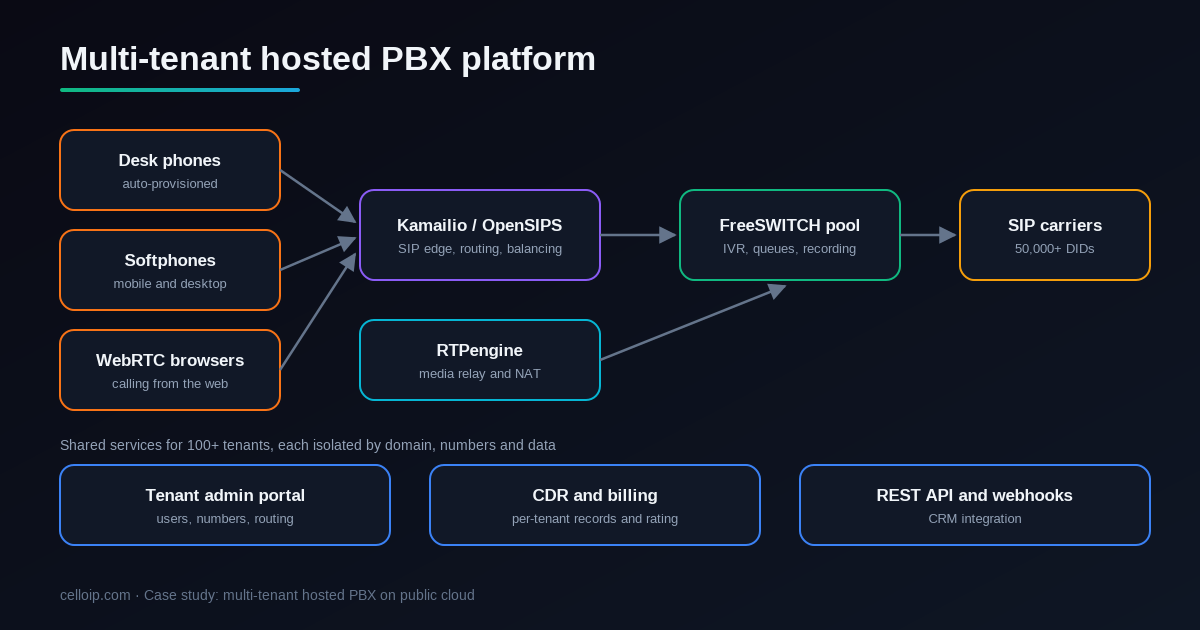
The design separates the platform into layers, each doing one job and each able to grow independently:
SIP edge (Kamailio/OpenSIPS)
The front door for all SIP traffic: registration of devices, authentication, routing to the right FreeSWITCH server and load balancing across the pool. Keeping registrations at the edge stops tens of thousands of devices from loading the media servers.
Media relay (RTPengine)
Relays audio between devices, carriers and FreeSWITCH, solving NAT problems for devices behind routers and keeping media paths predictable.
Call processing (FreeSWITCH pool)
Runs the PBX logic: IVR menus, call queues and recording. Servers in the pool are interchangeable, so capacity grows by adding servers.
Carrier connectivity
SIP trunks to carriers for 50,000+ DIDs, with inbound numbers mapped to tenants and outbound routing per tenant.
Portal, billing and APIs
The web portal for tenant administrators, CDR collection and per-tenant rating, and REST APIs with webhooks for integrations.
Public cloud
All layers run on public cloud infrastructure, so servers can be added as tenants and traffic grow.
Separating signalling from call processing is the single most important decision in a platform of this size. Our guide to multi-tenant VoIP platform architecture explains the trade-offs in more depth.
Tenant isolation
Isolation was built into every layer rather than added later in the portal:
| Layer | How tenants are kept separate |
|---|---|
| SIP | Each tenant has its own SIP domain; devices authenticate against their tenant, and calls are routed within the tenant's context |
| Numbers | Every DID maps to exactly one tenant, and inbound calls enter only that tenant's routing |
| Dialplan | FreeSWITCH dialplans and IVRs run per tenant, so extensions like 101 can exist in every tenant without conflict |
| Data | Recordings, call records and settings are stored and queried per tenant |
| Portal | Tenant administrators can see and change only their own users, numbers, routing and reports |
| Billing | Call records are rated and summarised per tenant |
This approach means a configuration mistake in one tenant affects only that tenant, and onboarding a new tenant is a matter of creating its domain, users and numbers rather than deploying new infrastructure.
Features delivered
IVR and call queues
IVR menus and call queues per tenant, configured from the portal.
Call recording
Recording with storage and playback in the portal, kept separate per tenant.
Tenant admin portal
Self-service management of users, extensions, numbers, IVRs, queues and routing, so tenants don't need to raise tickets for everyday changes.
CDR and billing
Call detail records collected across the platform and rated per tenant for reporting and invoicing.
Device provisioning
Automatic configuration of SIP desk phones, so new phones work when plugged in.
Integrations
REST APIs and webhooks, including CRM integration, so tenants can connect calls to their business systems.
For more on billing design, see our VoIP billing and CDR guide.
Phones, apps and APIs
Tenants use a mix of devices, so the platform supports all of them through the same SIP edge:
- SIP desk phones, auto-provisioned with the right account, features and settings.
- Mobile and desktop softphones for staff working away from a desk.
- WebRTC calling from the browser, so users can make and take calls without installing anything.
- REST APIs and webhooks for CRM integration, call events and automation.
Supporting browsers alongside traditional SIP devices needs WebRTC handled at the edge, with media relayed and transcoded where necessary. Our WebRTC-SIP gateway architecture guide covers how that works.
Designing for scale
These are the design principles that let the platform handle 1,000+ concurrent channels and 50,000+ extensions, and keep growing:
Keep registrations off the media servers
The SIP edge handles device registration and authentication, so FreeSWITCH servers spend their capacity on calls.
Make call servers interchangeable
Any FreeSWITCH server in the pool can take any tenant's call, so the edge can balance load and a server can be taken out for maintenance.
Relay media deliberately
RTPengine gives every call a predictable media path through NAT, which helps avoid one-way audio, a common complaint on hosted PBX platforms.
Route numbers fast
Inbound DID-to-tenant lookups are simple and quick, so tens of thousands of numbers don't slow down call setup.
Separate real-time and reporting work
CDR processing, billing and reporting run apart from call handling, so a heavy report never affects live calls.
Grow by adding servers
On public cloud, more capacity means adding servers to the relevant layer rather than redesigning the platform.
Our guides on OpenSIPS load balancing and Kamailio SBC configuration show how the edge layer is set up in practice.
Delivery
The first production version was delivered in three to six months, built in stages so the core could be tested before features were added on top:
| Stage | What was built |
|---|---|
| 1. Core telephony | SIP edge, media relay, FreeSWITCH pool and carrier trunks, with tenant-aware routing |
| 2. Tenant model | Domains, extensions, numbers and per-tenant dialplans and data |
| 3. PBX features | IVR, call queues and call recording |
| 4. Portal and billing | Tenant administration, CDR collection and per-tenant rating |
| 5. Endpoints and APIs | Desk-phone provisioning, softphones, WebRTC calling, REST APIs and CRM integration |
| 6. Production and support | Go-live, monitoring and ongoing maintenance and extension by CelloIP |
CelloIP continues to maintain the platform, including updates, monitoring and new features as the client's needs grow.
Lessons for anyone building a hosted PBX
- Decide on multi-tenancy at the start. Adding tenant separation to a single-company PBX later is far harder than designing for it.
- Separate signalling, media and call processing early; it is what makes growth possible.
- Plan for NAT from day one. Most devices sit behind routers, and media relay prevents one-way audio.
- Give tenants self-service. A good portal saves more support time than almost any other feature.
- Treat billing data as critical. Call records must be complete and accurate, because invoices depend on them.
- Build on open source you can own. FreeSWITCH, Kamailio, OpenSIPS and RTPengine are proven at scale, and you keep control of the platform.
If you are deciding between a hosted product and your own platform, our comparison of cloud PBX vs custom PBX sets out when each makes sense.
Frequently asked questions
What technology does the platform use?
FreeSWITCH for call processing (IVR, queues and recording), a Kamailio/OpenSIPS SIP proxy layer for registration, routing and load balancing, and RTPengine to relay media and handle NAT. It runs on public cloud, with a web portal, CDR and billing services and REST APIs alongside.
How large is it?
The platform handles 1,000+ concurrent channels and serves 50,000+ extensions and 50,000+ DIDs across 100+ tenants.
How long did it take to build?
The first production version was delivered in three to six months. CelloIP continues to maintain and extend the platform.
How are tenants kept separate?
Each tenant has its own SIP domain, extensions, numbers, routing, recordings and call records, and tenant administrators see only their own data in the portal. The SIP edge and FreeSWITCH dialplan enforce the same boundaries for calls.
Which phones and apps work with it?
Auto-provisioned SIP desk phones, mobile and desktop softphones, and WebRTC calling from the browser. Business systems connect through REST APIs and webhooks, including CRM integration.
Who is the client?
A North American enterprise. Like most CelloIP clients, it is covered by a confidentiality agreement, so we describe the project without naming the company.
What would a similar platform cost?
As a guide, a single-company PBX typically costs $8,000–$20,000 over four to eight weeks, and a multi-tenant cloud PBX platform $30,000–$80,000 over 10–20 weeks. Carrier-scale, highly available platforms are scoped after discovery.
Work with CelloIP
Planning your own hosted PBX platform?
CelloIP designs and builds multi-tenant PBX platforms on FreeSWITCH, Asterisk, Kamailio and OpenSIPS, with portals, billing, provisioning, softphones, WebRTC and APIs. You own the code and the platform.