VoIP Toll Fraud Prevention: Stop SIP Attacks Before They Cost You
Any phone system reachable from the internet is scanned within hours of going live. If an attacker gets in, they can run up thousands in international calls over a single weekend, and the bill usually lands on you. This guide explains how toll fraud works and the layered defences that stop it on Asterisk, FreeSWITCH, Kamailio and the PBXs built on them.
Quick answer
How do you prevent VoIP toll fraud?
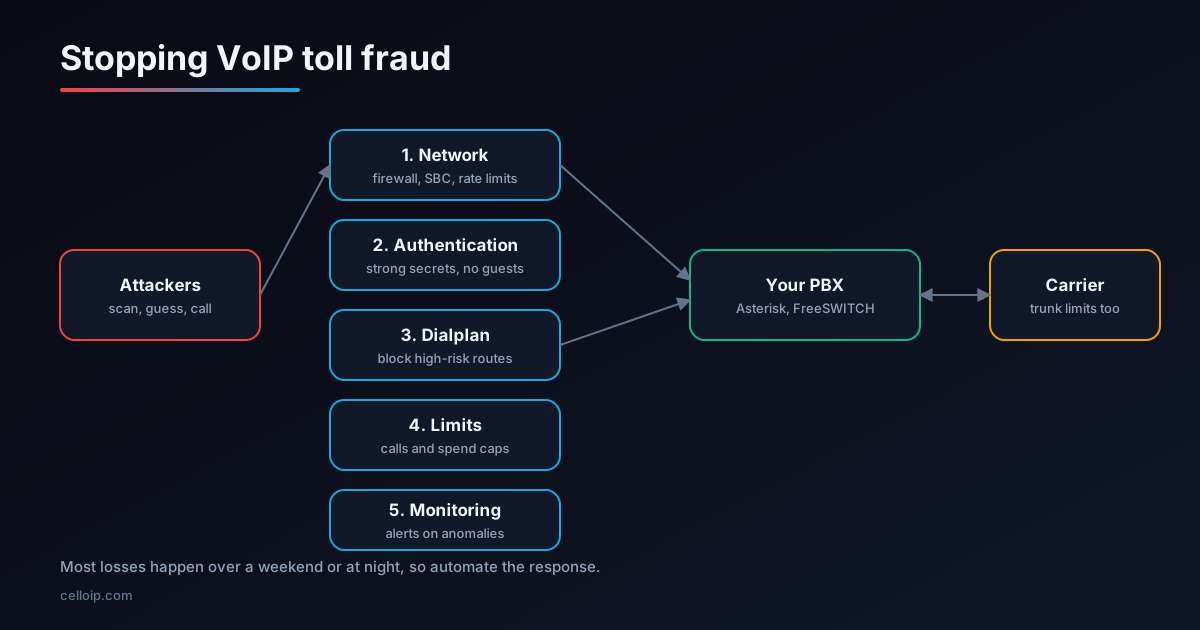
VoIP toll fraud happens when attackers gain access to your phone system or SIP accounts and place calls you pay for, usually to expensive international or premium-rate numbers where they share the revenue (IRSF). Most attacks start with automated scanning for exposed SIP servers and weak passwords. Stop it in layers: keep SIP off the open internet or behind an SBC or Kamailio edge with rate limiting, use strong unique credentials, block international and premium destinations by default, cap concurrent calls and spend, and monitor call records in real time with automatic blocking. Most losses happen at night and over weekends, so the response must be automatic.
What toll fraud is, and why it's so costly
Toll fraud is the unauthorised use of your phone system to make calls you pay for. The calls almost always go to expensive international or premium-rate destinations, because the attacker has an arrangement to receive part of the revenue for each minute. Every call they make earns them money and costs you.
The damage builds quickly. Attackers run many calls in parallel, around the clock, and they time attacks for nights, weekends and holidays when nobody is watching. By Monday morning the bill can run into thousands. Industry surveys put total telecom fraud losses in the tens of billions of dollars a year; the Communications Fraud Control Association's survey reported about $39 billion for 2023, with revenue-share fraud among the largest categories.
Types of VoIP fraud
| Type | How it works | Main defence |
|---|---|---|
| PBX hacking | Attackers break into a PBX or SIP account and place calls through it | Network restrictions, strong credentials, dialplan rules |
| International Revenue Share Fraud (IRSF) | Calls are pumped to international ranges where the attacker shares the revenue | Block high-risk destinations, call and spend limits |
| Premium-rate fraud | Calls to premium-rate numbers that charge high per-minute rates | Block premium ranges by default |
| Wangiri (one ring and cut) | Short calls from premium numbers bait people into calling back | Don't auto-return unknown international missed calls; block callbacks to high-risk ranges |
| Credential theft | Softphone or portal credentials stolen and reused elsewhere | Unique strong secrets, IP restrictions, alerts on new locations |
| Feature abuse | Weak voicemail PINs, remote-access (DISA) or call-forwarding used to reach outside lines | Disable unneeded features, strong PINs, no external forwarding by default |
How a typical attack happens
- Scanning: automated tools sweep the internet for SIP servers on ports 5060 and 5061 and identify the software.
- Enumeration: they probe extension numbers to find ones that exist.
- Password guessing: they try common and default passwords against each extension, at high speed.
- Testing: with a working account, they place a few short calls to check what routes are open.
- Attack: they launch many parallel calls to expensive destinations, usually at night or over a weekend.
- Repeat: if not blocked, they come back, sometimes through other accounts they have found.
Every step leaves a trace: failed registrations, unusual user agents, calls to new countries, too many concurrent calls. Good defences stop the early steps and catch the later ones within minutes.
Defence in layers
| Layer | What it stops | Examples |
|---|---|---|
| 1. Network and edge | Scanning, enumeration, brute force | Firewall allow-lists, SBC or Kamailio edge, rate limiting, non-public admin panels |
| 2. Authentication | Password guessing and reuse | Long random secrets, no default or guest accounts, IP restrictions, TLS |
| 3. Dialplan | Expensive calls even with a valid account | International and premium blocked by default, allow-lists, PINs for international |
| 4. Limits | Scale of any attack that gets through | Concurrent-call caps per account, daily spend caps, carrier-side limits |
| 5. Monitoring | Attacks in progress | Real-time call-record checks, alerts, automatic blocking |
Illustrative: how much each layer limits a weekend attack's cost (index, no protection = 100)
Illustrative only, not measured data: shows how layers multiply each other's effect.
Layer 1: network and edge
- Don't expose SIP to the whole internet if you don't need to: allow only your carriers' and offices' IP addresses.
- Where remote phones and apps must connect, put an SBC or a Kamailio or OpenSIPS edge in front of the PBX.
- Rate-limit requests per source address, and block known scanner user agents.
- Keep admin panels (FreePBX, FusionPBX, 3CX consoles) off the public internet, behind a VPN.
- Use fail2ban or similar to ban addresses after repeated authentication failures.
- Use SIP over TLS for phones and apps where possible; it also stops credentials leaking on the network.
A minimal fail2ban set-up for Asterisk watches the security log for failed authentication and bans the source address. Treat the numbers as starting points and tune them to your traffic.
# /etc/fail2ban/jail.d/asterisk.conf
[asterisk]
enabled  = true
filter   = asterisk          # shipped filter matching failed SIP authentication
logpath  = /var/log/asterisk/security
maxretry = 5                 # failures before a ban
findtime = 600               # within 10 minutes
bantime  = 86400             # ban for 24 hours
action   = iptables-allports[name=asterisk, protocol=all]
Example: rate limiting and scanner blocking in Kamailio
Kamailio's pike module tracks requests per source address and flags floods, which catches most scanners and brute-force attempts before they reach the PBX.
# kamailio.cfg (excerpt)
loadmodule "pike.so"
modparam("pike", "sampling_time_unit", 2)      # seconds per sampling window
modparam("pike", "reqs_density_per_unit", 16)  # max requests per window per IP
modparam("pike", "remove_latency", 4)

request_route {
    # Drop known scanner user agents early
    if ($ua =~ "friendly-scanner|sipvicious|sipcli|sip-scan") {
        xlog("L_WARN", "scanner blocked: $si ua=$ua\n");
        exit;
    }
    # Rate-limit everything not coming from our own servers
    if (src_ip != myself && !pike_check_req()) {
        xlog("L_ALERT", "pike: flood from $si, dropping\n");
        exit;
    }
    # ... normal routing, with authentication before relaying to the PBX
}
Our Kamailio development and OpenSIPS development pages cover SIP edge design, including topology hiding and per-tenant limits.
Layer 2: authentication
- Use long, random SIP secrets for every account, never the extension number or a dictionary word.
- Change every default password. FreeSWITCH, for example, ships with a default directory password (1234 in vars.xml) that must be changed before going live.
- Disable guest and anonymous calling unless you need it, and make sure unauthenticated calls can't reach outbound routes.
- Restrict where each account may register from, where possible, and alert when it registers from a new country.
- Use strong voicemail and portal PINs, and lock accounts after repeated failures.
- Remove accounts for departed staff and decommissioned phones promptly.
<!-- FreeSWITCH vars.xml: change the default directory password before go-live -->
<X-PRE-PROCESS cmd="set" data="default_password=CHANGE-ME-to-a-long-random-value"/>
Layer 3: dialplan rules
Assume a password will be stolen one day. The dialplan decides how much damage a stolen account can do.
- Block international calling by default; enable it per account or per tenant only where needed.
- Use a country allow-list rather than a block-list; allow only the countries each customer actually calls.
- Block premium-rate and special-service ranges outright.
- Require a PIN for international calls from desk phones, or limit them to business hours.
- Never let incoming calls reach outbound routes through forwarding or remote-access features unless strictly controlled.
; Asterisk extensions.conf: international only for allowed accounts, with a concurrency cap
[outbound]
exten => _00X.,1,NoOp(International call from ${CALLERID(num)} to ${EXTEN})
 same => n,GotoIf(${DB_EXISTS(intl_allowed/${CALLERID(num)})}?allowed)
 same => n,Playback(ss-noservice)              ; not allowed for this account
 same => n,Hangup()
 same => n(allowed),Set(GROUP(intl)=${CDR(accountcode)})
 same => n,GotoIf($[${GROUP_COUNT(${CDR(accountcode)}@intl)} > 2]?busy)
 same => n,Dial(PJSIP/${EXTEN}@carrier,60)
 same => n,Hangup()
 same => n(busy),Playback(all-circuits-busy-now) ; more than 2 international calls at once
 same => n,Hangup()
Layer 4: call and spend limits
Limits don't prevent an attack, but they cap how much it can cost. They are the cheapest insurance you can buy.
Concurrent calls per account
An office extension rarely needs more than one or two simultaneous outbound calls; a stolen one shouldn't be able to run fifty.
Daily spend per account and tenant
Rate calls as they happen and stop outbound calls when a daily budget is reached.
Destination limits
Lower limits, or none at all, for high-cost countries.
Carrier-side limits
Ask your SIP trunk provider for spend caps, international blocks and fraud alerts on your account as a second line.
On multi-tenant platforms, rating calls in real time against limits is part of the billing system; see our VoIP billing page and CDR and billing guide.
Layer 5: monitoring and automatic response
| Signal | What it may mean | Automatic response |
|---|---|---|
| Spike in failed registrations | Brute-force attempt | Ban the source address; alert |
| First-ever call to a new country | Compromised account testing routes | Alert; hold if the country is high-risk |
| Many short calls to one range | IRSF testing or Wangiri | Block the range; alert |
| Concurrent calls above normal | Attack in progress | Cap the account; alert |
| Spend rising fast at night | Attack in progress | Suspend international for the account; page on-call |
The response must be automatic. A human reading an email alert on Monday is too late; a rule that suspends international calling on an account within minutes is not.
Securing SIP trunks and carrier accounts
- Authenticate trunks by IP where your carrier supports it, and with strong credentials where it doesn't; ideally both.
- Never reuse trunk credentials on phones or apps.
- Enable international blocks, spend caps and fraud alerts on the carrier account itself, as a second line of defence.
- Use separate trunks or accounts for different tenants or departments, so one compromise doesn't affect all.
- Review carrier invoices and usage dashboards weekly, not only monthly.
Our SIP trunk solutions page covers trunk design and carrier failover.
Softphones and remote staff
Remote working means phones register from home networks, hotels and mobile data, so IP allow-lists alone can't protect them. Compensate with other controls.
- Provision softphones by QR code or link, so users never see or type their SIP password.
- Use TLS and SRTP for remote devices, so credentials and calls can't be captured on public Wi-Fi.
- Alert when an account registers from a new country, and block countries you never operate in.
- Limit remote accounts to the call types they need; most don't need international calling.
- Revoke credentials immediately when a device is lost or a person leaves.
Extra controls for multi-tenant platforms
Hosted PBX and UCaaS providers carry the risk for every customer at once. A single weak tenant can generate a large bill that the provider may not be able to recover.
Per-tenant limits
Concurrent calls, daily spend and allowed countries set per tenant, with safe defaults for new customers.
Real-time rating
Every call rated as it happens against the tenant's balance or credit limit, stopping calls when limits are reached.
Tenant isolation
Separate credentials, dialplans and limits per tenant, so a compromise stays contained.
Onboarding checks
International calling off by default for new tenants, enabled only after verification.
See our multi-tenant VoIP platform architecture guide and the hosted PBX case study.
If you're hit
- Stop outbound international calling immediately, globally if needed.
- Ask your carrier to block destinations and flag the fraud; some can stop calls already in progress.
- Identify the compromised account or route from call records, and disable it.
- Change credentials on every account that could be affected, and review recent configuration changes.
- Keep call records and logs as evidence for your carrier and, if appropriate, the authorities.
- Fix the root cause before restoring service, then add the missing layer.
Test your defences regularly
Controls drift: a new tenant is created with international enabled, a firewall rule is relaxed for a test and never restored, a carrier changes its addresses. A short, regular test catches these before an attacker does.
| Test | How | Expected result |
|---|---|---|
| Exposure | Run an authorised scan of your own public addresses from outside your network | SIP ports open only where intended; admin panels not reachable |
| Brute-force handling | Trigger repeated failed registrations from a test address | Address banned or rate-limited within minutes |
| International block | Dial an international number from an extension without permission | Call refused |
| Premium ranges | Dial a premium-rate prefix from an allowed account | Call refused |
| Concurrency cap | Start more simultaneous outbound calls than the limit | Extra calls refused |
| Monitoring | Simulate an unusual pattern on a test tenant | Alert raised and automatic action taken |
Only test systems you own or are authorised to test, and tell your carrier before deliberately generating unusual traffic. A quarterly test, plus one after any major change to the platform, is a sensible rhythm for most organisations.
Toll-fraud prevention checklist
| Check | Done? |
|---|---|
| SIP reachable only from allowed addresses, or behind an SBC or Kamailio edge | ☐ |
| Rate limiting and scanner blocking at the edge | ☐ |
| Admin panels off the public internet | ☐ |
| Long random secrets on every account; all defaults changed | ☐ |
| Guest and anonymous calls cannot reach outbound routes | ☐ |
| International blocked by default; country allow-lists per account or tenant | ☐ |
| Premium-rate ranges blocked | ☐ |
| Concurrent-call and daily spend limits per account and tenant | ☐ |
| Carrier spend caps and fraud alerts enabled | ☐ |
| Real-time monitoring with automatic suspension | ☐ |
| Software patched and supported versions in use | ☐ |
Frequently asked questions
What is VoIP toll fraud?
Toll fraud is the unauthorised use of your phone system or SIP accounts to make calls you pay for. Attackers usually call expensive international or premium-rate numbers where they receive a share of the call revenue, so every minute earns them money and costs you.
How do attackers get in?
Mostly through automated scanners that probe the internet for SIP servers, then guess extension numbers and passwords. Other routes include default passwords, exposed admin panels, voicemail or remote-access features with weak PINs, stolen softphone credentials and unpatched software.
What is IRSF?
International Revenue Share Fraud: the attacker arranges to receive part of the termination revenue for calls to certain international number ranges, then generates as much traffic to them as possible, often using a compromised PBX or SIP account.
What is Wangiri fraud?
'Wangiri' means 'one ring and cut' in Japanese. Fraudsters make very short calls from premium international numbers so people call back and pay high rates. Businesses are exposed when staff or automated systems return missed calls to unknown international numbers.
How much can toll fraud cost?
Losses can reach thousands of dollars in a single night or weekend, because attackers run many calls in parallel to expensive destinations. Industry surveys put total telecom fraud losses in the tens of billions of dollars a year.
Is fail2ban enough?
No. Fail2ban is useful for blocking addresses after repeated failed logins, but attackers rotate addresses, and it does nothing once valid credentials are stolen. Combine it with network restrictions, rate limiting, dialplan rules, call and spend limits and monitoring.
Who pays for fraudulent calls?
Usually the customer whose system or account made them. Carriers bill for completed calls, which is why spend limits on your carrier account and fast detection matter so much.
Work with CelloIP
Want your VoIP platform hardened against fraud?
CelloIP secures Asterisk, FreeSWITCH, FreePBX, FusionPBX and Kamailio deployments: SIP edges with rate limiting, dialplan controls, per-tenant limits, real-time rating and monitoring with automatic response. You own the code.