AI Voice Agent Cost: Build and Running Costs Explained
Voice agent quotes range from a few hundred dollars a month for an app to six figures for an enterprise build, and per-minute prices vary just as much. This guide breaks the cost into its parts so you can compare quotes properly and estimate what an agent will cost at your volume.
Quick answer
How much does an AI voice agent cost?
An AI voice agent has two costs. The build is typically $8,000–$20,000 for a managed-platform MVP and $25,000–$60,000 for a custom production agent, with enterprise deployments scoped separately. Running costs are charged per minute for telephony, speech-to-text, the language model and text-to-speech, plus a platform fee on managed platforms or hosting if self-hosted, so total cost depends heavily on call volume.
The two parts of voice agent cost
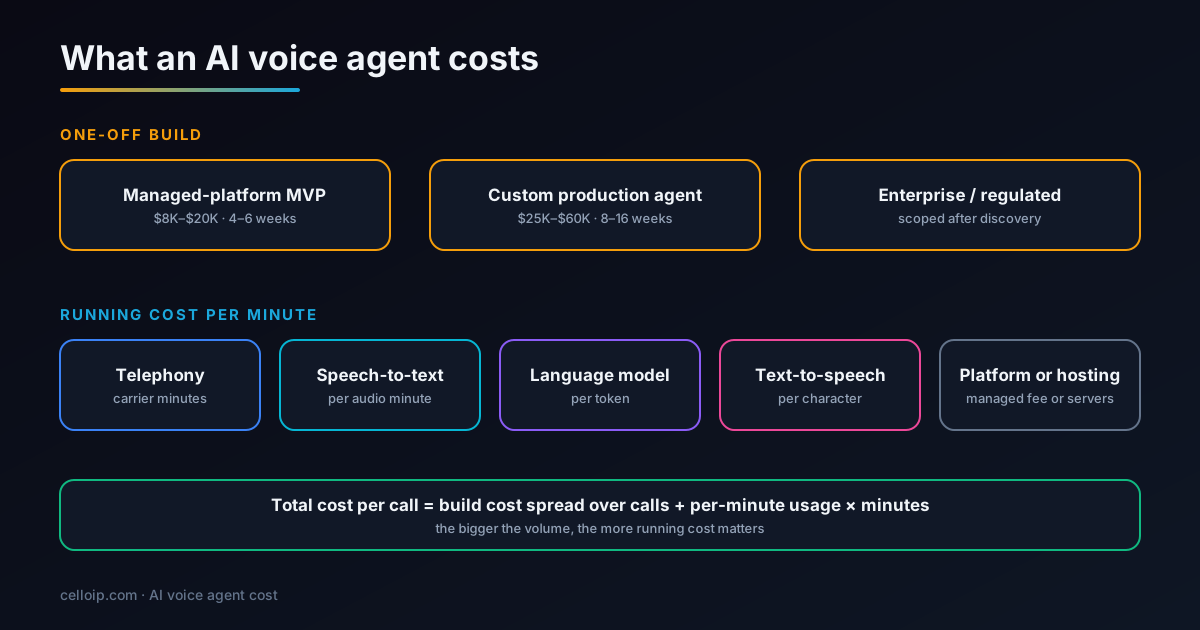
The build is a one-off project: designing the conversation, connecting the phone system and your business systems, writing and testing prompts and tools, and setting up monitoring. Its size depends on scope, not on call volume.
Running costs are usage-based. Every minute of every call consumes telephony, speech recognition, language model tokens and synthesised speech, and either a managed platform's per-minute fee or a share of your own servers. These grow with volume, which is why the right architecture for 2,000 minutes a month is often different from the right one for 200,000.
When comparing options, think about cost per resolved call over a year rather than the headline build price or the per-minute rate alone. A cheaper build that resolves fewer calls, or a low per-minute price on a platform that limits what the agent can do, can easily cost more in staff time than it saves.
Build cost by scope
These are typical ranges for custom work, consistent across our AI voice agent development pages. You get a fixed quote after a discovery call.
| Build | Typical scope | Typical range | Timeline |
|---|---|---|---|
| Managed-platform MVP | One use case on Vapi, Retell or similar, one or two languages, calendar or CRM integration | $8,000 – $20,000 | 4–6 weeks |
| Custom production agent | Self-hosted LiveKit or Pipecat, your choice of models, PBX or SIP integration, several tools, monitoring | $25,000 – $60,000 | 8–16 weeks |
| Enterprise or regulated deployment | Several use cases or languages, deep core-system integration, in-country or on-premise hosting, high concurrency | Scoped after discovery | Agreed in the plan |
Off-the-shelf AI receptionist apps sit below these ranges with a monthly subscription and limited customisation. They are a sensible first step for a single small office; the custom ranges above apply when the agent must fit your phone system, data and processes.
What drives build cost up or down
Number of call types
Each use case needs its own flows, tools, tests and edge cases. One well-defined call type is far cheaper than a general agent.
Integrations
Calendars and modern CRMs are quick; legacy systems without good APIs, or core banking and practice-management systems, take longer.
Telephony
A new number on a managed platform is simple; connecting to an existing PBX, contact centre and transfer rules adds work but keeps your setup intact.
Languages
Each language needs model selection, prompts and testing with native speakers, especially for dialects and mixed languages.
Compliance and hosting
Consent checks, recording controls, data redaction and in-country or on-premise hosting add design and testing time.
Quality bar
A rigorous test suite, simulated callers, load tests and dashboards cost more up front and save far more in production.
The most effective way to control build cost is to start narrow. Pick the call type with the highest volume and the clearest rules, build it properly with tests and monitoring, and add the next call type once the first is working. The second and third call types are usually much cheaper because the telephony, integrations and quality process are already in place.
Running cost per minute, component by component
Every minute of conversation uses several metered services. Their prices change often and vary by provider, model, voice and country, so treat this as a map of what to price rather than a price list.
| Component | How it is billed | What changes the cost |
|---|---|---|
| Telephony | Per minute of call, plus monthly number fees | Country, inbound vs outbound, mobile vs landline, toll-free numbers |
| Speech-to-text | Per minute of audio | Provider and model, streaming vs batch, language, self-hosting |
| Language model | Per token in and out | Model size, prompt and context length, number of turns, tool calls |
| Text-to-speech | Per character or per minute of audio | Voice quality tier, provider, how much the agent talks, caching |
| Platform fee (managed) | Per minute on top of the above | The platform and plan |
| Hosting (self-hosted) | Monthly servers, roughly per concurrent call | Concurrency, region, GPU use for self-hosted models |
A useful way to think about it: telephony and speech-to-text scale with how long calls last, the language model scales with how much context and reasoning each turn needs, and text-to-speech scales with how much the agent says. Short, efficient conversations are cheaper on every line.
Prices for speech and language models have been falling as competition grows, but premium voices and the most capable models still cost noticeably more than standard options. Re-check prices at least twice a year; switching providers or tiers for a component can change your cost per minute significantly without changing anything callers notice.
A worked example
To show how the components add up, here is an example with illustrative assumptions. These are not quotes from any provider; replace each figure with current pricing for the stack you choose.
Illustrative cost per minute in US cents (example assumptions only)
Example assumptions for a self-hosted agent: telephony 0.8¢, speech-to-text 0.6¢, language model 0.5¢, text-to-speech 2.0¢, hosting share 0.5¢ = 4.4¢ per minute. A managed platform would add its own per-minute fee instead of the hosting share.
# estimate.py: plug in current prices for your stack
avg_call_minutes   = 3.5
calls_per_month    = 15_000
minutes            = avg_call_minutes * calls_per_month   # 52,500 minutes

cents_per_minute = {          # EXAMPLE ASSUMPTIONS, replace with real pricing
    "telephony": 0.8,
    "speech_to_text": 0.6,
    "language_model": 0.5,
    "text_to_speech": 2.0,
    "hosting_share": 0.5,     # or a managed platform's per-minute fee
}
fixed_monthly = {"numbers": 50, "monitoring": 150, "storage": 50}   # USD

usage = minutes * sum(cents_per_minute.values()) / 100
total = usage + sum(fixed_monthly.values())
print(f"{minutes:,.0f} min -> usage ${usage:,.0f} + fixed ${sum(fixed_monthly.values())} = ${total:,.0f}/month")
print(f"cost per call ${total / calls_per_month:.2f}")
With these example assumptions, 52,500 minutes a month comes to roughly $2,310 in usage plus $250 of fixed costs, about $2,560 a month or 17 cents per call. The point of the exercise is not the specific number but seeing which lines dominate for your call pattern, so you know where optimisation pays.
Run the same calculation for a managed platform by replacing the hosting share with the platform's per-minute fee, and for a quieter month as well as a busy one. Seeing both cases side by side usually makes the right architecture for your volume obvious.
Managed platform or self-hosted: where the costs differ
| Managed platform | Self-hosted framework | |
|---|---|---|
| Build cost | Lower: the platform handles media and orchestration | Higher: you build and operate more of the stack |
| Per-minute cost | Provider usage plus a platform fee | Provider usage plus your hosting |
| Fixed monthly cost | Low | Servers, monitoring and operations |
| Cheapest at | Low and uncertain volumes | Steady, higher volumes |
| Other benefits | Fastest to launch | Data in your environment, any model, no lock-in |
The crossover point depends on your volume, call length and team, so model both before deciding. A common path is to prove the use case on a managed platform and move to a self-hosted framework such as LiveKit or Pipecat once volume makes the platform fee significant. See LiveKit vs Pipecat and Vapi vs Retell vs LiveKit.
Ways to reduce running costs without hurting quality
- Keep replies short and conversational; every extra sentence costs speech synthesis and caller time.
- Use a smaller, faster language model for routine turns and a larger one only when needed.
- Keep prompts and retrieved context lean, and summarise long conversations instead of resending everything.
- Cache fixed phrases such as greetings, disclosures and confirmations as pre-generated audio.
- Route simple, structured requests (opening hours, order status) through tools with templated replies.
- Choose speech and voice tiers per use case; premium voices aren't needed on every line.
- Hand over to people early when the agent is unlikely to resolve the call, instead of long failed conversations.
- Review cost per resolved call monthly; a cheaper agent that resolves less can cost more overall.
Measure before optimising. Logging cost per call by component for a few weeks shows exactly where money goes, and the biggest savings are often in places nobody expected, such as long greetings, repeated confirmations or tools that are called more often than needed.
Estimating return on investment
The honest way to value a voice agent is per resolved call. Start from the calls it will actually handle end to end, not every call it touches.
Cost today
Staff time per call including after-call work, overtime and after-hours cover, plus the value of calls currently missed or abandoned.
Cost with the agent
Build cost spread over a sensible period, plus running cost per minute times minutes, plus fixed monthly costs and ongoing tuning.
What to count
Only calls resolved by the agent, confirmed in your systems. Transferred calls still cost staff time.
Beyond cost
Faster answers, 24/7 availability, consistent compliance and more time for complex calls often matter as much as the cost saving.
Revisit the numbers after the first month of real traffic. Resolution rates, call lengths and transfer reasons from live calls are far more reliable than any estimate made before launch.
How the cost profile changes by use case
The same components apply to every voice agent, but which ones dominate depends on the job. Use this to focus your estimate on the lines that matter for your case.
| Use case | Typical call pattern | Costs that dominate |
|---|---|---|
| AI receptionist for a small business | Low volume, short calls, many questions | Build and fixed monthly costs; usage is small |
| Contact-centre tier-1 automation | High volume, medium calls, several tools | Per-minute usage, especially voice and telephony |
| Outbound reminders and confirmations | High volume, very short calls, many unanswered | Telephony and answering-machine handling |
| Complex support or sales conversations | Long calls, much reasoning and retrieval | Language model tokens and voice |
| Multilingual service lines | Mixed volumes per language | Build and testing per language; premium speech models for some languages |
| Regulated or in-country deployments | Any volume | Hosting, security and compliance work |
For low-volume use cases, focus on keeping the build lean. For high-volume ones, a few tenths of a cent saved per minute matters more than a few thousand dollars on the build.
Questions to ask before you sign
Whether you buy a platform, hire a partner or build in-house, these questions expose most of the costs that surprise people later.
- What is the full cost per minute at our expected volume, broken down by component?
- Which costs are fixed each month, regardless of call volume?
- What happens to price if we double our volume, add a language or add a phone number in another country?
- Who pays for changes when a speech, voice or model provider changes its pricing or API?
- What ongoing tuning and support is included after launch, and what is billed separately?
- Can we move to another platform or host it ourselves later, and what would that take?
Clear answers to these make quotes comparable and protect you from a cheap launch that becomes expensive at scale.
Frequently asked questions
How much does it cost to build an AI voice agent?
As a guide, a managed-platform MVP for one use case is typically $8,000–$20,000 over 4–6 weeks, and a custom production agent on a self-hosted framework with integrations and monitoring $25,000–$60,000 over 8–16 weeks. Enterprise, multilingual or regulated deployments are scoped after discovery.
What does an AI voice agent cost per minute to run?
It is the sum of telephony, speech-to-text, language model and text-to-speech usage, plus a per-minute platform fee on managed platforms or hosting costs if self-hosted. Prices vary widely by provider, model, voice quality and country, so estimate with current pricing for your chosen stack and your average call length.
Is self-hosting cheaper than a managed platform?
At low volume, usually not, because you pay for engineering and servers that sit idle. As volume grows, removing the per-minute platform fee often makes self-hosting cheaper, and it also keeps data in your environment. The crossover depends on your volume, call length and team.
What is usually the biggest running cost?
Often text-to-speech, especially with premium voices, followed by telephony and the language model. Choosing efficient models, keeping replies short and caching common responses can reduce it noticeably.
Are there hidden costs?
Common ones are phone numbers, recording storage, monitoring and analytics tools, prompt and content updates, testing, and engineering time when providers change their APIs or pricing. Include ongoing tuning in the budget, not just the build.
How do I estimate ROI for a voice agent?
Compare the fully loaded cost of the calls the agent resolves (staff time, overtime, missed calls, after-hours cover) with its build cost spread over a period plus running costs. Count only calls the agent genuinely resolves, not every call it touches.
Do costs differ by country?
Yes. Telephony rates, number costs, in-country hosting requirements and the availability of good speech models for each language all vary. Multilingual agents also need more testing per language.
Work with CelloIP
Want a clear quote for your voice agent?
Tell us your call types, volumes, languages and phone system. CelloIP will recommend managed or self-hosted, give you a fixed build quote, and model running costs at your volume. You own the code.