Self-Hosted vs Managed Voice AI: How to Choose
Every AI voice agent project hits the same question early: use a managed platform that runs everything for you, or build on an open-source framework you host yourself? The answer changes cost, speed, data control and how much engineering you need. This guide lays out the options, compares them honestly and gives a simple way to decide.
Quick answer
Should you use managed or self-hosted voice AI?
Managed voice AI platforms such as Vapi and Retell run the agent for you and charge per minute, which makes them the fastest way to launch and validate a use case. Self-hosted frameworks such as LiveKit Agents and Pipecat run in your own cloud or data centre, let you choose any models, keep call data under your control and remove the platform fee, in exchange for more engineering and operations. Choose managed to learn quickly at modest volume; choose self-hosted when volume, data rules, deep telephony integration or control make the platform fee and limits too costly.
What managed and self-hosted mean
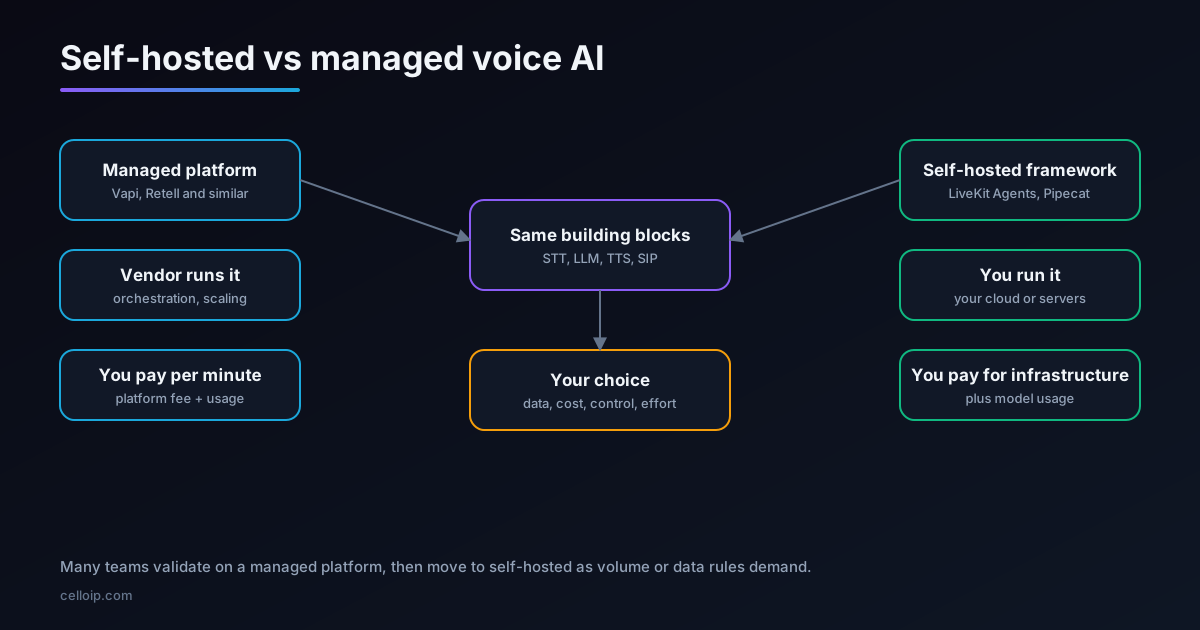
Every AI voice agent is built from the same parts: telephony or WebRTC to carry the call, speech-to-text, a language model with tools, text-to-speech, and orchestration that streams audio between them and handles turn-taking and interruptions.
Managed platforms such as Vapi, Retell, Bland and Synthflow run the orchestration for you. You configure prompts, voices, tools and phone numbers in their dashboard or API; they handle scaling, uptime and usually the telephony. You pay a per-minute platform fee on top of speech, model and phone costs.
Self-hosted frameworks, mainly LiveKit Agents and Pipecat, are open-source code your team runs. You write the agent, deploy it with its media servers in your cloud or data centre, connect your own phone system and choose every model. There is no platform fee, but you own the engineering and operations.
It's a spectrum: four realistic options
| Option | Who runs what | Typical fit |
|---|---|---|
| No-code managed app | Vendor runs everything; you configure in a dashboard | Simple receptionist or booking use cases, small teams |
| Developer managed platform (Vapi, Retell) | Vendor runs orchestration and telephony; you add prompts, tools and integrations through APIs | Validating a use case quickly with your own logic |
| Framework on its maker's cloud (LiveKit Cloud, Pipecat Cloud) | You write the agent code; the vendor hosts and scales it | Custom agents without running servers yourself |
| Fully self-hosted | You run the framework, media servers and optionally the models | High volume, strict data rules, deep telephony integration |
The middle options are often overlooked. Running LiveKit Agents or Pipecat on their makers' cloud services gives you open-source code you can take elsewhere, at a lower per-minute fee than most managed platforms, without operating servers.
Managed vs self-hosted, side by side
| Factor | Managed platform | Self-hosted framework |
|---|---|---|
| Time to first call | Hours to days | Days to weeks |
| Per-minute platform fee | Yes, on every minute | None; you pay for infrastructure |
| Cost at high volume | Grows linearly with minutes | Mostly fixed infrastructure plus usage |
| Model choice | The platform's supported list | Any hosted or open-weight model |
| Where call data goes | Through the vendor and its providers | Your servers, plus any hosted models you choose |
| Telephony | Vendor numbers or SIP trunk, within their features | Full SIP control: your PBX, carriers, routing, transfers |
| Custom behaviour | Within the platform's features and limits | Anything you can code |
| Operations | Vendor's job | Your job, or your partner's |
| Lock-in | Prompts and flows live in the vendor's system | Open-source code you can move |
| Compliance options | Depends on vendor plans, often paid add-ons | You design hosting, retention and access |
How cost changes with volume
Speech-to-text, the language model, text-to-speech and telephony cost roughly the same whichever way you host, because you pay those providers either way. The real difference is the platform or hosting layer.
| Option | Published pricing (late 2026, approximate) |
|---|---|
| Vapi | Platform fee around $0.05 per minute, with speech, model and telephony billed on top; third-party estimates put typical all-in cost at roughly $0.10–$0.30 per minute |
| Retell | Advertised at about $0.07–$0.31 per minute, depending on the model and voice chosen |
| LiveKit Cloud | Agent session minutes around $0.01 per minute on paid plans, plus model usage |
| Pipecat Cloud | Around $0.01 per active agent-minute for the smallest size, plus transport and model usage |
| Self-hosted LiveKit or Pipecat | No licence or platform fee; you pay for servers, bandwidth, model usage and operations |
Prices change often and depend on plan and volume; check each vendor's pricing page before budgeting. The pattern, though, is stable: a per-minute platform fee is small for a pilot and large at scale.
Illustrative monthly platform or hosting cost, excluding speech, model and telephony usage
Illustrative only. Assumes a $0.05/min managed platform fee and a $0.01/min framework-cloud fee; self-hosted figures are example server costs and exclude the engineering time to run them.
Two costs are easy to forget on the self-hosted side: the engineering to build and maintain the agent, and on-call operations. At a few thousand minutes a month they outweigh any savings; at hundreds of thousands of minutes they usually don't. Our AI voice agent cost guide works through per-minute costs component by component.
Data, privacy and compliance
For many organisations this decides the question before cost does. A phone call carries personal data, sometimes health or financial details, and rules on where it may be processed vary by country and industry.
| Set-up | Where audio and transcripts go |
|---|---|
| Managed platform | The platform and each speech, model and voice provider it uses |
| Self-hosted framework with hosted models | Your servers for media and logic; the chosen model providers for speech and text |
| Fully self-hosted, including models | Your servers only: for example self-hosted Whisper, an open-weight model served with vLLM, and local text-to-speech |
- Check whether each provider signs the agreements you need, such as a HIPAA business associate agreement, and on which plans.
- Check where each provider processes data, and whether in-region hosting is available.
- Decide how long recordings and transcripts are kept, and who can access them.
- Remember that your own compliance team makes the final assessment, whichever option you choose.
Our guide to HIPAA requirements for voice AI agents and voice AI for banks go deeper on regulated industries.
Control, quality and telephony
Model choice
Self-hosting lets you pick and mix any speech, language and voice models, including open-weight ones and the best option for each language.
Latency tuning
You control where each component runs, so you can place everything in one region near your callers and phone system.
Telephony
Direct SIP to your PBX or carriers gives full control over routing, transfers, caller ID and recording.
Custom logic
Anything you can code: custom turn-taking, multi-agent flows, unusual integrations, on-device or on-premise steps.
Managed convenience
Managed platforms ship features like analytics dashboards, number provisioning and testing tools out of the box.
Speed of change
Managed platforms update models and features for you; with self-hosting you choose when to upgrade.
For a closer look at the two main frameworks, see LiveKit vs Pipecat; for the managed platforms, see Vapi vs Retell vs LiveKit vs Bland.
What self-hosting actually takes
Self-hosting is not just deploying a container. A production voice agent needs the same care as any real-time service that customers depend on.
- Media servers and agent workers that scale with concurrent calls, with headroom for peaks.
- SIP connectivity to your PBX or carriers, with authentication, encryption and failover.
- GPUs or hosted endpoints if you run your own speech or language models.
- Monitoring of latency, errors and call quality, with alerts and an on-call rota.
- Logging, transcripts and retention rules that match your data policy.
- A test suite of real-style calls, run before every prompt, model or code change.
- Security updates for the framework, media servers and operating system.
This is where a partner earns its keep. Many teams keep the agent logic in-house and have a partner run the platform, or the reverse. Our self-hosted LiveKit deployment guide covers the infrastructure in detail.
Avoiding lock-in, whichever you choose
The best protection against lock-in is to keep your business logic in your own systems. If the agent books appointments by calling your own booking API, that API works the same whether a managed platform or a self-hosted agent calls it. Only the thin wiring changes.
# Self-hosted (LiveKit Agents): the tool simply calls YOUR booking API.
# A managed platform would call the same API through its webhook tools.
from livekit.agents import Agent, RunContext, function_tool
import httpx

BOOKING_API = "https://api.example.com/v1"

class BookingAgent(Agent):
    def __init__(self) -> None:
        super().__init__(instructions="Help callers book appointments. Confirm date and time back to them.")

    @function_tool()
    async def check_availability(self, context: RunContext, date: str) -> dict:
        """Return open appointment slots for a date in YYYY-MM-DD format."""
        async with httpx.AsyncClient(timeout=5) as http:
            r = await http.get(f"{BOOKING_API}/slots", params={"date": date})
            r.raise_for_status()
return r.json()- Keep prompts and call flows in version control, not only in a vendor dashboard.
- Expose business actions as your own APIs with clear inputs and permissions.
- Keep your phone numbers on your carrier or PBX, and route to the agent over SIP.
- Store transcripts and analytics in your own systems as well as the vendor's.
Questions to ask a managed vendor
- What is the all-in cost per minute at our expected volume, including speech, model, voice and telephony?
- Which features are paid add-ons, and which plans include them?
- Can we bring our own SIP trunk and keep our numbers on our carrier?
- Where is call data processed and stored, and for how long? Is in-region hosting available?
- Can we export prompts, call flows, transcripts and analytics if we leave?
- What concurrency and uptime commitments come with each plan?
- How often do you change models or pricing, and how much notice do we get?
How to decide
| If this describes you | Start with |
|---|---|
| You want to test whether AI can handle a call type, quickly | A managed platform |
| You expect modest volume and have no strict data rules | A managed platform |
| You need custom behaviour but don't want to run servers | A framework on its maker's cloud |
| You handle large call volumes, now or soon | Self-hosted, or plan the move early |
| Call data must stay in your infrastructure or region | Self-hosted, with self-hosted models if needed |
| You need deep integration with your own PBX or contact centre | Self-hosted framework over SIP |
| You have no engineers to run it | Managed, or self-hosted with a partner who operates it |
A common, sensible path: prove the use case on a managed platform for a few weeks, with business logic in your own APIs, then move to a self-hosted framework once the numbers justify it.
A real example: the hybrid route
CelloIP's AI voice agent for a North American contact centre sits in the middle of the spectrum. The agent runs on the open-source LiveKit Agents framework, connected over SIP to the contact centre's own FreeSWITCH platform, while speech-to-text, the language model and text-to-speech use hosted APIs. That gave the centre full control over telephony, routing and handover, kept the code portable, and kept the build fast by not running its own models.
CelloIP project outcome (client kept private)
Built in three to six months: LiveKit Agents over SIP to FreeSWITCH, English and Spanish, CRM, booking and helpdesk integrations, and handover to human agents. Live and maintained by CelloIP.
What it costs to build
| Build | Typical range | Timeline |
|---|---|---|
| Managed-platform MVP, one use case | $8,000 – $20,000 | 4–6 weeks |
| Custom production agent on a self-hosted framework | $25,000 – $60,000 | 8–16 weeks |
| Enterprise or on-premise, including self-hosted models | Scoped after discovery | Agreed in the plan |
Ranges match our AI voice agent development page. Running costs are separate.
Frequently asked questions
What is the difference between managed and self-hosted voice AI?
With a managed platform, the vendor runs the agent orchestration, scaling and often the telephony, and you configure your agent through their dashboard or API and pay per minute. With a self-hosted framework, your team or partner runs the agent code and media servers in your own cloud or data centre, chooses the speech and language models, and pays for infrastructure and usage instead of a platform fee.
Is self-hosted voice AI cheaper?
At low volume, usually not: engineering and operations cost more than the platform fee you save. As minutes grow, the per-minute platform fee becomes a large recurring cost, and self-hosting typically becomes cheaper. Speech, language model and telephony usage are paid either way, so compare the platform fee against your infrastructure and operations cost.
Can self-hosted voice AI keep call data on our own servers?
Yes, if you also self-host the models. Running LiveKit or Pipecat yourself keeps the media and agent logic on your infrastructure; using self-hosted speech-to-text, an open-weight language model and local text-to-speech keeps the audio and transcripts there too. With hosted model APIs, audio or text still goes to those providers.
Which managed platforms and frameworks are most common?
Popular managed platforms include Vapi, Retell, Bland and Synthflow. The leading open-source frameworks are LiveKit Agents and Pipecat, both of which can be self-hosted or run on their makers' cloud services.
Can we start managed and move to self-hosted later?
Yes, and many teams do. Keep prompts, call flows and business logic in your own systems (for example, tools that call your own APIs) rather than locked in a vendor's dashboard, and the move later is mostly re-wiring rather than rebuilding.
Does self-hosting work with our existing phone system?
Yes. Self-hosted frameworks connect over SIP to your PBX or carrier, for example LiveKit SIP or a SIP bridge in front of Pipecat, which gives you full control over routing, transfers and caller ID.
What does it cost to build?
As a guide, a managed-platform MVP for one use case is typically $8,000–$20,000 over 4–6 weeks, and a custom production agent on a self-hosted framework $25,000–$60,000 over 8–16 weeks. Enterprise and on-premise deployments are scoped after discovery.
Work with CelloIP
Not sure which way to go?
CelloIP builds voice agents on managed platforms and on self-hosted LiveKit and Pipecat, connected to your phone system, and can run the platform for you. We'll recommend the option that fits your volume, data rules and team. You own the code.