Voice AI for Banks: Use Cases, Security and How to Build It
Banks have some of the busiest phone lines and the strictest rules. This guide covers where AI voice agents fit in banking, how to authenticate callers and protect card data, how to connect to legacy phone and core systems, and the rules that shape outbound calls.
Quick answer
How do banks use voice AI?
Banks use AI voice agents to handle routine phone calls such as card activation and blocking, balance and transaction questions, loan and EMI reminders, collections and fraud-alert confirmations, while handing complex cases to staff. Doing it safely needs strong caller authentication, card data kept out of recordings and AI models, integration with existing phone and core systems, and controls for each country's rules.
Why banks are adding AI voice agents
Despite apps and online banking, the phone remains the channel customers use when something matters: a lost card, a payment that didn't arrive, a suspected fraud, a loan question. Those calls arrive in spikes, after outages, on salary days, at month end, and they are expensive to staff for.
A large share of them follow predictable patterns. Card blocking, balance questions, payment due dates and branch information don't need a person, but they do need speed, accuracy and trust. Older IVRs handled them with long menus that customers learned to skip. AI voice agents can understand the request in the caller's own words, verify who they are, and complete the task or route them to the right specialist with the context already captured.
The opportunity is not to remove people from banking calls but to give them back the time spent on routine work, so the calls that need judgement, empathy and authority get faster answers.
Banking use cases for voice AI
These are the call types where AI voice agents fit best, ordered roughly from simplest to most sensitive. Most banks start at the top of the list.
| Use case | What the agent does | Risk level | Main control |
|---|---|---|---|
| Branch, product and hours information | Answers from approved content | Low | Grounded answers only |
| Card activation and blocking | Verifies the caller, activates or blocks the card | Medium | Strong authentication; blocking always allowed |
| Balance and recent transactions | Reads back balances and recent items | Medium | Authentication before any account data |
| Payment and EMI reminders (outbound) | Reminds, explains options, captures a promise to pay | Medium | Consent, calling hours, approved numbers |
| Fraud-alert confirmation (outbound) | Asks the customer to confirm or reject flagged transactions | High | Never asks for full credentials; callback options |
| Dispute and complaint intake | Collects details and creates the case for specialists | Medium | Clear handover; complaint rules |
| Collections | Explains balances and options, takes promises or payments | High | Frequency limits, disclosures, scripts |
| Loan and application status | Gives status and next steps | Medium | Authentication; no credit decisions by AI |
A useful rule: the AI can inform, collect and route freely, but anything that moves money, changes credentials or makes a credit decision needs either strong verification and existing banking controls, or a person.
Reference architecture
A banking voice agent is a channel like any other, so it should reuse the bank's existing controls rather than bypass them. This is the shape we design around:
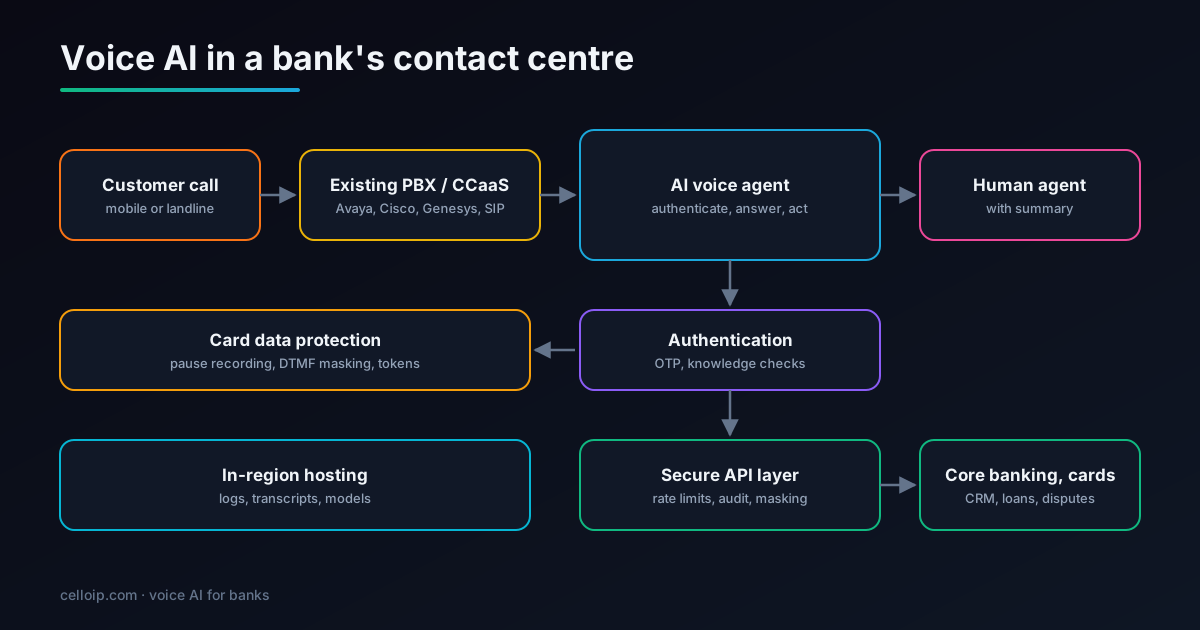
Behind the existing phone platform
Calls keep arriving on the bank's numbers and contact-centre platform. Routing rules send selected call types to the AI and everything else to agents, so the change is gradual and reversible.
Through a secure API layer
The agent never talks to core banking directly. A narrow API exposes only the actions it needs, with rate limits, masking of sensitive fields and audit logs for every call.
Authentication as its own service
Caller verification uses the bank's existing methods (OTP, app push, knowledge checks), and its result decides which tools the agent may use for that call.
In-region by default
Transcripts, recordings, logs and, where needed, the speech and language models themselves run in the bank's chosen region or data centre.
Authenticating callers without frustrating them
Authentication is where banking voice agents succeed or fail. Too weak and you invite fraud; too heavy and callers give up. A layered approach works best, with the strength of checks matched to what the caller wants to do.
| Level | Allows | Typical checks |
|---|---|---|
| None | General information, branch hours, product details | No checks needed |
| Basic | Card blocking, payment due date, application status | Registered number plus a knowledge check |
| Strong | Balances, transactions, card activation, promise to pay | One-time passcode to the registered phone or an app push approval |
| Step-up | Changes to contact details, payee or credential resets | Strong checks plus transfer to a person or the bank's existing secure process |
Voice biometrics can make returning callers' experience smoother, but cloned voices are now easy to produce. Treat voice as one signal combined with others, add deepfake detection where it is used, and never rely on it alone for high-risk actions. Our guide to voice biometrics and deepfake detection in IVRs covers this in depth.
- The agent never asks for full passwords, full card numbers or PINs by voice.
- Failed checks route to a person or a secure fallback, not to unlimited retries.
- The authentication result is passed to tools as a permission, not as text in the prompt.
Keeping card data out of recordings and AI models
Card numbers and security codes are the most sensitive data a banking call can contain. Card data in recordings, transcripts or model prompts widens the scope of payment-card security obligations and creates risk you don't need. Banking voice agents should be built for PCI DSS scope from the start:
Capture cards outside the AI
Use DTMF entry with masking or hand the call briefly to a secure payment IVR, so digits never reach speech recognition or the language model.
Pause recording and transcription
Automatically pause recording and transcription during card capture and resume afterwards, with the pause logged.
Redact anything that slips through
Scan transcripts for card-like numbers and personal identifiers and redact them before storage or analytics.
Tokens, not numbers
Payment systems return tokens or masked references; tools and logs only ever see those.
The same principles apply to other sensitive data: account numbers, national IDs and passwords should be captured through controlled flows and kept out of free-text transcripts wherever possible.
Connecting to legacy phone and core systems
Most banks run established contact-centre platforms and core banking systems that won't be replaced for an AI project, and shouldn't need to be. The integration points are well understood:
| System | How the AI connects | Notes |
|---|---|---|
| Contact-centre platform (Avaya, Cisco, Genesys, Asterisk) | SIP trunk or media forking; transfer back to queues | Keep numbers and routing; send selected call types to the AI |
| Core banking and card systems | Through an API gateway or middleware | Narrow, audited endpoints; no direct database access |
| CRM and case management | REST APIs for lookups and case creation | Every call leaves a record and summary |
| Authentication services | OTP, push and risk-scoring APIs | Result controls which tools the agent may use |
| Recording and compliance archive | Existing recorder or archive APIs | Pause during sensitive capture; retention rules |
A narrow tool definition keeps the AI on a short leash. The model can only request a card block for the authenticated customer; your code checks the session, calls the card system and logs the result:
{
  "type": "function",
  "function": {
    "name": "block_card",
    "description": "Block one of the authenticated customer's cards after they confirm which card and the reason. Never call before authentication succeeds.",
    "parameters": {
      "type": "object",
      "properties": {
        "card_reference": { "type": "string", "description": "Masked card reference from list_cards, e.g. 'debit-****1234'" },
        "reason": { "type": "string", "enum": ["lost", "stolen", "suspected_fraud", "damaged"] }
      },
      "required": ["card_reference", "reason"],
      "additionalProperties": false
    }
  }
}
The handler ignores any customer identifier the model might supply and uses the authenticated session instead, so the AI cannot act on another customer's account even if a caller tries to trick it.
Rules that shape banking voice agents, by country
This is a planning summary, not legal advice. Your compliance team confirms what applies to your products and calls.
| Country | Calling rules | Banking and data rules |
|---|---|---|
| United States | TCPA consent for artificial-voice calls (including AI voices since 2024); do-not-call lists; calling hours | FDCPA and Regulation F for collections; GLBA privacy; UDAAP expectations; state rules |
| United Kingdom | PECR for marketing calls; Ofcom rules on abandoned calls and caller ID | FCA rules including the Consumer Duty; call recording for relevant regulated activities; UK GDPR |
| India | TRAI TCCCPR; BFSI service and transactional calls from 1600-series numbers since early 2026 | RBI requirements for regulated entities; DPDP Act |
| UAE | Cabinet Resolution 56 of 2024 telemarketing rules; Do Not Call Registry | Central Bank (CBUAE) rules for banks' telemarketing and consumer protection; UAE PDPL |
Collections calls with AI
Collections is one of the most requested banking use cases, and one of the most regulated. A voice agent can explain balances, offer payment plans, take a promise to pay and route disputes, consistently and without fatigue. It must also follow the rules every time.
Frequency limits
In the US, Regulation F creates a rebuttable presumption that more than seven calls about a debt within seven days, or a call within seven days after a conversation about it, is harassing. The dialer and the agent must count attempts per debt.
Disclosures and identity
Required disclosures are delivered word for word, and the agent confirms it is speaking to the right person before discussing the debt.
Consent for AI voice
Artificial-voice calls, including AI voices, need appropriate consent under the TCPA in the US; other countries have their own rules.
Escalation
Disputes, hardship, vulnerability signals and requests to stop calling go to trained staff, and the stop request is honoured across all channels.
A safe roll-out plan
Banking projects succeed when risk grows with evidence. A typical sequence, with phases overlapping:
Example roll-out (typical effort per phase, in weeks)
Phases overlap in practice; regulated outbound use cases come last.
- Start with calls that need no account access, then add authenticated self-service.
- Run each new call type on a share of traffic first, with daily transcript review.
- Involve compliance, fraud and information security teams from the design stage, not at sign-off.
- Measure resolution, transfers, authentication failures and complaints per call type.
What a banking voice agent costs
Costs depend mostly on the number of call types, the depth of core-system integration, authentication methods and hosting requirements. As a guide, matching our voice agent cost ranges:
| Build | Typical range | Timeline |
|---|---|---|
| Managed-platform MVP, one call type | $8,000 – $20,000 | 4–6 weeks |
| Custom production agent, several call types | $25,000 – $60,000 | 8–16 weeks |
| Bank-wide deployment with in-country hosting | Scoped after discovery | Agreed in the plan |
Running costs cover telephony, speech and model usage, and hosting. Self-hosting models in-region raises infrastructure cost but removes per-minute platform fees and keeps data inside the bank's environment.
CelloIP project outcome (client kept private)
We built a custom PBX platform handling 1,000+ concurrent channels, 50,000+ extensions and 50,000+ DIDs, and an omnichannel contact centre with campaigns, SLA rules and ticketing: the telephony foundations banking voice agents run on.
Measuring success in banking
Banking leaders will ask whether the voice agent reduced cost without increasing risk or complaints. Agree the measures with operations, risk and compliance before launch, and report them per call type rather than as one blended number.
- Self-service completion rate per call type, confirmed in the core or card system, not just from the transcript.
- Authentication success and failure rates, and how often failures were routed to a person rather than retried.
- Fraud signals: attempted social engineering, repeated failed verification and unusual request patterns.
- Complaints, escalations and regulator-relevant events linked to AI-handled calls.
- Average speed to reach a specialist for calls the agent transfers.
Frequently asked questions
How do banks use voice AI?
Mostly for high-volume, rules-based calls: card activation and blocking, balance and recent transactions, payment due dates, loan and EMI reminders, collections conversations, fraud-alert confirmations, branch and product information, and intake for disputes or complaints before a specialist takes over.
Is voice AI secure enough for banking?
It can be, if it is designed like any other banking channel: strong authentication before account information is shared, card data kept out of recordings and AI models, least-privilege API access, full audit logs, in-region hosting and regular security testing. The AI should never be the only control protecting money movement.
Can a voice agent take card payments?
It can guide a payment while the card number is captured securely, for example through DTMF masking or a secure payment IVR, with recording and transcription paused. The language model itself should never see full card numbers.
How should callers be authenticated?
Typically with layered checks: caller number as a signal, one-time passcodes sent to the registered phone or app, and knowledge checks. Voice biometrics can add convenience but should be combined with deepfake detection and other factors, never used alone for high-risk actions.
Can AI voice agents make collections calls?
Yes, with care. In the US, collections calls follow the FDCPA and Regulation F, including a rebuttable presumption against more than seven calls about a debt in seven days, plus TCPA consent rules for artificial-voice calls. Other countries have their own rules. Scripts, frequency limits and disclosures must be built in.
Do we have to replace our IVR or contact-centre platform?
No. The AI agent can sit behind your existing number and platform (for example Avaya, Cisco, Genesys or an Asterisk-based PBX) through SIP, taking specific call types and transferring to your queues with context.
Where is customer data processed?
Wherever your rules require: in-region cloud accounts, a private cloud or your own data centre. Speech and language models can be self-hosted when data must not reach external providers.
How much does a banking voice agent cost to build?
As a guide, a managed-platform MVP for one call type is typically $8,000–$20,000 and a custom production agent $25,000–$60,000. Banking deployments with several call types, deep core integration and in-country hosting are usually scoped after discovery.
Work with CelloIP
Planning voice AI for your bank?
CelloIP builds AI voice agents that sit behind your existing contact centre, authenticate callers properly, keep card data out of the AI and connect to core systems through audited APIs, hosted where your rules require. You own the code.