AI Voice Agents for Debt Collection: Rules, Design and Build
Collections teams make huge numbers of calls, most of them repetitive, all of them regulated. AI voice agents can take on the routine work consistently and at any scale, but only if the rules are built into every call. This guide covers where AI fits in collections, the rules that shape it, and how to design agents that are effective and fair.
Quick answer
Can AI voice agents handle debt collection calls?
AI voice agents can handle routine collections calls: reminding customers before and after due dates, confirming the right person, giving required disclosures, explaining balances and options, and taking promises to pay or secure payments, while sending disputes, hardship and vulnerable customers to trained staff. Every call must follow local collection rules on frequency, timing, disclosures and consent.
Why collections teams are adopting voice AI
Collections is a volume business. Lenders, banks, utilities, telecom providers, healthcare billers and agencies contact large numbers of customers every day, often with the same messages: a payment is due, a payment was missed, here are your options. Staffing for that volume is expensive, and the work is repetitive and emotionally draining for agents.
AI voice agents can make early-stage and routine calls consistently, at any hour the rules allow, in the customer's language, and never get tired or impatient. They follow the script and the rules on every call, which is not always true of large human teams under pressure.
The opportunity is strongest in early collections, before accounts become seriously delinquent, where a timely, polite reminder and an easy way to pay or arrange a plan resolve many cases. Later-stage and complex cases still need skilled people, now with more time to spend on them.
Customers often prefer it too. Many people find it easier to discuss a missed payment with an automated assistant than with a person, and an AI agent that offers clear options and a simple way to pay removes some of the embarrassment and friction from the conversation, while a person is always available on request.
Where AI fits across collection stages
| Stage | Typical conversation | AI role | Human role |
|---|---|---|---|
| Pre-due reminder | Payment due in a few days; confirm or update payment method | Fully automated with consent | Exceptions only |
| Early delinquency | Payment missed; reasons; pay now or set a date | Most calls, with promise to pay or payment link | Disputes and hardship |
| Payment plans | Explain approved plan options and set one up | Offers pre-approved options within rules | Non-standard arrangements |
| Broken promises | Follow up a missed promise | Reminder and new date within limits | Repeated breaks, escalation |
| Late stage and recovery | Serious arrears, settlements, legal steps | Scheduling and information only | Negotiation and decisions |
Most organisations start with pre-due reminders and early delinquency, measure results, and expand only when compliance and customer outcomes are clearly good.
Segment accounts before choosing who the AI calls. Customers with a history of disputes, recent hardship flags or legal holds should go straight to staff, while customers who simply forgot a payment are ideal for an automated reminder with an easy way to pay.
A compliant call flow
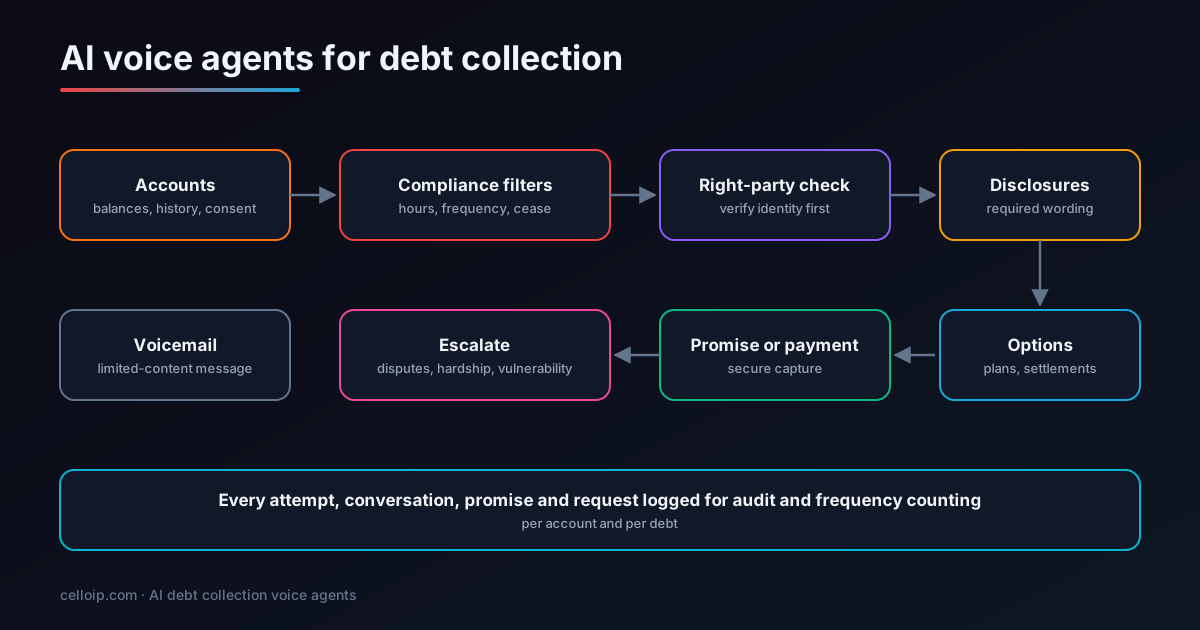
- Before dialling: check consent, calling hours for the customer's location, frequency limits per debt and any cease or do-not-call requests.
- On answer: confirm you are speaking to the right person before mentioning the debt; if not, end politely without disclosure.
- Give the required disclosures in the required wording, and say the caller is an AI assistant.
- Explain the balance and options clearly; offer only pre-approved plans and amounts.
- Take a promise to pay or route to secure payment; confirm by text or email.
- Escalate disputes, hardship, vulnerability and requests to stop calling immediately, and record them.
- If voicemail: leave only a permitted limited-content message, or no message.
Keep the flow short. Customers are more likely to stay on the line and agree a plan when the call gets to the point quickly, so disclosures and verification should be clear but efficient.
United States: FDCPA, Regulation F and TCPA
US collections calls are governed by the Fair Debt Collection Practices Act and the CFPB's Regulation F for debt collectors, plus the TCPA for automated and artificial-voice calls and state laws, some of which are stricter. Key points that shape an AI agent:
Call frequency (7-in-7)
More than seven calls about a particular debt within seven days, or a call within seven days after a phone conversation about it, is presumed to be harassment. The presumption is rebuttable, and voicemails count as calls.
Convenient times
Calls before 8 a.m. or after 9 p.m. at the consumer's location are presumed inconvenient, and some states set tighter limits.
Limited-content voicemail
A voicemail with only a business name that doesn't indicate debt collection, a person to reply to, a request to reply and a callback number is treated as an attempt to communicate rather than a communication.
Disclosures and third parties
Required disclosures must be given, and the debt must not be revealed to third parties, which is why right-party verification comes first.
TCPA consent
Calls with an artificial or AI-generated voice, especially to mobile numbers, need appropriate consent under the TCPA in addition to collection rules.
Stop requests
Requests to stop calling, or to use a different channel, must be honoured and recorded across all channels.
This is a planning summary, not legal advice. Collection agencies, first-party lenders and different states can face different requirements; your compliance counsel confirms the rules for your portfolio.
United Kingdom, India and the UAE
| Country | Main rules | What the agent must do |
|---|---|---|
| United Kingdom | FCA rules for arrears and recovery, the Consumer Duty, guidance on vulnerable customers; Ofcom rules on calls; PECR for marketing | Treat customers in difficulty fairly, offer appropriate forbearance, identify vulnerability, avoid excessive contact, keep records |
| India | RBI guidance for regulated entities and their recovery agents, including no recovery calls before 8 a.m. or after 7 p.m.; TRAI rules; DPDP Act | Calling windows enforced, respectful conduct, no misleading statements, BFSI numbering for service calls, data protection |
| UAE | Central Bank (CBUAE) consumer protection rules for licensed institutions; Cabinet Resolution 56 of 2024 for marketing calls; UAE PDPL | Fair treatment, permitted contact practices, recording and data handling under local rules |
Rules change; for example, RBI has consulted on further changes to recovery conduct. Build the rules as configuration per country and portfolio, so they can be updated without rewriting the agent.
Example: a compliance gate before every dial
The safest design puts rule checks outside the AI, in code that decides whether a call may be placed at all. The AI never decides on its own to call someone.
# compliance_gate.py: simplified pre-dial checks for one account and debt
from datetime import datetime, timedelta
from zoneinfo import ZoneInfo

RULES = {
    "US": {"start": 8, "end": 21, "max_calls_7d": 7, "quiet_days_after_convo": 7},
    "IN": {"start": 8, "end": 19, "max_calls_7d": None, "quiet_days_after_convo": 0},
}

def may_call(account, now_utc: datetime) -> tuple[bool, str]:
    rules = RULES[account.country]
    local = now_utc.astimezone(ZoneInfo(account.timezone))
    if account.cease_requested or account.do_not_call:
        return False, "cease or do-not-call on file"
    if account.requires_ai_voice_consent and not account.ai_voice_consent:
        return False, "no consent for AI voice calls"
    if not (rules["start"] <= local.hour < rules["end"]):
        return False, f"outside calling hours ({local:%H:%M} local)"
    if account.state_rules and not account.state_rules.allows(local):
        return False, "stricter state rule"
    week_ago = now_utc - timedelta(days=7)
    attempts = [a for a in account.call_attempts if a.debt_id == account.debt_id and a.at >= week_ago]
    if rules["max_calls_7d"] is not None and len(attempts) >= rules["max_calls_7d"]:
        return False, "weekly call limit for this debt reached"
    last = account.last_conversation_at
    if last and now_utc - last < timedelta(days=rules["quiet_days_after_convo"]):
        return False, "inside quiet period after a conversation"
    return True, "ok"
Real implementations add per-state rules, holidays, channel preferences, bankruptcy and legal holds, and an audit log of every decision. Keeping this logic separate makes it testable and easy to show to auditors.
Tone, fairness and vulnerable customers
Collections conversations are stressful for customers. A good AI agent is calm, clear and respectful, and its consistency is an advantage: it never raises its voice or uses pressure tactics.
Plain, neutral language
Explain balances and options simply, without threats, exaggeration or misleading urgency.
Listen for vulnerability
Mentions of illness, bereavement, job loss, mental health or confusion trigger a gentle handover to trained staff with notes.
Offer real options
Present approved plans and hardship routes, not just “pay in full today”.
Respect the customer's choices
Honour requests to stop calling, to use email or text instead, or to speak to a person.
Review a sample of calls each week specifically for tone and fairness, not just for outcomes. Regulators increasingly look at customer outcomes and treatment, and so should you.
Language matters as much as tone. Offer the customer's preferred language at the start, avoid jargon such as “delinquency” or “charge-off”, and confirm understanding before ending the call, so agreements are clear and fewer disputes follow.
Taking payments safely
Payment is where collections calls create value, and where security matters most.
- Capture card details outside the AI with masked keypad entry or a secure payment link sent by text.
- Pause recording and transcription during payment capture, and log the pause.
- Use tokens from the payment provider; never store or show full card numbers to the AI or in logs.
- Confirm the amount and date verbally, then send a written confirmation with a reference.
- Write promises and payments back to the account system immediately to stop further calls.
Offer more than one way to pay. Some customers will pay during the call, others prefer a link they can open later, and some want to visit a branch or use their banking app. Making payment easy matters more than which channel it happens in.
Measuring results
Measure outcomes and conduct together. A collections agent that improves recovery while increasing complaints is not a success.
| Metric | Why it matters |
|---|---|
| Right-party contact rate | Whether the right people are being reached at the right times |
| Promise-to-pay rate and kept-promise rate | Whether conversations turn into payments |
| Payments and amount collected per contact | The financial result |
| Escalations by reason (dispute, hardship, vulnerability) | Whether the agent recognises when people need a human |
| Complaints and compliance exceptions | Conduct risk; should be near zero |
| Opt-outs and channel changes | Whether contact strategy respects customers |
Illustrative example: how early-stage calls might end (share of answered calls)
An illustration of the outcome categories worth tracking, not measured data; real results depend on portfolio, stage and region.
Compare AI-handled and human-handled accounts in the same segment and stage rather than across the whole portfolio, because the AI usually starts with the easiest accounts and a blended comparison flatters it.
What it costs
As a guide, matching our voice agent cost ranges:
| Build | Typical range | Timeline |
|---|---|---|
| Managed-platform MVP for one collection stage | $8,000 – $20,000 | 4–6 weeks |
| Custom agent with account integration, compliance gate and payments | $25,000 – $60,000 | 8–16 weeks |
| Multi-country or large-scale collections platform | Scoped after discovery | Agreed in the plan |
Running costs are per minute for telephony, speech, model and voice. Collections calls are often short and many go unanswered, so telephony and answering-machine handling matter more than in other use cases. See our AI voice agent cost guide and predictive dialer guide.
CelloIP project outcome (client kept private)
We built an omnichannel contact centre with outbound campaigns, WhatsApp, Instagram, email and SMS in one agent desktop, with SLA rules and ticketing: the same foundations collections operations run on.
Common mistakes in AI collections
Most problems with AI collections come from treating it as a dialing efficiency project rather than a regulated customer conversation.
Counting calls per customer, not per debt
Frequency limits in the US apply per debt, and voicemails count. Counting wrongly either breaks the rule or leaves recoverable accounts uncontacted.
Disclosing before verifying
Mentioning the debt before confirming the right person risks third-party disclosure. Verification always comes first.
Over-long voicemails
Adding details to a voicemail can turn a permitted limited-content message into a communication that reveals the debt.
Letting the AI improvise offers
The model must only present pre-approved plans and amounts; anything else goes to staff.
Missing vulnerability signals
Agents tuned only for promises to pay can talk past customers who mention illness or hardship. Test specifically for these cases.
No audit trail
Every attempt, disclosure, promise and request needs a timestamped record. Without it, defending a complaint is hard.
Frequently asked questions
Can AI voice agents be used for debt collection?
Yes, for many routine conversations, from early reminders to promise-to-pay calls, provided the agent follows the collection rules in each country: who can be contacted and when, how often, what must be disclosed, how consent is handled for automated or AI voices, and how disputes and vulnerable customers are treated.
What is the 7-in-7 rule?
Under the US CFPB's Regulation F, a debt collector is presumed to violate the law if it calls a person about a particular debt more than seven times within seven days, or within seven days after a telephone conversation about that debt. It is a rebuttable presumption, and voicemails count as calls.
Can an AI agent leave voicemails about a debt?
In the US, Regulation F allows a limited-content message: a voicemail that gives a business name not indicating debt collection, a person to reply to, a request to reply and a callback number, without revealing the debt, so third parties who hear it learn nothing about it. Adding more content can turn it into a full communication with more risk.
What calling hours apply?
In the US, calls before 8 a.m. or after 9 p.m. at the consumer's location are presumed inconvenient, and some states are stricter. In India, RBI guidance bars recovery calls before 8 a.m. and after 7 p.m. Other countries have their own rules, so the dialer must apply them per customer location.
Do AI-voice collection calls need consent?
In the US, calls using an artificial or AI-generated voice fall under the TCPA, so appropriate consent is generally needed, particularly for mobile numbers. Collection rules are in addition to consent rules, not instead of them. Other countries have their own requirements.
How should vulnerable customers be handled?
The agent should listen for signs of vulnerability, such as illness, bereavement, job loss or confusion, and pass those customers to trained staff promptly, with notes. In the UK, the FCA's rules and Consumer Duty put particular emphasis on fair treatment of customers in financial difficulty.
Can the agent take payments?
It can guide a payment while card details are captured securely outside the AI, for example through masked keypad entry or a payment link, with recording paused. The language model should never see full card numbers.
How much does a collections voice agent cost?
As a guide, a managed-platform MVP for one collections stage is typically $8,000–$20,000 and a custom production agent with account integration, compliance controls and payments $25,000–$60,000. Multi-country or large-scale collections platforms are scoped after discovery.
Work with CelloIP
Planning AI for your collections operation?
CelloIP builds collections voice agents with compliance gates, right-party verification, required disclosures, secure payments and fast escalation to your team, connected to your account systems and dialers. You own the code.