AI to Human Handover: Designing Warm Transfers for Voice Agents and Chatbots
Customers forgive an AI that says “let me get you to someone who can help”. They don't forgive one that traps them, or a transfer that makes them start again. This guide covers when an AI should hand over, how to pass context, the telephony mechanics, and how to measure whether handovers work.
Quick answer
How should an AI agent hand over to a human?
A good AI-to-human handover happens at the right moment (when the customer asks, the AI is unsure, the topic is sensitive or the conversation is going nowhere), sends the customer to the right person, tells them what is happening, and passes a summary so the agent never asks them to repeat themselves. In phone systems this is usually a warm transfer with the summary shown to the agent as the call arrives.
Why handover is where AI agents win or lose trust
No AI agent resolves every conversation, and it shouldn't try. Some requests need judgement, authority, empathy or access the AI doesn't have. What customers remember is how those moments are handled: whether they reached the right person quickly, and whether that person already knew why they were calling.
Poor handovers are one of the most common reasons AI projects disappoint. The AI does its part well, then sends the caller into a general queue with no context, where they wait, explain everything again and leave frustrated. The AI gets the blame, even though the problem was the join between the AI and the people.
Designing the handover first, before polishing what the AI says, usually produces better customer experience and fewer complaints than any amount of prompt tuning.
The handover flow, step by step
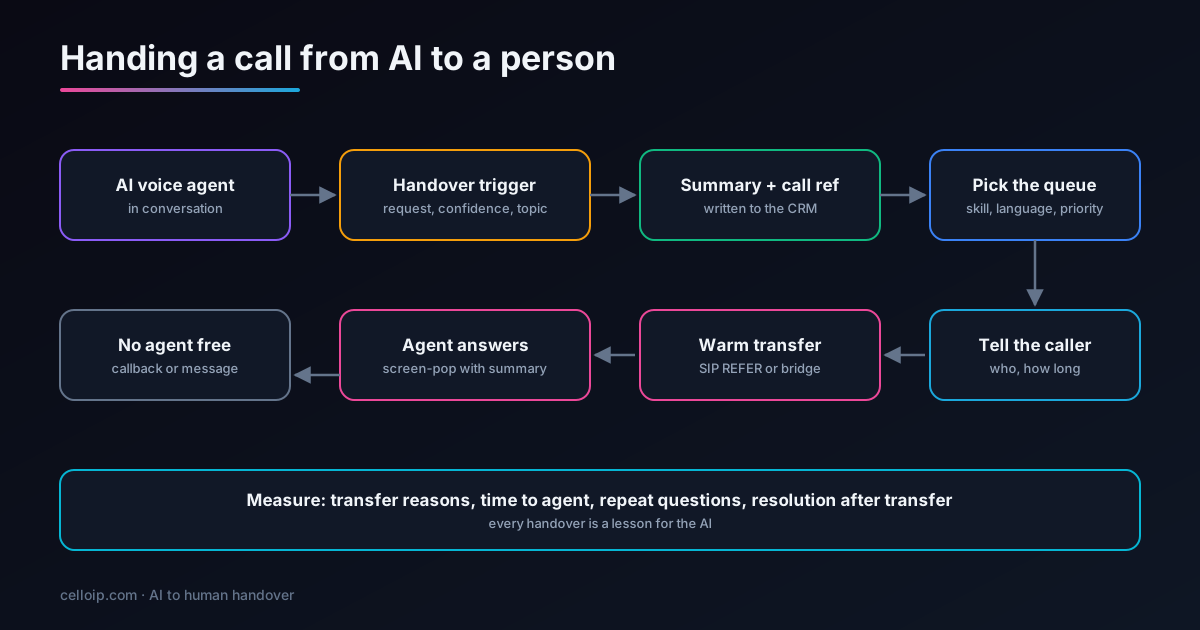
- Detect the trigger and decide that a person is needed.
- Write a short summary, intent, verification status and key details to the CRM with a call reference.
- Choose the right queue or person by skill, language, customer value and hours.
- Tell the caller who they will speak to and roughly how long it will take.
- Transfer with the call reference so the agent's screen shows the summary as the call connects.
- If nobody is free, offer a callback or message instead of an open-ended wait.
When to hand over: seven triggers
| Trigger | Example | Why it matters |
|---|---|---|
| Customer asks for a person | “Can I speak to someone?” | Honour it quickly; refusing damages trust more than anything else |
| Low confidence | The AI isn't sure what the caller wants after a clarifying question | Guessing leads to wrong answers and repeat calls |
| Sensitive topic | Complaints, bereavement, hardship, legal or medical questions | Needs human judgement and, often, regulatory care |
| Failed verification | Caller can't pass identity checks | Protects accounts; a person can use other methods safely |
| Repeated failure | The same step fails twice, or the conversation goes in circles | Stops frustration before it builds |
| Frustration or distress | Raised voice, negative sentiment, interruptions | Early transfer prevents complaints and escalations |
| High value or authority | Large orders, negotiations, exceptions to policy | Needs someone empowered to decide |
Write these triggers down, test each one with simulated callers, and review real transfers weekly to see which triggers fire and whether they fire at the right moment. Too few triggers trap customers; too many waste the AI.
Some triggers depend on the business. A retailer may hand over every order above a certain value; a clinic may hand over anything that sounds clinical; a bank may hand over any mention of fraud. Agree these with the teams who receive the calls, because they know which conversations they want to own.
Passing context so nobody repeats themselves
The single most valuable thing a handover can do is save the customer from repeating themselves. That means the agent needs the right information at the moment they answer, in a form they can read in seconds.
One-line reason
“Wants to change delivery address on order 4817; address confirmed; card not discussed.” Agents read the first line, so make it count.
Verification status
Whether identity checks passed and which ones, so the agent knows if they can go straight to the account or must verify again.
What the AI already did
Actions taken, information given and anything promised, so the agent doesn't contradict or duplicate it.
Transcript link
The full conversation one click away for the cases where details matter.
Write the context to your CRM or contact-centre system before the transfer starts, keyed by a call reference. Sending large summaries inside the call signalling itself is fragile; sending a short reference that the agent desktop uses to fetch the record is reliable.
Agree a summary format with the agents who will read it. A consistent structure, such as reason, status, actions taken and next step, is faster to scan than free-form prose, and agents quickly learn where to look.
Transfer mechanics: SIP REFER, bridging and queue transfers
On the telephony side there are three common ways to move a call from an AI agent to a person. The right one depends on where the AI sits in your call path.
| Method | How it works | Good for | Watch out for |
|---|---|---|---|
| SIP REFER (blind or attended) | The AI's SIP endpoint asks the other side to send the call to a new destination | AI on an external platform transferring back to your PBX or carrier | Not every carrier or PBX honours REFER; context must travel separately |
| Bridge or conference | The call stays on your PBX; the AI leg is replaced or joined by an agent leg | AI connected to your own Asterisk, FreeSWITCH or LiveKit | More control, but the media path stays on your system |
| Return to queue | The AI hands the call back to the contact-centre platform, which queues it | AI sitting in front of an existing contact centre | Make sure the queue position and context are preserved |
Where possible, keep the PBX or contact-centre platform as the anchor of the call and treat the AI as one participant. That way transfers, recordings, queue statistics and fallbacks all stay in the system your team already manages.
Test transfers end to end with your actual carriers and platforms before launch. REFER support, header passing and caller ID behaviour vary more than documentation suggests, and a transfer that works in the lab can fail on one carrier in production.
Example: warm transfer on Asterisk with a call reference
In this pattern the AI agent runs over AudioSocket or a SIP leg. When it decides to hand over, it writes the summary to the CRM under the call's unique ID and ends its leg with a result variable. The dialplan then queues the call with a header the agent desktop uses to pop the record.
; extensions.conf (simplified)
[ai-front-door]
exten => s,1,Answer()
 same => n,Set(CALL_REF=${UNIQUEID})
 ; AI agent handles the conversation; it writes the summary to the CRM
 ; keyed by CALL_REF and returns the outcome in a channel variable.
 same => n,AudioSocket(${CALL_REF},10.0.0.30:9092)
 same => n,Set(OUTCOME=${CURL(http://10.0.0.30:8080/outcome/${CALL_REF})})
 same => n,GotoIf($["${OUTCOME}" = "resolved"]?done)
 same => n,Goto(handover,1)
 same => n(done),Hangup()

exten => handover,1,NoOp(Warm transfer for ${CALL_REF})
 ; queue chosen by the AI: billing, support, retention...
 same => n,Set(TARGET=${CURL(http://10.0.0.30:8080/queue/${CALL_REF})})
 ; agents' softphones receive the reference and pop the CRM record
 same => n,Set(__CALL_REF=${CALL_REF})
 same => n,Set(PJSIP_HEADER(add,X-Call-Ref)=${CALL_REF})
 same => n,Queue(${TARGET},tT,,,300)
 ; nobody answered within 5 minutes: offer a callback instead
 same => n,Goto(callback-offer,s,1)
The same idea works with FreeSWITCH, LiveKit SIP or a commercial contact-centre platform: write context first, keyed by a reference, then move the call with that reference attached so the agent's tools can find it instantly.
What the caller should hear
The words around a transfer matter as much as the mechanics. Callers should always know what is happening and never sit in unexplained silence.
Say why
“That's something a member of our billing team needs to look at.” A reason makes the transfer feel helpful rather than a failure.
Say who and how long
“I'm passing you to the billing team now. The wait is usually about two minutes.” Use real queue data, not guesses.
Reassure about context
“I've passed on what you told me, so you won't need to repeat it.” Then make sure that is true.
Offer a choice when waits are long
“The wait is longer than usual. Would you prefer a call back within the hour?”
Avoid phrases that blame the caller (“I didn't understand you”) or the system (“I'm only an AI”). The AI is simply connecting the customer with the right help.
Handover in chat and WhatsApp
Chat handovers follow the same principles, with a few differences. Customers can leave and come back, conversations can span hours, and several channels may be involved.
Pause the bot
When an agent takes over, stop automatic replies so the bot and the person don't talk over each other, and resume only when the agent hands back.
Show the whole thread
Agents see the full history and a summary in the inbox, not just the last message.
Be honest about timing
Tell customers when a person will reply, especially outside working hours.
Respect channel rules
On WhatsApp, replies outside the 24-hour window need approved templates, so plan follow-ups accordingly.
More detail: WhatsApp AI chatbot guide.
Measuring handover quality
Measure handovers as their own part of the service, not only as a failure of the AI.
| Metric | What it tells you |
|---|---|
| Transfer rate by reason | Where the AI needs knowledge, tools or better triggers |
| Time from trigger to agent answer | Whether queues and routing support the AI |
| Repeat-information rate | How often agents ask for details the AI already collected |
| Resolution after transfer | Whether callers reach the right person first time |
| Satisfaction on transferred calls | How customers feel about the combined experience |
| Callbacks completed on time | Whether promises made by the AI are kept |
Illustrative example: share of transfers by reason after the first month
An illustration of how tagged reasons guide improvements, not measured data; your own breakdown will differ.
Review a sample of transferred conversations weekly. Some transfers are exactly right and should stay; others reveal missing knowledge, a tool the AI should have, or a trigger firing too early. Each fix moves more calls to resolution without making customers feel trapped.
Involve the agents who receive transfers. They know immediately when summaries are wrong, when callers arrive in the wrong queue, or when the AI promised something it shouldn't have, and a simple feedback button on the agent desktop turns that knowledge into improvements.
Common handover mistakes
These are the problems we find most often when reviewing AI agents that customers complain about.
Refusing to hand over
Designing the AI to “contain” every call at all costs. Callers who ask for a person and don't get one become complainants.
Cold transfers into general queues
The AI collects details, then drops the caller into a generic queue where an agent asks the same questions again.
Context in the wrong place
Summaries written to a system agents don't look at, or arriving after the agent has already answered.
Silence during the transfer
Callers hear nothing for several seconds and assume the call has dropped. Always say what is happening.
Ignoring opening hours
Offering a transfer at night, then leaving the caller in an empty queue. Check hours and offer a callback instead.
Never reviewing transfers
Transfers are treated as failures and ignored, when they are the best source of improvements for the AI.
Frequently asked questions
When should an AI voice agent hand over to a person?
When the caller asks for a person, when the AI is not confident it understood or can help, when the topic is sensitive (complaints, bereavement, hardship, legal or medical advice), when verification fails, when the same step fails twice, or when the caller is upset. These triggers should be defined in advance and tested.
What is the difference between a warm and a cold transfer?
A cold transfer sends the call to another number or queue with no context. A warm transfer passes context, such as a summary and the customer's identity, so the person answering already knows the situation. With AI agents, a warm transfer usually means the summary appears on the agent's screen as the call connects.
How do you pass context to the human agent?
Write a summary, the detected intent, verification status and key details to the CRM or contact-centre system with a call reference, and send that reference with the transfer, for example in a SIP header or call variable, so the agent desktop can pop the right record.
Should the AI stay on the call during the transfer?
Usually it should tell the caller what is about to happen, then step away. In some designs the AI stays briefly to introduce the caller to the agent, which can be reassuring for complex cases. The caller should never hear silence without explanation.
What happens if no agent is available?
The AI should say so honestly, offer a callback or a message, give a realistic time, and record the request so it is not lost. Leaving callers in an endless queue after an AI conversation undoes the good work the AI did.
How do you measure handover quality?
Track transfer rate and reasons, time from trigger to an agent answering, how often agents ask customers to repeat information, resolution after transfer, and customer satisfaction on transferred calls.
Does this work for chatbots too?
Yes. The same principles apply on WhatsApp, web chat and other channels: clear triggers, routing to the right team, an honest message about response times, and the full conversation plus a summary in the agent inbox.
Work with CelloIP
Want AI and people working as one team?
CelloIP designs AI voice agents and chatbots with handovers built in: clear triggers, warm transfers into your existing PBX or contact centre, summaries on the agent's screen, and callbacks when nobody is free. You own the code.