Custom Contact Center vs CCaaS: Cost and Break-even
Renting a cloud contact centre is the default choice for most teams, and often the right one. But per-seat licences grow with every agent you hire, and at some point owning the platform costs less. This guide sets out what CCaaS really costs in 2026, what a custom build costs, where the break-even sits and how to decide without guessing.
Quick answer
Is a custom contact centre cheaper than CCaaS?
CCaaS platforms such as Five9, Genesys Cloud CX and NICE CXone charge roughly $75 to $250 per agent per month on published list prices, while Amazon Connect charges per minute instead. A custom contact centre on FreeSWITCH or Asterisk costs more up front but has no per-seat licence. Below about 30 to 50 seats, or when you need to launch in weeks, CCaaS is usually cheaper and faster. From around 50 to 100 seats on list prices, or when you sell the platform to your own customers, a custom build usually pays back within two to three years.
The two options, in plain terms
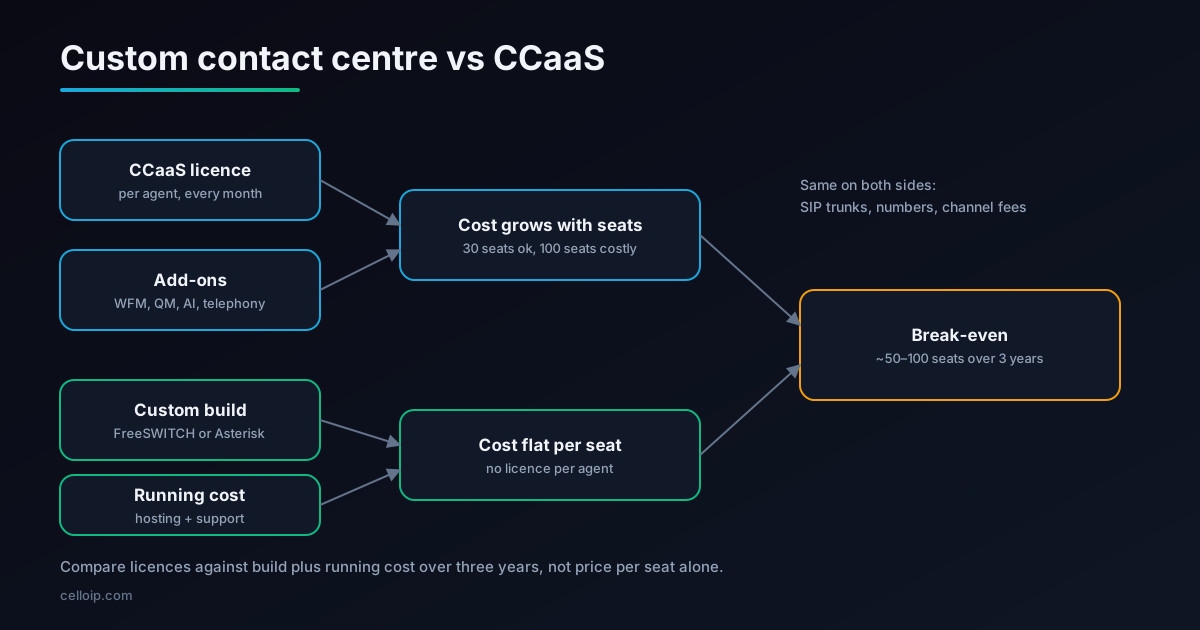
CCaaS (Contact Centre as a Service) is software you rent. The vendor runs the telephony, call routing, IVR, agent desktop, recording, reports and optional extras such as workforce management and AI. You pay a licence per agent each month, or per minute in the case of Amazon Connect, plus telephony and add-ons. Five9, Genesys Cloud CX, NICE CXone, Talkdesk and Amazon Connect are the best-known examples.
A custom contact centre is software you own. It is usually built on open-source telephony engines such as FreeSWITCH or Asterisk, with a SIP edge such as Kamailio or OpenSIPS, your own agent desktop, routing rules, dialers, reports and integrations. You pay to build it once, then pay for hosting, SIP trunks, channel fees and maintenance. There is no per-seat licence.
Neither option is better in general. The right choice depends on how many seats you run, how fast you need to launch, how unusual your workflows are and whether the contact centre is a cost for you or a product you sell.
What CCaaS costs in 2026
Most CCaaS vendors publish entry prices and quote the rest. The figures below are list prices published by vendors or widely reported by independent pricing sites in 2026. They are approximate, change often and are frequently discounted for larger contracts, so treat them as a starting point and confirm with each vendor.
| Platform | Pricing model | Approximate list price (late 2026) |
|---|---|---|
| Genesys Cloud CX | Per named user per month, usually billed annually | CX 1 about $75 (voice), CX 2 about $115 (adds digital), CX 3 about $155 (adds workforce management), CX 4 about $240 |
| Five9 | Per user per month; higher tiers quoted | Digital about $119, Core about $159 (adds voice); Premium and above quoted by sales |
| NICE CXone | Per agent per month by suite | About $110 for the entry suite up to about $249 for the top suite, with usage fees on some suites |
| Amazon Connect | Pay per use, no seat licence | About $0.038 per voice minute on the current plan, plus telephony such as a daily fee per number and per-minute inbound or outbound charges |
| Custom (FreeSWITCH / Asterisk) | One-off build, then hosting and support | No licence fee; see the next section for build ranges |
Sources disagree on a few tiers: one pricing site lists Genesys CX 2 at $110 rather than $115, and Five9's higher tiers have no public price. Some reports also mention minimum seat counts and annual commitments. Ask every vendor for a written quote at your real seat count, with telephony, AI and workforce management priced separately.
Two things push the real cost above the list price. First, telephony is usually billed on top, per minute and per number. Second, the features that make a modern contact centre work well, such as workforce management, quality management, speech analytics and AI agent assist, often sit in higher tiers or paid add-ons.
What a custom contact centre costs
A custom platform has two kinds of cost: the build, which you pay once, and the running cost, which you pay every month. The build ranges below match our call centre software development page.
| Build | Typical range | Timeline |
|---|---|---|
| Voice call centre: ACD, IVR, recording, CRM integration | $20,000 – $50,000 | 8–14 weeks |
| Omnichannel cloud contact centre: campaigns, WhatsApp, email, SMS, SLAs, ticketing | $50,000 – $150,000 | 4–8 months |
| Enterprise or AI-first contact centre | Scoped after discovery | Agreed in the plan |
Running costs depend on scale and design. Plan for each of these:
- Hosting: cloud servers for the telephony engine, SIP edge, database, recording storage and the web app, sized for peak concurrent calls.
- SIP trunks and numbers: per-minute call charges and monthly number fees from your carrier, which you pay with CCaaS too.
- Channel fees: WhatsApp Business Platform, SMS and email provider charges, again paid with either option.
- Support and maintenance: an in-house engineer, a partner, or a mix, to patch, monitor and improve the platform.
- Optional third-party tools: workforce management, speech analytics or AI services you choose to integrate.
Notice that telephony and channel fees appear on both sides. The real comparison is the CCaaS licence and add-ons against the custom build plus hosting and support.
Three-year cost and the break-even point
Comparing a monthly licence with a one-off build only makes sense over a fixed period. Three years is a sensible window: long enough for a build to pay back, short enough that technology choices still hold.
The chart below is an illustration, not a quote. It compares the licence cost of a $159 per-seat plan (Five9 Core's reported list price) with a custom build, over 36 months, at two sizes. Telephony and channel fees are left out because you pay them either way.
Illustrative 3-year cost: CCaaS licences vs a custom contact centre (USD)
Illustrative only. CCaaS: $159 per seat per month list price, no discount. Custom at 30 seats: $35,000 build plus $5,000 a month for hosting and support. Custom at 100 seats: $100,000 build plus $7,000 a month for hosting and support. Telephony, channel fees and discounts excluded. Your figures will differ.
At 30 seats, the licence is cheaper than building and running your own platform. At 100 seats, the custom platform costs roughly 40% less over three years in this example, and the gap widens every year after that because there is no build cost left to recover.
A simple way to find your own break-even point:
| Step | What to calculate |
|---|---|
| 1. Licence cost | Seats × quoted price per seat × 36 months, plus add-ons you need (WFM, QM, AI) |
| 2. Custom build | The build range for your scope, from a written estimate |
| 3. Custom running | Monthly hosting + support allowance × 36 months |
| 4. Compare | If step 1 is larger than steps 2 and 3 combined, custom pays back inside three years |
| 5. Stress-test | Repeat with a 20–30% licence discount and a 50% higher custom running cost; if custom still wins, the case is robust |
On list prices the break-even usually lands somewhere between 50 and 100 seats: lower if you need expensive add-ons on every seat and higher if you negotiate a large discount. Seasonal headcount matters too: named-user licences charge for agents even in quiet months, while a custom platform's cost hardly changes.
CCaaS vs custom, side by side
| Factor | CCaaS | Custom contact centre |
|---|---|---|
| Time to launch | Days to a few weeks | 8 weeks to 8 months, depending on scope |
| Up-front cost | Low; often onboarding fees only | Build cost paid once |
| Cost per added seat | A full licence every month | Close to zero until you need more servers |
| Features on day one | Broad: WFM, QM, analytics, AI in higher tiers | What you scope and build, plus integrated tools |
| Custom workflows | Within the vendor's configuration options | Anything you can specify |
| Telephony and carriers | Vendor's telephony or approved carriers | Any SIP carrier, any country, your routing rules |
| Data location | Vendor's regions and policies | Your choice of cloud region or your own data centre |
| Operations | Vendor's job | Your team or a partner |
| Reselling to your customers | Usually needs a reseller agreement | Yes, on a multi-tenant build |
| Exit cost | Migration of flows, data and integrations | You own the code; change partners if needed |
When CCaaS is the better choice
Under 30–50 seats
Licence costs stay modest, and a build plus support will rarely pay back inside three years.
Launch in weeks
If a new team or service must take calls next month, renting is the only realistic option.
Standard workflows
Inbound queues, an IVR and a CRM integration are things every CCaaS does well out of the box.
No engineering capacity
If nobody can own a real-time platform, in-house or through a partner, rent one.
You need WFM and QM now
Mature workforce and quality management take time to build or integrate; CCaaS higher tiers include them.
Uncertain future
If headcount may fall or the operation may close, monthly licences keep you flexible.
When a custom contact centre is the better choice
80–100+ seats
Per-seat licences become one of your largest software costs, and a build usually pays back within two to three years.
You sell it
BPOs, telecom operators and SaaS companies can offer a multi-tenant platform to their own customers under their brand.
Unusual workflows
Complex dialing, regulated scripts, custom routing or deep back-office integration that CCaaS configuration cannot express.
Carrier and country control
Local carriers, in-country numbers and routing rules in markets where CCaaS telephony is limited or expensive.
Data location
Recordings and transcripts must stay in a particular region or your own data centre.
AI on your terms
Choose your own speech and language models and pay their usage directly, rather than a bundled per-minute AI price.
Our FreeSWITCH vs Asterisk for call centres guide covers the engine choice, and the predictive dialer guide covers outbound campaigns and abandonment rules.
Hybrid routes worth considering
The choice is not always all or nothing. Three middle paths work well:
| Hybrid option | How it works | Good for |
|---|---|---|
| Keep CCaaS, add custom pieces | Build custom integrations, AI voice agents or reporting around the CCaaS through its APIs | Teams happy with the platform but blocked on specific workflows |
| Custom voice, CCaaS digital | Run high-volume voice on your own FreeSWITCH or Asterisk, keep a smaller CCaaS licence for digital channels | Voice-heavy operations with a small digital team |
| Amazon Connect plus custom | Pay per minute on Amazon Connect, with a custom agent desktop and integrations | Uneven volume and teams already on AWS |
| Staged migration | Move one team or one campaign to the custom platform first, then the rest | Large centres that cannot risk a single cut-over |
Adding AI is a common first step. Our guides to AI call centre software and adding an AI voice agent to your existing phone system show how to do it without replacing everything.
Moving off CCaaS: a safe plan
A migration fails when it is treated as a single switch-over. These steps keep agents and customers unaffected:
- Export what you have: IVR flows, queues, skills, schedules, dispositions, reports and call recordings you must keep.
- Map every integration: CRM, helpdesk, payment, authentication, wallboards and data warehouse feeds.
- Agree the minimum feature set for day one, and what can follow later.
- Start number porting early; it can take several weeks depending on the country and carrier.
- Pilot with one team or campaign, run both platforms in parallel and compare service levels.
- Train supervisors first; they will coach agents on the new desktop.
- Keep the CCaaS contract until the pilot meets agreed targets, then plan the remaining moves around renewal dates.
A real example: a contact centre sold as a product
CelloIP built a multi-tenant omnichannel contact centre for a European SaaS company that offers it to its own customers. Voice runs on FreeSWITCH with IVR, skills routing, recording and predictive, progressive, preview and manual dialing. WhatsApp, Instagram, Facebook Messenger, email, SMS and web chat arrive in the same agent desktop, with SLA rules, ticketing, supervisor tools, reports and CRM and helpdesk integration.
For this company, renting CCaaS seats was never the answer: the platform is the product. Owning the code means every new customer adds revenue rather than another licence fee.
CelloIP project outcome (client kept private)
Serves 100 to 500 agent seats across tenants. Built in six to twelve months on FreeSWITCH, and maintained by CelloIP.
Questions to answer before you decide
- How many seats do we run today, and how many in three years? How seasonal is headcount?
- What is our written CCaaS quote at that size, including telephony, WFM, QM and AI?
- Which workflows do agents or customers struggle with on the current platform?
- Do we need to resell the platform, or run it in a particular region or data centre?
- Who will run a custom platform: our team, a partner, or both?
- What must work on day one, and what can follow in later releases?
- What would a failed migration cost us, and how will a pilot reduce that risk?
If the answers point to custom, our guide to choosing a custom VoIP development company covers what to ask a partner.
Frequently asked questions
What is CCaaS?
Contact Centre as a Service is cloud contact-centre software that you rent per agent or per minute. The vendor runs the telephony, routing, agent desktop, reporting and add-ons such as workforce management. Examples include Five9, Genesys Cloud CX, NICE CXone, Talkdesk and Amazon Connect.
How much does CCaaS cost per agent?
On published or widely reported list prices in late 2026, Genesys Cloud CX tiers run from about $75 to $240 per user per month, Five9 from about $119 (digital only) to $159 (with voice), and NICE CXone suites from about $110 to $249. Amazon Connect charges per minute, around $0.038 per voice minute plus telephony. Enterprise deals are often discounted, and telephony, AI features and add-ons are usually extra. Check each vendor's current pricing before budgeting.
When is a custom contact centre cheaper than CCaaS?
Usually somewhere between 50 and 100 seats over a three-year view, depending on discounts and add-ons, because licence fees grow with every seat while a custom platform's running cost grows slowly. Below 30 to 50 seats, CCaaS is usually cheaper once you count the build and the people to run a custom platform. Your own break-even depends on your seat count, channels, discounts and who operates the platform.
How much does a custom contact centre cost to build?
As a guide, a voice call centre with ACD, IVR, recording and a CRM integration is typically $20,000 to $50,000 over 8 to 14 weeks. An omnichannel cloud contact centre with campaigns, WhatsApp, email, SMS, SLAs and ticketing is typically $50,000 to $150,000 over 4 to 8 months. Hosting, SIP trunks and channel fees are separate running costs.
Is Amazon Connect a cheaper alternative to a custom build?
It can be at low or uneven volume, because you pay per minute with no seat licence. At high, steady volume the per-minute charge adds up, and you still build and maintain flows, the agent desktop and integrations on AWS. Many teams compare Amazon Connect and a custom build side by side on their real minute volume.
Can we keep our CRM and phone numbers if we move off CCaaS?
Yes. A custom contact centre integrates with CRMs such as Salesforce, HubSpot, Zoho and Freshdesk through their APIs, and your numbers can be ported to a SIP trunk provider that connects to your own platform. Plan porting early, as it can take a few weeks depending on the country and carrier.
What do we lose by leaving a CCaaS platform?
Mainly ready-made extras: workforce management, advanced analytics and AI add-ons the vendor ships, plus the vendor's operations team. A custom platform can integrate specialist tools for these, or build what you need, but the scope must be planned rather than assumed.
Can we sell a custom contact centre to our own customers?
Yes, and this is one of the strongest reasons to build. A multi-tenant custom platform can be offered to your own customers under your brand, which most CCaaS licences do not allow without a reseller agreement and margin sharing.
Work with CelloIP
Working out whether to build?
Send us your seat count, channels and current quote. CelloIP will give you an honest view on whether a custom contact centre pays back, with a written estimate if it does. We reply within one business day, and you own the code.