AI Voice Agents for Hotels and Travel: Reservations, Guests and Build
Hotels and travel companies live on the phone: reservation enquiries, guests asking about parking and breakfast, requests for late checkout, booking changes and calls at three in the morning. Missed calls are missed bookings. AI voice agents can answer every call in the guest's language, connected to your booking systems. This guide covers what they do, how they integrate and how to build one guests are happy to talk to.
Quick answer
What do AI voice agents do for hotels and travel companies?
AI voice agents for hotels and travel answer reservation and guest calls at any hour and in many languages. Connected to the property management system or booking engine, they check availability and rates, make and change bookings, answer questions about the property, take requests such as late checkout or airport transfers and pass VIPs, complaints and complex group bookings to staff. Card guarantees are captured through secure payment links or masked entry, never by the AI itself.
Why hotels and travel companies are adding voice AI
Phone calls remain an important booking channel for many hotels, especially for longer stays, special requests, groups, older guests and markets where calling is the norm. A direct phone booking also avoids online travel agency commission, so every call that goes unanswered can cost twice: the booking itself and the margin.
Yet the phone is hard to staff. Front desks are busiest at check-in and check-out, exactly when the phone rings most. Night shifts are thin. Reservations teams are often small, and peak seasons make everything worse. Calls go to voicemail, guests give up and book elsewhere.
An AI voice agent answers instantly, at any hour, in the guest's language. It can check live availability, quote rates from your systems, make or change a booking, answer common questions and take requests, then confirm everything by email or message. Staff step in for the conversations that need a personal touch: VIP guests, complaints, complex groups and anything unusual.
For travel agencies, tour operators and airlines' partners, the same applies to booking enquiries, itinerary changes, pre-departure reminders and disruption calls, where spikes in volume can overwhelm any team overnight.
Hospitality and travel use cases
| Use case | What the agent does | When staff take over |
|---|---|---|
| Reservations | Checks availability and rates, makes, changes or cancels bookings within policy | Groups, special contracts, negotiated rates |
| Property questions | Answers about parking, breakfast, check-in times, pets, accessibility, directions | Detailed accessibility needs, unusual requests |
| Guest requests | Late checkout, extra beds, cots, early check-in, airport transfers | Requests needing manager approval |
| Upgrades and add-ons | Offers room upgrades, packages, spa or dining add-ons at approved prices | Custom packages |
| Restaurant and spa bookings | Takes table or treatment bookings in the outlet's system | Large parties, private events |
| After-hours calls | Covers night calls, takes messages, handles simple requests | Emergencies and in-house guest issues |
| Pre-arrival calls | Confirms arrival time, offers transfers and preferences | VIP arrivals |
| Overflow during peaks | Answers when all staff are busy instead of sending calls to voicemail | Calls that need a person |
Most properties start with reservation enquiries and property questions, often only for overflow and night calls at first, then extend to requests and upsells once the agent has proven reliable.
How a reservation call works
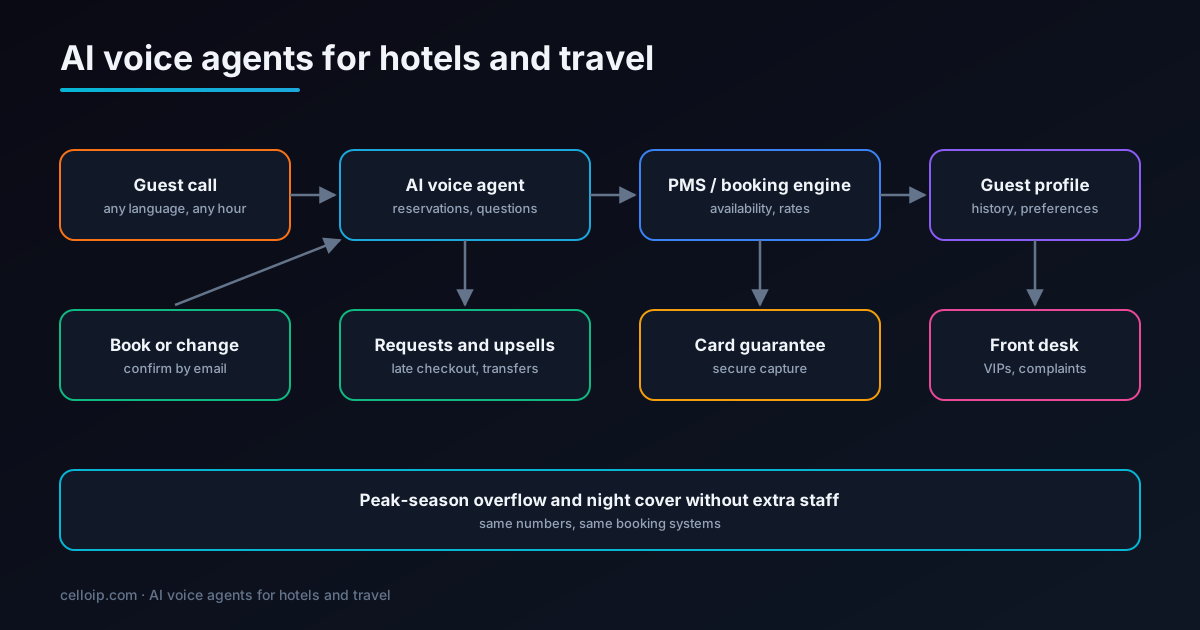
- Greet in the guest's language, say the caller is speaking with an AI assistant, and ask how to help.
- Collect dates, number of guests and room preferences, repeating them back to avoid mistakes.
- Check live availability and rates in the PMS or booking engine; never quote from memory.
- Explain the options, including the rate rules: cancellation policy, breakfast, deposit.
- Take guest details and send a secure link for the card guarantee or deposit.
- Create the reservation once the guarantee is confirmed and read back the confirmation number.
- Send the confirmation by email, SMS or WhatsApp, with the cancellation policy in writing.
- Transfer to staff, with a summary, for groups, complaints, VIPs or whenever the guest asks.
Dates are the classic failure point in voice bookings. "Next Friday", "the 3rd to the 5th" and different date formats cause mistakes, so the agent should convert everything to exact dates with weekdays and confirm them: "arriving Friday 12 December, leaving Sunday 14 December, two nights".
PMS and booking-system integration
Property management system
Oracle OPERA Cloud (through OHIP APIs), Cloudbeds, Mews, Apaleo, Protel and others. Read availability and rates, create and modify reservations, add requests and notes.
Booking engine and CRS
For chains and groups, the central reservation system may be the source of truth for rates and inventory across properties.
Channel manager
Keeps phone bookings in sync with OTA inventory. Phone reservations made in the PMS normally flow through automatically.
Payment provider
Tokenised card guarantees and deposits through secure links or masked entry, attached to the reservation.
CRM and guest profiles
Recognise returning guests, use their preferences and loyalty status, and record the call outcome.
Telephony
Your existing hotel numbers through a SIP trunk or the hotel phone system, with transfer to the front desk, reservations or a manager.
Integration access varies by vendor. Some PMS providers offer open APIs to any developer; others require partner programmes, certification or an extra fee, and API rate limits can matter at busy properties. Check this early, because it often decides the timeline more than the AI does.
Where a PMS has no usable API, a fallback is to let the agent take a booking request, send a payment link and create a task for staff to enter it, with the guest told clearly that confirmation will follow. It is less elegant, but it still captures bookings that would otherwise be lost.
Example: an availability tool with exact dates
This simplified example shows two principles: dates are resolved and confirmed in code, and rates come only from the booking system. The PMS client stands in for whichever API your property uses.
# availability_tool.py: simplified availability check for a hotel voice agent
from datetime import date
from pms_client import PMS   # thin wrapper around your PMS / booking engine API

pms = PMS.from_env()          # credentials scoped to availability and reservations only

def check_availability(arrival: str, departure: str, adults: int, children: int = 0) -> dict:
    """Dates arrive as ISO strings (YYYY-MM-DD) after the agent has confirmed them aloud."""
    a, d = date.fromisoformat(arrival), date.fromisoformat(departure)
    if a < date.today() or d <= a:
        return {"ok": False, "reason": "invalid_dates"}
    nights = (d - a).days
    offers = pms.get_offers(arrival=a, departure=d, adults=adults, children=children)
    return {
        "ok": True,
        "arrival": a.strftime("%A %d %B %Y"),       # read back as "Friday 12 December 2026"
        "departure": d.strftime("%A %d %B %Y"),
        "nights": nights,
        "offers": [
            {
                "room": o.room_type_name,
                "rate_plan": o.rate_plan_name,           # e.g. "Flexible, breakfast included"
                "total": str(o.total_amount),            # from the PMS, never calculated by the AI
                "currency": o.currency,
                "cancellation": o.cancellation_policy_text,
                "offer_id": o.id,                        # used to book, so the price can't drift
            }
            for o in offers[:3]                          # offer a short list on the phone
        ],
    }
Booking then uses the offer ID, so the price the guest heard is the price that is booked. The agent cannot invent a discount, because it has no tool that would let it.
Card guarantees and payments
Hotels routinely take card details to guarantee reservations, and that is exactly what a voice agent must not handle directly. Card numbers spoken aloud end up in recordings, transcripts and model prompts, bringing them into PCI DSS scope and creating real risk.
- Send a secure payment or card-guarantee link by SMS, WhatsApp or email, and create the reservation once the provider confirms.
- If the guest can't use a link, transfer to a PCI DSS-compliant payment step with masked keypad entry and recording paused, or to staff.
- Store only the payment token on the reservation; never the card number.
- Keep card data out of the language model, transcripts and logs, and test that it stays out.
- Explain deposits and cancellation charges clearly before the guest pays, and confirm them in writing.
- For Europe and the UK, follow the payment provider's strong customer authentication flow for deposits.
The link approach also helps conversion: the guest completes payment on their phone in a familiar checkout while still on the call, and the agent confirms the booking as soon as the payment provider reports success.
Multilingual guest calls
Hotels serve international guests, and many properties receive calls in languages the staff on shift don't speak. A voice agent can switch language automatically or offer a choice at the start of the call.
Illustrative example: languages of reservation calls at an international city hotel
An illustration of why a language mix matters, not measured data; every property's mix depends on its location and source markets.
Quality varies by language and accent. Test each language with native speakers using real phrases, such as dates, names, street addresses and room types, before launch, and make sure confirmations and policies are sent in the guest's language too. Our multilingual voice AI page and Arabic voice AI page cover this in more depth.
Names are particularly tricky. Speech recognition often mishears surnames, so ask guests to spell them, confirm the email address letter by letter or send a form link for details, and rely on the written confirmation to catch mistakes.
Guest requests and upselling
Room upgrades
Offer a better room type at the PMS rate difference when availability allows, once the main booking is settled.
Packages and add-ons
Breakfast, parking, spa, dining credits or romance packages at approved prices, added to the reservation.
Early check-in, late checkout
Check availability and policy, quote any charge and add it to the booking, or pass to the desk for same-day decisions.
Airport transfers
Collect flight details, book through your transport partner and confirm the pickup in writing.
Special occasions
Note birthdays and anniversaries and pass them to the team so the welcome feels personal.
Restaurant bookings
Book tables in the outlet's reservation system and recommend times when the restaurant is quieter.
Keep upsells light: one relevant offer at the right moment works better than a list. Guests who called to cancel or complain should not be offered anything until their issue is resolved.
Travel agencies, tour operators and transport
The same building blocks serve the wider travel industry. Typical uses include:
- Booking enquiries for packages and tours, with quotes taken from your booking platform.
- Itinerary changes and add-ons within the fare or package rules.
- Pre-departure calls and reminders: documents, visas to check, check-in times and baggage rules.
- Disruption notifications when flights, trains or tours change, with options to rebook or talk to an agent.
- After-sales questions about vouchers, transfers and meeting points.
- Lead qualification for high-value trips before passing to a travel consultant.
Prices and rules change constantly in travel, so the agent must never quote from its own knowledge. Every fare, availability and rule comes from your systems at the time of the call, and anything the agent can't confirm is passed to a consultant. For visa or entry rules, the agent should point to the official source rather than give its own advice.
Measuring results
| Metric | What it tells you |
|---|---|
| Answer rate | Share of calls answered, especially at night and peak times, compared with before |
| Bookings made by the agent | Reservations created and their value, net of cancellations |
| Conversion rate | Share of reservation enquiries that become bookings |
| Transfer rate and reasons | What still needs staff, and what the agent could learn next |
| Upsell take-up | Add-ons and upgrades accepted per booking |
| Booking accuracy | Reservations with wrong dates, names or rates found on audit |
| Guest satisfaction | Post-call or post-stay feedback mentioning the phone experience |
Audit a sample of agent-made bookings every week at first, comparing the call against the reservation. Date and name mistakes are the ones to catch early.
CelloIP project outcome (client kept private)
We built a custom PBX platform handling 1,000+ concurrent channels, 50,000+ extensions and 50,000+ DIDs, and an omnichannel contact centre with queues, SLA rules and ticketing: the telephony foundations hotel and travel voice agents run on.
Cost and timeline
| Scope | Typical budget | Typical timeline |
|---|---|---|
| Managed-platform MVP: reservations and FAQs, one property, one or two languages | $8,000–$20,000 | 4–8 weeks |
| Custom production agent: PMS, payments, CRM, requests and upsells, several languages | $25,000–$60,000 | 8–16 weeks |
| Hotel groups, CRS integration, travel platforms | Scoped after discovery | Phased |
Running costs depend on call minutes, languages and providers. See our AI voice agent cost guide for the per-minute components. For many properties, the main business case is direct bookings captured from calls that used to go unanswered, plus staff time freed at the desk.
Ready-made hotel phone assistants exist and may suit a single property with a supported PMS. A custom build makes sense for groups, unusual systems, many languages, specific workflows or when you want to own the agent and the data.
Common mistakes
Quoting rates from the prompt
Rates in a prompt go stale within days. Always read them live from the PMS or booking engine.
Sloppy date handling
Not confirming exact dates with weekdays leads to wrong bookings and unhappy guests.
Taking card numbers by voice
It puts recordings and transcripts in PCI DSS scope. Use links or masked entry.
No route to the desk
Guests with problems want a person. Make transfer easy, with a summary passed along.
Ignoring in-house guests
Calls from guest rooms about urgent issues, such as no hot water or a safety problem, must go straight to staff.
Testing only in English
If guests call in Arabic, Hindi or German, test those languages with native speakers before launch.
Frequently asked questions
What can an AI voice agent do for a hotel?
It can answer reservation calls, quote availability and rates, make, change and cancel bookings within policy, answer property questions (parking, breakfast, check-in times, pets), take requests such as late checkout, extra beds or airport transfers, offer room upgrades and add-ons, and handle after-hours calls. Complaints, VIPs and complex requests go to staff.
Which hotel systems can it integrate with?
Any property management system (PMS), central reservation system or booking engine with an API. Examples include Oracle OPERA Cloud through Oracle Hospitality Integration Platform (OHIP) APIs, Cloudbeds, Mews, Apaleo and others, plus channel managers, CRM and guest-messaging tools. Access terms vary by vendor and contract.
How does the agent handle card guarantees?
It should never hear or store card numbers. The usual approach is a secure payment link sent by SMS, WhatsApp or email, or a PCI DSS-compliant payment step with masked keypad entry and recording paused. The payment provider returns a token that is attached to the reservation.
Can it speak several languages?
Yes. Modern speech recognition and voices handle many languages, and the agent can detect the caller's language or offer a choice. Quality varies by language and accent, so test the languages your guests actually use, including Arabic, Hindi, Mandarin or European languages as relevant.
Will guests accept talking to an AI?
Most guests care about getting a quick, correct answer. Tell callers they are speaking with an AI assistant, make it easy to reach a person, and keep the agent focused on tasks it does well. Many hotels start with overflow and after-hours calls, then expand.
Does it replace the front desk?
No. It takes repetitive phone work off the desk, especially during check-in rushes and at night, so staff can focus on guests in front of them. Anything needing judgement or a personal touch still goes to a person.
How much does a hotel voice agent cost?
As a guide, a managed-platform MVP for reservations and FAQs at one property is typically $8,000–$20,000, and a custom production agent with PMS, payment and CRM integrations $25,000–$60,000. Multi-property groups and travel companies are scoped after discovery.
Can travel agencies and tour operators use it too?
Yes. Common uses include booking enquiries, itinerary changes, reminders before departure, document checklists, disruption notifications and after-sales questions, connected to the booking platform. Fare and package quotes must come from your systems, never from the AI's own knowledge.
Work with CelloIP
Planning a voice agent for your hotel or travel business?
CelloIP builds hospitality voice agents connected to your PMS, booking engine, payments and CRM, answering reservation and guest calls in the languages your guests speak, with secure card guarantees and easy handover to your team. You own the code.