AI Voice Agents for E-commerce: Use Cases, Integrations and Build
Online stores get the same calls again and again: where is my order, can I change the address, how do I return this, when will my refund arrive. Stores that sell cash on delivery also make thousands of confirmation calls. AI voice agents can handle most of this work around the clock, connected to your store and courier systems. This guide covers where they help, how to build them and what to watch out for.
Quick answer
What do AI voice agents do for e-commerce?
AI voice agents for e-commerce answer and make the calls online stores handle every day: where is my order, delivery changes, returns and refunds, cash-on-delivery confirmations and payment reminders. They look up orders in the store platform and courier systems, act within your policies, send links by SMS or WhatsApp and pass complex cases to your support team with the full context.
Why online stores are adding voice AI
Most e-commerce support volume is predictable. "Where is my order?", often shortened to WISMO, is usually the single biggest reason customers contact a store, followed by delivery changes, returns, refunds and payment questions. The answers already sit in your store platform and courier systems; customers simply want them quickly.
Chat and email handle much of this, but many customers still phone, especially older customers, customers in markets where calling is the norm, and anyone whose parcel is late. Phone support is the most expensive channel to staff, and demand spikes around sales, festivals and holidays, exactly when hiring is hardest.
An AI voice agent answers instantly, at any hour, in the customer's language. It looks up the order, explains the status in plain words, takes the action your policy allows, sends a link or confirmation by SMS or WhatsApp and logs the call in your help desk. Your team then spends its time on the problems that need judgement: damaged goods, repeat failures and unhappy customers.
Outbound calling matters just as much in some markets. Stores in India, the Middle East and parts of South-East Asia sell a large share of orders cash on delivery, and every unconfirmed COD order risks a wasted shipment if the customer refuses it. Confirmation calls before dispatch are repetitive, time-sensitive and well suited to automation.
E-commerce use cases for voice AI
| Use case | Direction | What the agent does | When a person takes over |
|---|---|---|---|
| Order status (WISMO) | Inbound | Finds the order, reads fulfilment and courier status, gives the expected delivery date | Lost parcels, repeated delays |
| Delivery changes | Inbound | Changes slot or address before dispatch, within courier rules | Order already out for delivery |
| Returns and exchanges | Inbound | Checks eligibility against your policy, creates the return, sends the label or pickup slot | Out-of-policy requests, damaged goods |
| Refund status | Inbound | Explains where the refund is and when it should arrive | Missing refunds past the expected date |
| COD confirmation | Outbound | Confirms order, amount and address before dispatch; cancels on request | Suspected fraud patterns, disputes |
| Failed delivery follow-up | Outbound | Arranges redelivery or pickup point after a failed attempt | Address problems the courier can't fix |
| Payment reminders | Outbound | Reminds about pending payments or prepaid conversion, sends a secure link | Payment disputes |
| Product and policy questions | Inbound | Answers from approved catalogue and policy content | Detailed advice, complaints |
Start with the one or two use cases that make up most of your call volume, usually order status plus either returns or COD confirmation. Pull a month of call reasons from your help desk to check before deciding.
Abandoned-cart calls are sometimes suggested too. They are marketing calls in most countries, with stricter consent rules and a higher risk of annoying customers, so treat them as a later, carefully consented experiment rather than a first use case.
How an e-commerce voice call works
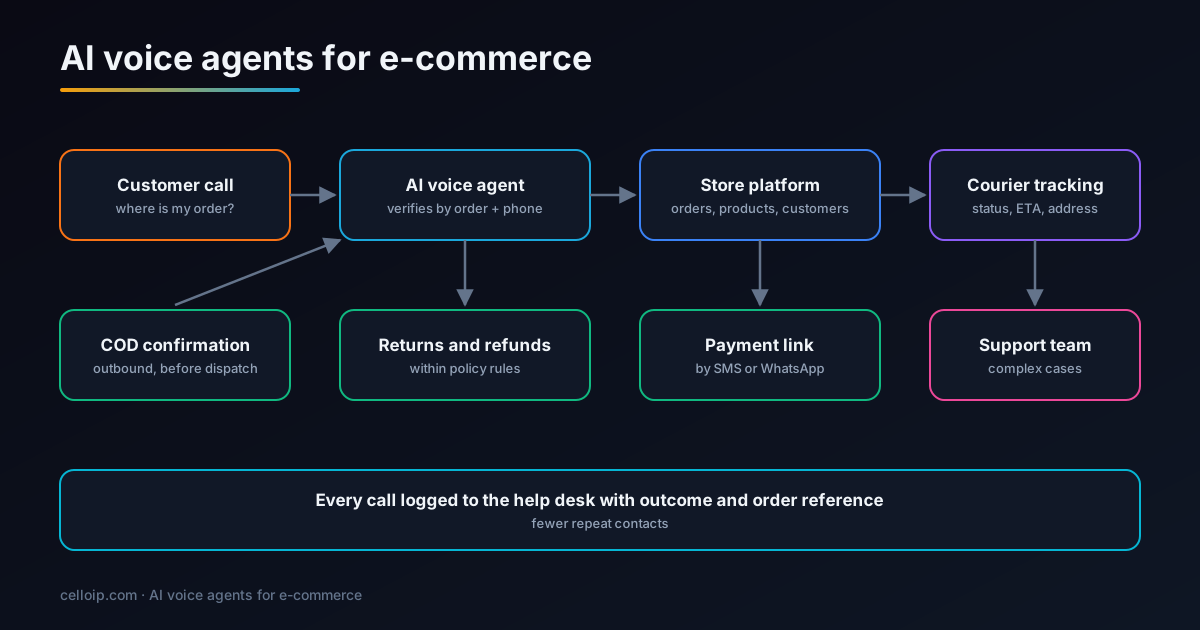
- Identify: match the calling number to recent orders; if there are several, ask which one, or ask for the order number.
- Verify: confirm a second detail, such as the postcode or the email on the order, before sharing anything beyond basic status.
- Look up: fetch the order, fulfilment and courier tracking in real time rather than from a stale copy.
- Explain: give the status in plain words with a date, not courier jargon such as "manifested" or "in transit to hub".
- Act: change, return, cancel or resend only where your rules allow, and confirm the result back to the caller.
- Follow up: send the tracking link, return label or confirmation by SMS, WhatsApp or email.
- Hand over: transfer to support, with a summary, when the request is outside policy or the customer asks for a person.
- Log: write the outcome and order reference to the help desk so the next agent, human or AI, can see it.
Speed matters. A caller asking about a parcel wants an answer in the first twenty seconds, so recognise returning callers from their number, skip unnecessary menus and keep the order lookup fast by calling the store API directly rather than through several layers.
Integrations: store, courier, help desk and messaging
Store platform
Shopify (Admin GraphQL API), WooCommerce (REST API), Magento/Adobe Commerce, BigCommerce or a custom order system. Read orders, customers, fulfilments; create returns and refunds where allowed.
Courier and logistics
Carrier or aggregator tracking APIs for live status, expected dates and failed-delivery reasons; redelivery and pickup booking where the carrier supports it.
Returns platform
If you use a returns app or portal, the agent creates the return there so labels, inspections and refunds follow your existing process.
Help desk and CRM
Zendesk, Freshdesk, Gorgias, HubSpot or your CRM: create or update a ticket with transcript, outcome and order reference after every call.
Messaging
SMS and WhatsApp Business messages for tracking links, return labels, payment links and confirmations, so the caller has it in writing.
Telephony
Your existing numbers through a SIP trunk or cloud contact centre, with transfer to your support queue and call recording where permitted.
Give the agent narrow tools rather than broad API access. A tool called "get order status for a verified caller" is much safer than a raw API key that can read every order in the store. Each tool checks its inputs, applies your rules and returns only the fields the conversation needs.
Keep one source of truth. If the courier and store disagree, the agent should say what it knows, such as "the courier last scanned it yesterday at the local hub", rather than guess, and create a ticket for follow-up.
Example: an order-status tool for Shopify
This simplified Python tool shows the pattern: verify the caller against the order before returning anything, and return only the fields the agent needs. The same shape works for WooCommerce with its REST API.
# order_status_tool.py: simplified order lookup for a voice agent
import os, re, requests

SHOP = os.environ["SHOPIFY_SHOP"]            # e.g. "mystore"
TOKEN = os.environ["SHOPIFY_ADMIN_TOKEN"]    # Admin API token with read_orders scope only
API = "https://" + SHOP + ".myshopify.com/admin/api/2025-10/graphql.json"

QUERY = """
query($q: String!) {
  orders(first: 1, query: $q) {
    edges { node {
      name
      phone
      displayFulfillmentStatus
      fulfillments(first: 3) { status trackingInfo { company number url } }
    } }
  }
}
"""

def digits(n):
    return re.sub(r"\D", "", n or "")[-10:]

def get_order_status(order_number: str, caller_phone: str) -> dict:
    """Return status only if the caller's number matches the order."""
    r = requests.post(API, json={"query": QUERY, "variables": {"q": "name:#" + order_number}},
                      headers={"X-Shopify-Access-Token": TOKEN}, timeout=5)
    r.raise_for_status()
    edges = r.json()["data"]["orders"]["edges"]
    if not edges:
        return {"found": False}
    order = edges[0]["node"]
    if digits(order["phone"]) != digits(caller_phone):
        return {"found": True, "verified": False}   # agent asks for another detail
    tracking = [t for f in order["fulfillments"] for t in f["trackingInfo"]]
    return {
        "found": True, "verified": True,
        "order": order["name"],
        "status": order["displayFulfillmentStatus"],   # e.g. FULFILLED, UNFULFILLED
        "carrier": tracking[0]["company"] if tracking else None,
        "tracking_url": tracking[0]["url"] if tracking else None,  # sent by SMS, not read out
    }
Note the details: the token has only read access to orders, the phone check happens in code rather than being left to the language model, and the tracking link is sent as a message rather than read aloud. Courier status from the tracking API would be added the same way, as a separate small tool.
Cash-on-delivery confirmation calls
For stores with a high share of cash-on-delivery orders, return-to-origin (RTO), where the customer refuses or is unavailable and the parcel comes back, is a direct cost: forward shipping, return shipping, handling and stock that sits unsold. A short confirmation call before dispatch can catch many of these orders early.
- Call within minutes or hours of the order, while the customer still remembers it, and within local calling hours.
- Confirm the product, quantity, total amount payable on delivery and delivery address, then ask the customer to confirm.
- Offer to switch to prepaid with a secure payment link if your business wants to encourage it.
- Cancel immediately if the customer did not place the order or no longer wants it, and stop further calls.
- Capture address corrections, such as a landmark or a missing flat number, and update the order before dispatch.
- Try again a set number of times if unanswered, then follow your rule: hold, dispatch or cancel.
- Speak the customer's language; in India that often means Hindi and regional languages as well as English.
Illustrative example: how COD confirmation calls might end (share of orders called)
An illustration of the outcome categories worth tracking, not measured data; real results depend on your category, region, price point and customers.
Measure the effect honestly: compare RTO for confirmed, cancelled and unreachable orders over several weeks, and include the cost of the calls. If unreachable orders have very high RTO, your rule for them, hold or dispatch, may matter as much as the calls themselves.
Returns, exchanges and refunds within policy
Returns are where an AI agent can save the most handling time, and where poor design costs the most money. The agent must apply your policy exactly, not approximately.
Encode the policy in code
Return windows, excluded categories, condition rules and exchange options live in a rules service. The AI asks the questions; the rules decide eligibility.
Ask the right questions
Which item, why, and what the customer wants: refund, exchange or store credit. The reason codes feed your product and quality teams.
Book the logistics
Create the return in your returns platform or store, then send the label, QR code or pickup slot by message.
Explain refunds clearly
Tell the customer when the refund starts (on pickup, on receipt or after inspection) and how long their bank or wallet usually takes.
Limit money actions
Refunds above a set value, repeat returners and out-of-policy requests go to staff for approval rather than being issued by the agent.
Handle damage and wrong items
Ask for photos by WhatsApp or email and create a priority ticket; these customers usually want a person quickly.
A useful rule of thumb: the agent can create returns that your policy would approve automatically on a website returns portal. Anything that would need a human decision on the website also needs one on the phone.
Payments and customer data
Voice agents and card numbers do not mix. Speech-to-text transcripts, recordings, language-model prompts and logs can all capture sensitive data, which would bring large parts of your system into PCI DSS scope and create real risk.
- Send secure payment links by SMS, WhatsApp or email instead of collecting card details by voice.
- If payment on the call is essential, use a PCI DSS-compliant payment service with keypad (DTMF) masking, and pause recording and transcription during capture.
- Never pass full card numbers, CVVs or one-time passwords to the language model or store them in transcripts.
- Mask personal data such as full addresses and email addresses in logs where they aren't needed.
- Set retention periods for recordings and transcripts and delete them on schedule.
- Follow the data protection law where your customers live, for example GDPR in Europe and the UK, India's DPDP Act and the UAE PDPL.
Tell callers they are speaking with an AI assistant and, where you record, that the call is recorded. It sets expectations and is required or expected in many places.
Outbound calling rules by market
| Market | Key rules | What it means for the agent |
|---|---|---|
| United States | TCPA, including the FCC's 2024 ruling that AI-generated voices are "artificial" voices; state telemarketing laws | Get appropriate consent for AI-voice calls, keep transactional and marketing calls separate, honour opt-outs |
| India | TRAI rules for commercial communications, separate service and promotional categories, DPDP Act | Use registered headers and number series for service calls, respect DND for promotional calls, calling windows |
| United Kingdom and EU | PECR (UK) and national rules, GDPR, Ofcom guidance on silent and abandoned calls | Transactional calls on a lawful basis, marketing only with consent, no abandoned calls |
| UAE | Cabinet Resolution 56 of 2024 on marketing calls, UAE PDPL | Marketing only within permitted hours and with consent; transactional calls handled under data rules |
This is a planning summary, not legal advice. Order-related calls are usually easier to justify than marketing calls, but the line is not always obvious. A COD confirmation that also pitches an upgrade can become a marketing call, so keep them separate. See our TCPA guide for AI outbound calling for US detail.
Measuring results
| Metric | What it tells you |
|---|---|
| Containment rate | Share of calls fully resolved by the agent without a transfer |
| Repeat contact within 7 days | Whether customers had to call or chat again about the same order |
| Transfer reasons | Which requests the agent can't handle yet, and why |
| Average handling time | How quickly calls finish, for both AI-only and transferred calls |
| RTO rate by confirmation outcome | Whether COD confirmation calls are actually reducing returns |
| Return and refund accuracy | Share of agent-created returns that matched your policy on audit |
| Customer satisfaction | Post-call survey score, compared with human-handled calls of the same type |
Review a sample of calls every week during the first months. Listen for misunderstood order numbers, accents the speech recognition struggles with, and policy edge cases. Most improvements come from small fixes to prompts, tools and rules found in these reviews. Our guide to voice agent testing and monitoring covers how to set this up.
CelloIP project outcome (client kept private)
We built an omnichannel contact centre with outbound campaigns, WhatsApp, Instagram, email and SMS in one agent desktop, with SLA rules and ticketing: the same foundations e-commerce support teams run on.
Cost and timeline
| Scope | Typical budget | Typical timeline |
|---|---|---|
| Managed-platform MVP: order status plus one more use case, one store platform | $8,000–$20,000 | 4–8 weeks |
| Custom production agent: store, courier, help desk, messaging and payment links | $25,000–$60,000 | 8–16 weeks |
| Multi-brand, multi-country or high-volume COD platform | Scoped after discovery | Phased |
Running costs come on top: telephony minutes, speech-to-text, the language model and text-to-speech, usually charged per minute by each provider, plus messaging fees. Our AI voice agent cost guide breaks these down. Compare the total against the cost of staffing the same calls, including peak seasons and night cover.
Ready-made e-commerce voice products exist and can be the right choice for a single small store. A custom build makes sense when you have your own order system, several couriers, high COD volume, regional languages or specific policies that off-the-shelf tools handle poorly, and you want to own the code.
Common mistakes
Reading jargon aloud
Courier statuses like "bagged" or "RTO initiated" confuse callers. Map every status to a plain sentence with a date.
Weak verification
Changing an address or issuing a refund on the strength of an order number alone invites fraud. Use the phone match plus another detail or a code.
Letting the AI decide policy
A friendly model will "make an exception" if you let it. Eligibility and refunds belong in code.
No easy way to a person
Customers with a damaged or lost parcel want a human. Make transfer quick, and pass the summary so they don't repeat themselves.
Mixing marketing into service calls
Adding offers to COD or delivery calls can change their legal category and annoy customers.
Ignoring peak load
Test with the call volumes you see during sales and festivals, including telephony and API rate limits.
Frequently asked questions
What can an AI voice agent do for an online store?
The most common jobs are order status ("where is my order?"), delivery changes, return and exchange requests, refund status, cash-on-delivery confirmation before dispatch, failed-delivery follow-up, payment-link reminders and simple product or policy questions. Anything outside policy or emotionally charged goes to a person.
Does it work with Shopify and WooCommerce?
Yes. Both platforms have APIs for orders, customers, fulfilments and refunds: Shopify's Admin GraphQL API and WooCommerce's REST API. The agent calls them through small, permission-limited tools, and can also connect to courier tracking, help-desk and payment systems.
How does the agent verify the caller?
Usually by matching the calling number to the order phone number, plus the order number or another detail such as the postcode or email. Sensitive actions like changing a delivery address or issuing a refund should need stronger checks or a one-time code.
Can AI reduce return-to-origin (RTO) on cash-on-delivery orders?
Confirmation calls before dispatch help catch fake, duplicate and impulse orders and confirm the address, which is why many Indian and Middle Eastern stores use them. Results depend on your category and customers, so measure RTO on confirmed versus unconfirmed orders during a pilot.
Can the agent take card payments?
It should not hear or see card numbers. Instead it sends a secure payment link by SMS, WhatsApp or email, or passes the caller to a PCI DSS-compliant payment step, and confirms once the payment provider reports success.
Is it legal to make outbound AI calls to customers?
Transactional calls about an existing order are usually treated differently from marketing calls, but rules vary. In the US, calls using an AI-generated voice fall under the TCPA and generally need prior consent. India, the UK, the EU and the UAE have their own rules, so check consent and calling windows per country.
How much does an e-commerce voice agent cost?
As a guide, a managed-platform MVP for one or two use cases is typically $8,000–$20,000, and a custom production agent with store, courier, help-desk and payment integrations $25,000–$60,000. Multi-brand or multi-country builds are scoped after discovery.
How long does it take to launch?
A focused order-status and returns agent on one store platform can usually go live in four to eight weeks, including testing on real call recordings. Adding outbound COD confirmation, more languages or more couriers adds time.
Work with CelloIP
Planning a voice agent for your store?
CelloIP builds e-commerce voice agents connected to your store platform, couriers, help desk and messaging, for order status, returns, COD confirmation and more, in the languages your customers speak. You own the code.