AI Voice Agents for Recruiting: Screening Calls, Scheduling and the Rules
High-volume hiring means thousands of applicants, most of whom wait days for a call that takes five minutes. AI voice agents can reach every applicant quickly, confirm the basics, answer their questions and book interviews. But hiring is one of the most regulated uses of AI. This guide covers what voice agents can do in recruiting, where people must stay in charge, and the rules to design for.
Quick answer
What do AI voice agents do in recruiting?
AI voice agents for recruiting call candidates to confirm basic, job-related requirements, answer questions about the role and schedule interviews in the applicant tracking system, and remind candidates before interviews. People should make the hiring decisions. Because recruitment AI is regulated in many places, for example by NYC Local Law 144, the EU AI Act and GDPR, the agent needs notices, consent, accommodations, bias testing and human review designed in from the start.
Why recruiting teams are adding voice AI
In high-volume hiring, such as retail, logistics, warehouses, contact centres, hospitality, healthcare support roles and staffing agencies, speed decides who you hire. Good candidates apply to several employers at once and take the first reasonable offer. A recruiter who calls back in four days often finds the candidate already working elsewhere.
Most of the first contact is repetitive: confirm the candidate is still interested, check they can work the shifts and location, confirm a required licence or certificate, answer questions about pay and the process, and book an interview. Recruiters spend hours on the phone doing this, chasing voicemails and rescheduling no-shows.
An AI voice agent can call every applicant within minutes of applying, at a time that suits them, in their language. It asks the same job-related questions every time, answers common questions from approved information, books interviews straight into recruiters' calendars and sends reminders. Recruiters then spend their time talking to candidates who are interested and available, and making the decisions.
Many candidates in these roles apply from their phones and prefer a quick call or text to long online forms. Done well, an AI phone screen feels faster and more responsive than a silent application portal.
Recruiting use cases
| Use case | What the agent does | Where people stay in charge |
|---|---|---|
| First-contact call | Calls new applicants, confirms interest and best time to talk | Candidates who ask for a person |
| Basic requirements | Confirms objective, job-related requirements: location, shifts, work authorisation, licence | Reviewing mismatches before any rejection |
| Role questions | Answers about pay range, hours, location, benefits and process from approved content | Questions outside the approved content |
| Interview scheduling | Books, confirms and reschedules interviews in recruiters' calendars | Senior or complex interview loops |
| Reminders | Calls or texts before interviews and first shifts to cut no-shows | Candidates raising concerns |
| Inbound candidate line | Answers status questions and FAQs for applicants calling in | Offers, disputes, complaints |
| Re-engagement | Contacts past applicants who agreed to hear about new roles | Talent decisions |
| Onboarding logistics | Confirms start date, documents to bring and where to go | Contract and pay questions |
The safest and most valuable starting point is usually scheduling and logistics: getting interested candidates in front of a recruiter quickly. Screening questions come next, kept strictly objective and job-related.
How an AI screening call works
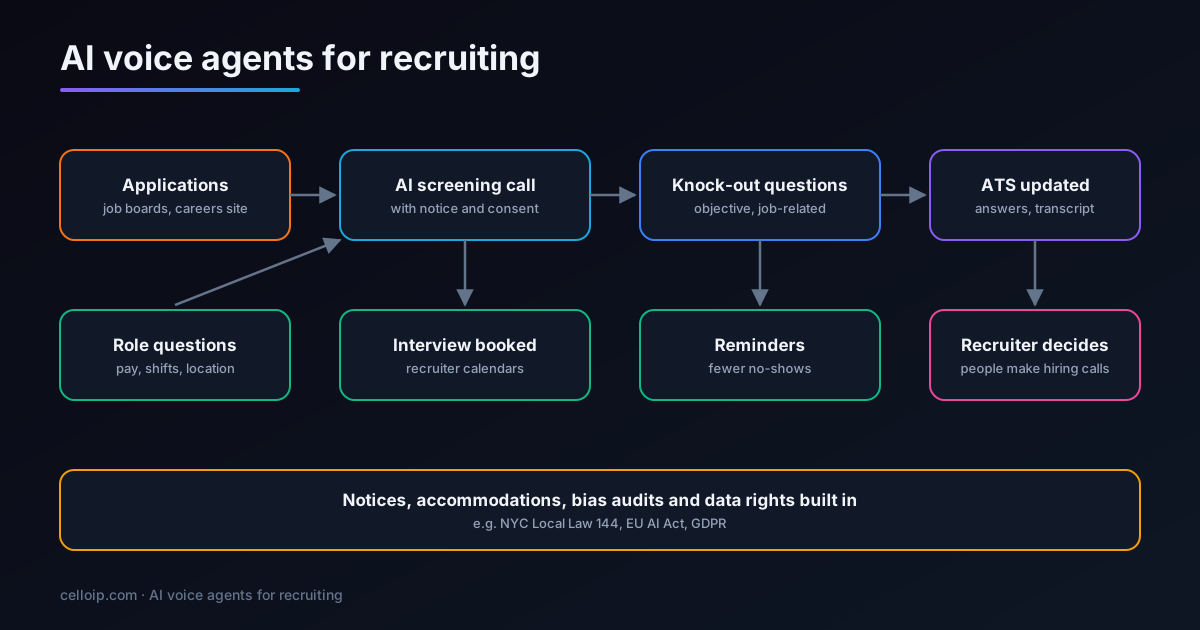
- Before calling: check the candidate gave a phone number and agreed to be contacted, and that any required notice (such as NYC's 10 business days) has been given.
- Open by saying it is an AI assistant calling on behalf of the employer about their application, and ask if now is a good time.
- Explain briefly what the call covers, how answers are used and how to ask for a person or an accommodation instead.
- Ask a short set of objective, job-related questions approved by HR and legal, the same for every candidate.
- Answer the candidate's questions from approved role information; pass anything else to the recruiter.
- Offer interview slots from the recruiter's calendar and book the one the candidate picks.
- Confirm by text or email, write answers and transcript to the ATS, and flag anything for recruiter review.
Keep the call to a few minutes. Long AI interviews feel like an exam and push candidates away, and they drift into assessment, which carries more legal weight than fact-gathering.
Keep hiring decisions with people
The most important design choice is what the agent does not do. It gathers facts and books interviews; it does not judge, rank or reject candidates on its own.
Facts, not judgements
"Do you hold a forklift licence?" is a fact. "How confident did the candidate sound?" is a judgement the agent must never make or record.
Flags, not rejections
When an answer doesn't meet a hard requirement, the agent flags it for the recruiter, who confirms before any rejection is sent.
No hidden scoring
Don't score voice, tone, accent, pauses or word choice. These can reflect disability, language background or nerves, not ability.
No emotion recognition
Inferring emotions in the workplace, generally understood to include hiring, is banned under the EU AI Act, and is a poor idea everywhere.
A human alternative
Candidates can choose to speak to a person instead, and choosing that must not count against them.
Audit trail
Every question, answer, flag and recruiter decision is logged, so you can explain any outcome.
This design is also simpler to justify under the rules. A tool that only collects facts and books interviews may fall outside some definitions of automated decision-making, while a tool that scores or filters candidates usually falls within them. Your counsel decides which applies; the narrower the tool, the easier that conversation is.
The rules that apply
| Jurisdiction | Rule | What it means for a voice agent |
|---|---|---|
| New York City | Local Law 144 on automated employment decision tools (enforced from July 5, 2023) | If the tool substantially assists hiring decisions: independent bias audit within the past year, public summary, notice at least 10 business days before use, information on requesting an alternative or accommodation |
| European Union | AI Act: recruitment and selection AI is high-risk; emotion recognition in the workplace is prohibited | Risk management, data governance, documentation, human oversight, transparency to candidates; high-risk duties expected to apply from December 2027 under the Digital Omnibus changes, so check current dates |
| EU and UK | GDPR / UK GDPR, including Article 22 on solely automated decisions | Lawful basis, privacy notice, data minimisation, retention limits; meaningful human review before decisions with significant effects |
| United States | Title VII, ADA and other federal anti-discrimination law; state laws such as Illinois's on AI in employment; TCPA for AI-voice calls | Test for adverse impact, offer accommodations, give notices where required, get consent for AI-voice calls to candidates |
| India | Digital Personal Data Protection Act, 2023 | Notice and consent for candidate data, purpose limits and data protection safeguards |
This is a planning summary, not legal advice, and AI employment rules are changing quickly in several US states and in the EU. Treat the rules as configuration, such as notices, required questions, retention periods and which features are switched on per country or city, so the agent can follow them as they change.
Your recruiting agency or software vendor is not the only one responsible. Under NYC Local Law 144 and the EU AI Act, employers using these tools carry duties of their own, so keep your own records of audits, notices and human reviews.
Example: objective screening flags, not rejections
This simplified example shows how screening logic can live in code that HR controls. The AI gathers structured answers; the code compares them with requirements and produces flags for a recruiter, never a rejection.
# screening_rules.py: simplified screening flags reviewed by a recruiter
from dataclasses import dataclass

@dataclass
class Requirement:
    key: str            # e.g. "forklift_licence"
    question: str       # read by the agent, approved by HR and legal
    required: bool      # a genuine, job-related requirement
    expected: object    # e.g. True, or a set of acceptable values

REQUIREMENTS = [
    Requirement("work_authorised", "Are you legally allowed to work in this country?", True, True),
    Requirement("forklift_licence", "Do you hold a current forklift licence?", True, True),
    Requirement("shift", "Which shifts can you work: early, late or night?", False, {"early", "late", "night"}),
]

def screening_summary(answers: dict) -> dict:
    """Never rejects. Produces facts and flags for the recruiter to review."""
    flags, missing = [], []
    for r in REQUIREMENTS:
        if r.key not in answers:
            missing.append(r.key)                      # ask again or let the recruiter follow up
            continue
        value = answers[r.key]
        ok = value in r.expected if isinstance(r.expected, set) else value == r.expected
        if r.required and not ok:
            flags.append({"key": r.key, "answer": value, "note": "Does not meet stated requirement"})
    return {
        "status": "needs_recruiter_review" if flags or missing else "ready_to_schedule",
        "flags": flags,
        "missing": missing,
        "answers": answers,          # stored with the transcript in the ATS
        "decided_by": "recruiter",   # the AI never sets a final outcome
    }
Requirements are kept short, objective and job-related, and HR can change them without touching the AI. Candidates who meet everything go straight to scheduling; everyone else is reviewed by a person, who may well schedule them anyway.
Fairness, accessibility and bias testing
Voice brings fairness issues that text forms don't. Speech recognition is less accurate for some accents, dialects and speech differences, background noise affects candidates calling from busy homes or workplaces, and people with hearing or speech disabilities may not be able to use a phone screen at all.
- Test speech recognition accuracy across the accents, languages and phone conditions of your real applicant pool before launch.
- Confirm key answers back to the candidate ("so that's yes to the forklift licence, is that right?") to catch recognition errors.
- Offer alternatives: text, web form or a human call, and accommodations on request, without penalty.
- Monitor outcomes by group where lawful: who is flagged, who is scheduled, who drops out, and investigate differences.
- Commission an independent bias audit where required, such as for NYC, and repeat it at least yearly.
- Review questions regularly with HR and legal to remove anything not genuinely job-related.
Illustrative example: speech recognition word error rate by audio condition during testing
An illustration of what to measure before launch, not measured data; real results depend on the speech model, languages, accents and phone networks in your applicant pool.
If error rates differ by group, fix it before launch: better models, confirmation steps, shorter answers or alternatives. Don't let recognition errors turn into screening flags.
ATS, calendar and messaging integration
Applicant tracking system
Greenhouse, Lever, Workday, SmartRecruiters, iCIMS or Bullhorn: read new applicants and jobs, write answers, transcripts, flags and stage changes approved by recruiters.
Calendars
Google Workspace or Microsoft 365 calendars, or the ATS's own scheduling, for live interview slots per recruiter or site.
Messaging
SMS, WhatsApp and email for confirmations, reminders, directions and links to alternatives.
Telephony
A dedicated recruiting number through a SIP trunk or cloud contact centre, with transfer to recruiters during working hours.
Job content
Approved role information (pay range, shifts, location, benefits) kept in one place so answers are consistent and current.
Audit store
Notices sent, consents, questions asked, answers, flags and decisions kept for the retention period your counsel sets.
Write to the ATS through narrow, logged actions. The agent should be able to add notes and propose a stage, while only recruiters move candidates to rejection. Check each ATS vendor's API terms early, as partner programmes and rate limits can shape the design.
Designing a good candidate experience
Candidates are also customers, neighbours and future applicants. A clumsy AI call can damage your employer brand quickly, especially on social media.
Be open
Say it's an AI assistant at the start, and why you're calling.
Call at sensible times
Respect calling hours and the candidate's time zone, and let them choose a callback time.
Keep it short
A few minutes, a handful of questions, then a booked interview.
Let them ask
Answer questions about pay, shifts and the process honestly; if the agent doesn't know, say a recruiter will follow up.
Speak their language
Offer the languages your applicants use, such as Spanish in the US or Hindi in India.
Close the loop
Confirm next steps in writing, and make sure every candidate eventually hears an outcome from a person or a clear message.
Measuring results
| Metric | What it tells you |
|---|---|
| Time to first contact | How quickly applicants hear from you after applying |
| Contact rate | Share of applicants reached, and by which channel |
| Interview booking rate | Share of reached candidates who book an interview |
| Interview show rate | Whether reminders are reducing no-shows |
| Recruiter overrides | How often recruiters disagree with flags, a signal of poor questions or recognition errors |
| Outcomes by group | Flag, scheduling and drop-off rates by group where lawful, for bias monitoring |
| Candidate feedback | Short post-call survey on clarity and fairness |
Review a sample of calls every week, especially calls where candidates were flagged or dropped out. See our guide to voice agent testing and monitoring for how to set up reviews and alerts.
CelloIP project outcome (client kept private)
We built an omnichannel contact centre with outbound campaigns, WhatsApp, Instagram, email and SMS in one agent desktop, with SLA rules and ticketing: the same building blocks high-volume recruiting teams use to reach candidates.
Cost and timeline
| Scope | Typical budget | Typical timeline |
|---|---|---|
| Managed-platform MVP: first contact, basic questions and scheduling for one hiring process | $8,000–$20,000 | 4–8 weeks |
| Custom production agent: ATS, calendars, messaging, several languages, audit trail and compliance configuration | $25,000–$60,000 | 8–16 weeks |
| Multi-country or staffing-agency platform | Scoped after discovery | Phased |
Budget separately for any independent bias audit you need, and for legal review of questions and notices. Running costs are per call minute and per message; see our AI voice agent cost guide.
Off-the-shelf recruiting assistants exist and may suit standard hiring on a supported ATS. A custom build makes sense for staffing agencies, unusual workflows, several countries and languages, or when you need full control of questions, data and audit records.
Common mistakes
Letting the AI reject
Automatic rejections based on AI calls create legal risk and lose good candidates to recognition errors.
Scoring voice or tone
Judging how people sound invites discrimination claims and, in the EU, may be banned outright.
Skipping notices
Using a tool for NYC candidates without the required notice and audit is a straightforward violation.
Vague questions
"Tell me about yourself" turns a logistics call into an assessment. Keep questions objective.
No alternative route
Candidates who can't or won't use a phone screen need another way in, without penalty.
Stale role information
Wrong pay or shift details damage trust. Keep approved content current and in one place.
Frequently asked questions
What can an AI voice agent do in recruiting?
It can call or answer calls from applicants, confirm objective requirements such as work authorisation, location, shift availability or a required licence, answer questions about pay, hours and the process, schedule interviews in recruiters' calendars, send reminders and reschedule. Assessing and selecting candidates should stay with people.
Is it legal to use AI to screen job candidates?
Generally yes, but it is regulated. In New York City, Local Law 144 requires a bias audit and candidate notices before using an automated employment decision tool. The EU AI Act treats recruitment AI as high-risk. GDPR gives people rights around solely automated decisions. US anti-discrimination law applies to AI tools as it does to any hiring practice.
What does NYC Local Law 144 require?
Employers and employment agencies using an automated employment decision tool for NYC candidates must have an independent bias audit no more than a year old, publish a summary of the results, give candidates at least 10 business days' notice that the tool will be used and tell them how to request an alternative process or accommodation. Enforcement began on July 5, 2023.
How does the EU AI Act affect recruitment AI?
AI used to recruit or select people, including filtering applications and evaluating candidates, is listed as high-risk, with duties on risk management, data quality, documentation, human oversight and transparency. The date those duties apply has been the subject of the EU's Digital Omnibus changes, which are expected to move it from August 2026 to December 2027, so check the current position. Emotion recognition in the workplace is already banned.
Should the AI reject candidates automatically?
We advise against it. Let the agent collect structured answers and flag clear mismatches, and have a recruiter review before anyone is rejected. Fully automated rejection raises legal risk under GDPR Article 22 and similar rules, and can quietly exclude good candidates when speech recognition misunderstands them.
Which ATS platforms can it integrate with?
Any applicant tracking system with an API, such as Greenhouse, Lever, Workday, SmartRecruiters, iCIMS or Bullhorn for staffing agencies, plus calendar systems for interview scheduling. Access depends on the vendor's API terms and your plan.
How much does a recruiting voice agent cost?
As a guide, a managed-platform MVP for screening calls and scheduling for one hiring process is typically $8,000–$20,000, and a custom production agent with ATS, calendar, multiple languages and compliance controls $25,000–$60,000. Larger multi-country programmes are scoped after discovery.
Will candidates accept an AI phone screen?
Candidates for high-volume roles usually value a fast response and an interview booked the same day. Be open that it is an AI, keep the call short, let candidates ask questions, offer a human alternative and make sure no one is penalised for choosing it.
Work with CelloIP
Planning a voice agent for your hiring team?
CelloIP builds recruiting voice agents that reach applicants quickly, confirm objective requirements, answer questions and book interviews in your ATS and calendars, with notices, alternatives, audit trails and human review designed in. You own the code.