AI Voice Agents for Real Estate: A Practical Guide
In real estate, the business that answers first often wins the client. Agents are out at viewings, offices close in the evening, and portal leads arrive at all hours. This guide explains how AI voice agents help estate agents, brokers and property managers answer every call and lead, and how to deploy them without crossing legal lines.
Quick answer
How do real estate businesses use AI voice agents?
Real estate businesses use AI voice agents to answer every property enquiry at any hour, give listing details, qualify buyers and renters, book viewings into agents' calendars, follow up quickly on web leads, and take maintenance requests for managed properties, passing serious leads to agents with full notes. They must follow consent rules for outbound calls and fair housing rules in every conversation.
Why real estate is a natural fit for voice AI
Real estate runs on phone calls, and most of them arrive when nobody can answer properly. Agents are driving between viewings, showing a property or negotiating an offer. Buyers browse listings in the evening and at weekends, and portal enquiries arrive at midnight. Every missed or slow call is a lead that may call the next agency on the list.
Most of these calls follow a pattern: is the property still available, what is the price and service charge, how many bedrooms, can I view it, and what else do you have in this area? Those questions can be answered from listing data, and the next step, booking a viewing or a valuation, is a calendar action. That is exactly what AI voice agents do well.
The goal is not to replace agents. It is to make sure every enquiry gets a fast, accurate response and that agents spend their time with serious buyers, sellers and landlords rather than repeating basic details or chasing voicemails.
Real estate also has a strong multilingual and international dimension. Buyers in markets such as Dubai, London, Miami, Singapore and Indian metros often call from abroad or prefer another language. A voice agent that can switch to Arabic, Hindi, Russian, Mandarin or Spanish, at any hour, gives smaller agencies the reach of much larger ones.
Six real estate use cases
| Use case | What the agent does | Systems it needs |
|---|---|---|
| Listing enquiries | Answers availability, price, features, fees and viewing times for a specific property | Listing feed or portal data |
| Lead qualification | Asks about budget, financing, area, timeline and needs, and scores the lead | CRM |
| Viewing and valuation booking | Offers slots, books, confirms and reschedules | Agents' calendars |
| Speed-to-lead calls | Calls new web and portal leads within minutes of the enquiry, with consent | Lead sources, CRM, dialer |
| Reminders and follow-ups | Confirms viewings, reminds about open houses, follows up after viewings | Calendar, CRM |
| Tenant and maintenance lines | Logs repair requests, triages emergencies and updates tenants | Property management system |
Most brokerages start with listing enquiries and viewing booking on inbound calls, then add speed-to-lead outbound calling once consent capture on lead forms is in place.
How a real estate voice agent works
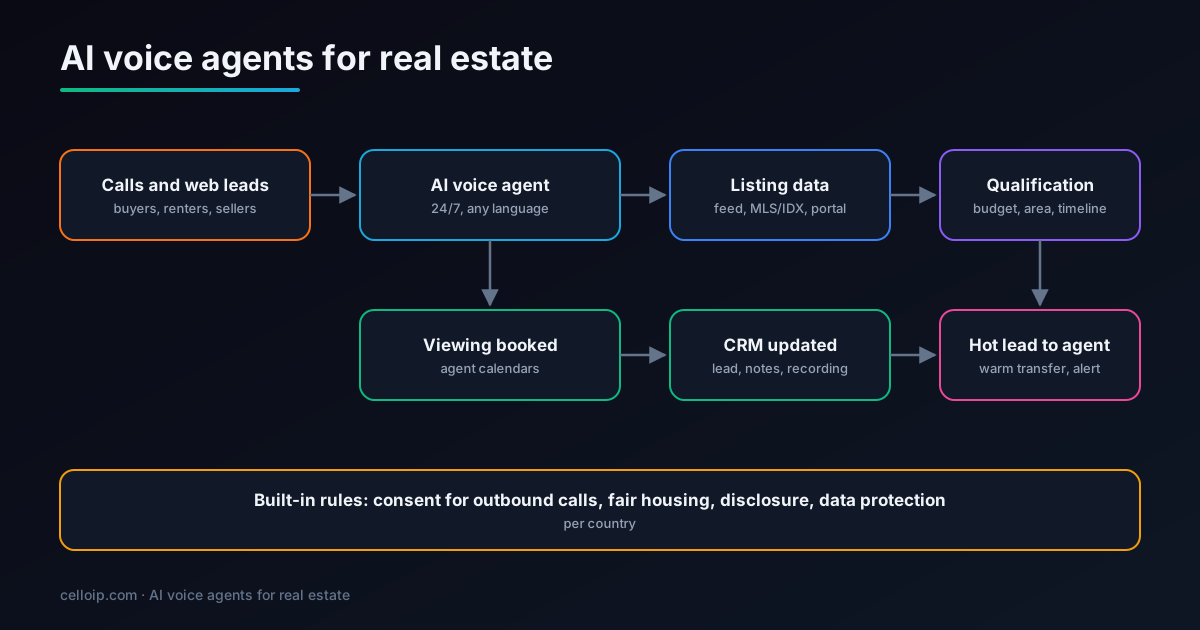
Calls reach the agent through your existing numbers, including tracked numbers on portals and signs, or through an outbound trigger when a web lead arrives. The agent identifies which property the caller is asking about, from the tracked number, the reference number or the address, answers from listing data, qualifies the caller, books the next step and writes everything to your CRM.
When a caller is ready to make an offer, wants to negotiate, has a complaint or simply asks for a person, the agent transfers to the right negotiator or sends an urgent alert with the call summary, so the human conversation starts where the AI left off.
Qualification that agents actually trust
A voice agent that books every caller into every viewing wastes agents' time; one that interrogates callers loses them. Good qualification feels like a helpful conversation and asks the same fair, job-relevant questions of everyone.
Buyers
Area and property type, budget range, financing position (cash, mortgage in principle, need advice), timeline, whether they need to sell first.
Renters
Move-in date, budget, number of occupants within legal limits, pets, length of tenancy, and the documents they will need.
Sellers and landlords
Property address and type, reason and timing, whether they want a valuation, and best times for a call back.
Lead score
A simple score from the answers, readiness, budget fit and timeline, so agents see who to call first, with the reasoning visible in the CRM.
Keep qualification criteria objective and documented. Questions should relate to the transaction, never to who the caller is.
Integrations: listings, calendars and CRM
The agent is only as useful as its connections. Three integrations matter most:
- Listing data: your website feed, portal exports or an MLS/IDX feed where licensed, refreshed often so the agent never offers a property that has gone under offer.
- Calendars: each negotiator's availability, viewing rules (minimum notice, travel time between viewings) and property access arrangements.
- CRM: create or update the contact, log the call with summary and recording, store qualification answers and trigger follow-up tasks.
A simple tool definition keeps listing answers grounded in live data rather than the model's guesses:
{
  "type": "function",
  "function": {
    "name": "get_listing",
    "description": "Look up a property by reference, tracked phone number or address before answering any question about it. Answer only from the returned fields.",
    "parameters": {
      "type": "object",
      "properties": {
        "reference": { "type": "string", "description": "Listing reference, e.g. 'DXB-1043'" },
        "tracked_number": { "type": "string", "description": "The number the caller dialled, if it is a listing-specific tracked number" },
        "address_text": { "type": "string", "description": "Address or building name as the caller said it" }
      },
      "additionalProperties": false
    }
  }
}
The tool returns structured fields: status, price, fees, bedrooms, size, features and viewing rules. If the listing is under offer or withdrawn, the agent says so and offers similar properties from the same feed.
Keep data fresh and consistent across channels. If the same listing appears on your website, portals and WhatsApp, the voice agent should read from the same source of truth, so a price change or a property going under offer is reflected everywhere at once. Inconsistent information is one of the fastest ways to lose a buyer's trust.
Speed to lead: why minutes matter
Online property enquiries go cold quickly. A buyer who submits a form on three agencies' websites tends to engage with the one that calls back first. A voice agent can call a new lead within a minute or two of the enquiry, at any hour the rules allow, confirm what they are looking for and book a viewing before a competitor has seen the email.
Illustrative response windows: when a new web lead hears back
Illustrative comparison of typical response patterns, not measured data. The point is the gap between an instant call and the next working session.
Speed only helps if the call is welcome and lawful. Lead forms should say clearly that the person agrees to be called, including by an automated or AI voice where that requires specific consent, and the agent should respect calling hours and opt-outs every time.
Speed-to-lead also works for sellers and landlords. A homeowner who requests an online valuation is often comparing agencies that same evening, and a prompt call that books the valuation visit puts your agency first in line.
Rules to design for
A planning summary, not legal advice. Check the rules for your market and lead sources with your compliance adviser.
| Area | What it means for the voice agent |
|---|---|
| Fair housing and equality laws | No steering or different treatment based on protected characteristics; no comments on who lives in an area; the same questions for everyone (for example the US Fair Housing Act and UK Equality Act) |
| Outbound calling consent | In the US, AI-voice calls fall under the TCPA, so lead forms need clear consent; UK PECR, India TRAI and UAE telemarketing rules apply in those markets |
| Disclosure | The agent says it is an AI assistant for the agency and gives the agency's name |
| Recording and data protection | Recording notices where required; personal data stored and retained under GDPR, the DPDP Act, UAE PDPL or local law |
| Advertising and licensing | Property details match the approved listing; regulated information such as permit or registration numbers is given where local rules require it |
Market detail: USA · UK · India · UAE and Dubai.
Property management and tenant lines
For letting and property management teams, the phone is busiest with tenants rather than buyers. A voice agent can take the load off a small team:
Maintenance intake
Collects the address, problem, photos by text link, access arrangements and urgency, then creates the job in your property management system.
Emergency triage
Recognises emergencies such as leaks, no heating in winter or security problems, and routes them to the on-call contractor or manager immediately.
Status updates
Tells tenants when a repair is booked or a contractor is on the way, from the job record.
Rent and move-in questions
Answers routine questions about payments, deposits, inspections and move-in steps from approved information.
Property management teams also benefit from consistent records. Every tenant call, repair request and update is logged against the property and tenancy, which helps with disputes, landlord reporting and deposit decisions at the end of a tenancy.
What it costs, and how to start
Costs depend on the number of offices, the listing and CRM integrations, languages and whether outbound calling is included. As a guide, matching our voice agent cost ranges:
| Build | Typical range | Timeline |
|---|---|---|
| Managed-platform MVP for one office | $8,000 – $20,000 | 4–6 weeks |
| Custom agent with listings, calendars and CRM | $25,000 – $60,000 | 8–16 weeks |
| Multi-branch, multilingual or developer sales centres | Scoped after discovery | Agreed in the plan |
- Start with inbound listing enquiries and viewing booking on one office's numbers.
- Measure answered enquiries, viewings booked, show-up rate and leads passed to agents.
- Add after-hours coverage, then speed-to-lead calling once consent capture is in place.
- Extend to other offices, languages and the tenant line.
CelloIP project outcome (client kept private)
We built an omnichannel contact centre with outbound campaigns, WhatsApp, Instagram, email and SMS in one agent desktop, with SLA rules and ticketing: the same building blocks real estate sales centres use.
An example conversation flow
A well-designed real estate voice agent follows a simple, predictable structure that still feels natural. This is a typical flow for an inbound listing enquiry:
- Greet with the agency's name and say it is an AI assistant that can help with properties and viewings.
- Identify the property from the tracked number, reference or address, and confirm it with the caller.
- Answer the caller's questions from the listing data: availability, price, fees, size, features, parking, viewing rules.
- Offer the next step: a viewing, similar properties, or a call back from the negotiator.
- Ask the agreed qualification questions, briefly and in a natural order.
- Book the viewing in the right agent's calendar, confirm the time and send a text or WhatsApp confirmation with the address.
- Log everything in the CRM and alert the agent immediately for hot leads, offers or complaints.
The same structure works for sellers and landlords, with a valuation booking instead of a viewing, and for tenants, with a maintenance job instead of a booking. Keeping flows consistent makes the agent easier to test and easier for your team to trust.
Measuring results
Agree a few numbers with your team before launch and compare them with the months before. Real estate has strong seasonality, so compare like with like where you can.
| Metric | What it shows |
|---|---|
| Enquiries answered (including after hours) | How many leads were previously being missed |
| Time to first response for web leads | Whether speed-to-lead calling is working |
| Viewings and valuations booked | The agent's direct contribution to the pipeline |
| Viewing show-up rate | Whether bookings and reminders are reaching serious people |
| Leads passed to agents and their quality | Whether qualification is useful to negotiators |
| Caller feedback and complaints | Whether the experience is helping or hurting the brand |
Ask negotiators for feedback weekly in the first month. They notice quickly when qualification questions are missing something or when bookings don't match how they actually work, and small adjustments early make a big difference to adoption.
Frequently asked questions
How do real estate agents use AI voice agents?
To answer listing enquiries around the clock, qualify buyers, renters and sellers, book viewings and valuations into calendars, call new web leads quickly, remind people about viewings and open houses, and take maintenance requests for managed properties, with hot leads passed to agents immediately.
Can an AI voice agent answer questions about specific listings?
Yes, when it is connected to your listing data, such as your website feed, portal listings or an MLS/IDX feed where licensed. It answers from that data only and offers to connect the caller with an agent for anything it doesn't know.
Can it call new leads from our website or portals?
Yes, and calling quickly after an enquiry is one of the most valuable uses. Outbound calls need the right consent: in the US, AI-voice calls fall under the TCPA, so lead forms should collect clear consent to be called. Other countries have their own rules.
How do you stay compliant with fair housing rules?
The agent is designed never to steer callers based on protected characteristics, never to comment on neighbourhood demographics, schools as proxies for people, or who lives somewhere, and to apply the same qualification questions to everyone. Prompts, answers and transcripts are reviewed against those rules.
Which CRMs can it work with?
Any CRM with an API, including general CRMs like Salesforce, HubSpot and Zoho and real estate CRMs. Each call creates or updates the lead, adds notes, the qualification answers and the recording, and triggers the right follow-up.
Can it speak several languages?
Yes. Real estate markets such as Dubai, London, Miami and Indian metros have many international buyers. The agent can handle English, Arabic, Hindi, Russian, Mandarin, Spanish or any language you need.
How much does a real estate AI voice agent cost?
As a guide, a managed-platform MVP for one brokerage is typically $8,000–$20,000 and a custom production agent with listing feeds, CRM and calendar integration $25,000–$60,000. Multi-branch and multilingual deployments are scoped after discovery.
Work with CelloIP
Want every property enquiry answered?
CelloIP builds AI voice agents for estate agents, brokers, developers and property managers, connected to your listings, calendars and CRM, in any language, with consent and fair housing rules built in. You own the code.