What makes a voice AI agent HIPAA-compliant?
A HIPAA-compliant voice AI agent requires a signed Business Associate Agreement with every vendor whose layer touches Protected Health Information — telephony/SIP carrier, speech-to-text, LLM, and text-to-speech — plus encryption in transit and at rest, role-based access controls, comprehensive audit logging, and a minimum-necessary data policy.
Which voice AI providers sign BAAs in 2026?
Deepgram, OpenAI (enterprise/API tier), Anthropic, Microsoft Azure OpenAI, and Google Cloud offer BAAs on qualifying tiers, as do ElevenLabs and Cartesia on enterprise plans. Consumer-tier API keys for the same providers typically do not include a BAA — it is a contractual and billing-tier distinction, not a technical one.
HIPAA-Compliant Voice AI Agents: Build Guide for Healthcare Call Automation
Short answer: HIPAA compliance for a voice AI agent isn't a single checkbox — it's a Business Associate Agreement with every vendor in the pipeline that touches Protected Health Information: telephony, speech-to-text, the LLM, and text-to-speech, each independently.
Most teams building a healthcare voice AI agent assume that picking an "enterprise-grade" platform is enough. It isn't. A platform can be SOC 2 Type II certified and still be legally unable to touch PHI if it hasn't signed a BAA — and even when the platform has, the STT/LLM/TTS providers underneath it may not be covered unless you verify that explicitly.
This guide breaks down exactly which layers need a BAA, which vendors currently offer one, the technical controls HIPAA actually requires (not just implies), a managed-API vs self-hosted architecture comparison, and the healthcare call-automation use cases we've built this stack for.
4 layers
Need their own BAA
AES-256
Encryption at rest standard
$15K–$90K
Build cost range
6–16 wks
Timeline (managed vs self-hosted)
This article explains the technical and architectural implications of HIPAA for engineering teams building voice AI agents. It is general information, not legal advice — consult healthcare compliance counsel before launching a production PHI-handling voice AI system.
Quick Answer
HIPAA compliance for a voice AI agent means a signed Business Associate Agreement (BAA) with every vendor that can access Protected Health Information (PHI) — the telephony/SIP carrier, the speech-to-text engine, the LLM, and the text-to-speech engine — because each is technically a separate business associate under HIPAA regardless of how unified the product feels from the outside. On top of the BAA layer, HIPAA requires encryption in transit (TLS 1.2+/SRTP) and at rest (AES-256), role-based access controls, comprehensive audit logging of every PHI access event, and a minimum-necessary data-handling policy. None of this is automatic just because a vendor is "enterprise-grade" — it has to be verified contractually and built into the architecture from day one.
What Counts as PHI in a Voice AI Call
Protected Health Information isn't limited to diagnosis codes or lab results. In a voice AI context, PHI includes anything that combines individually identifiable information with health-related content: the patient's name plus the reason for their call, an appointment time tied to a specific provider or clinic, a medication name mentioned during an adherence check-in call, or even a callback number tied to a patient record. This matters architecturally because it means almost every healthcare voice AI call — not just ones explicitly about diagnoses — creates PHI the moment the agent captures caller ID, asks "what are you calling about," or reads back an appointment detail.
The practical implication for engineering teams: treat every call to a healthcare voice AI agent as a PHI-handling event by default, rather than trying to selectively route only the "sensitive" parts of a conversation through a compliant path. Selective routing is where compliance gaps get introduced.
The HIPAA Voice AI Stack, Layer by Layer
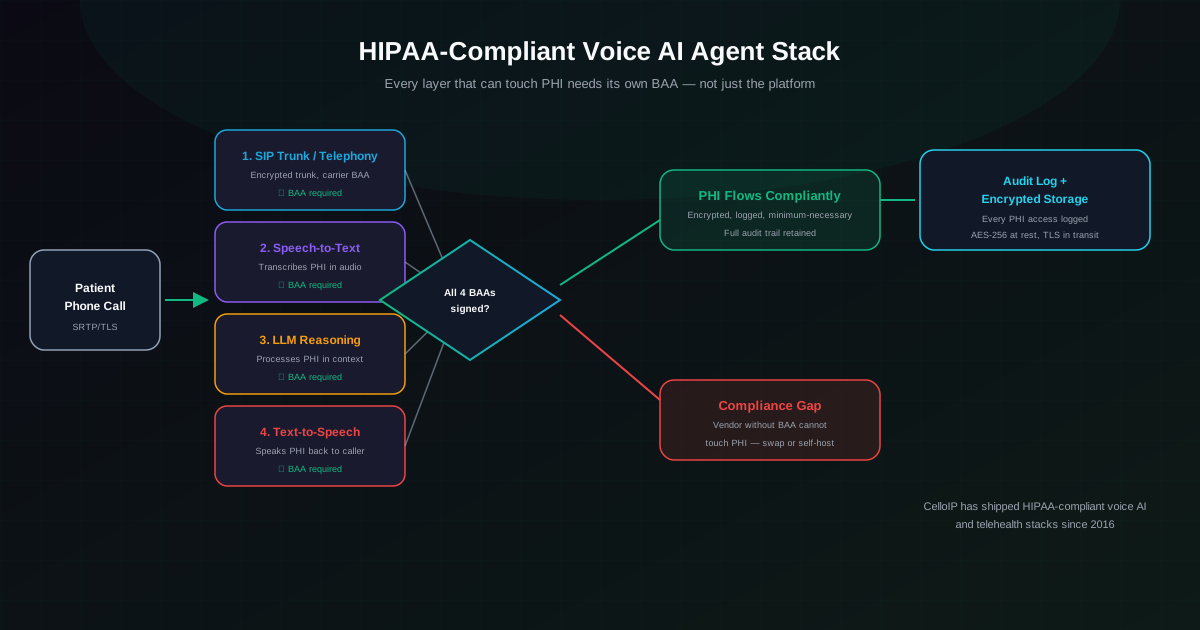
A voice AI call passes through at least four independent systems before it becomes a response the patient hears — and HIPAA treats each one as a separate business associate:
- Telephony / SIP trunk — carries the raw audio (and often caller ID/ANI) between the PSTN and your platform. The carrier needs a BAA if audio or metadata is PHI-bearing, and the trunk needs SRTP/TLS encryption end-to-end.
- Speech-to-Text (STT) — transcribes spoken PHI into text. This is often the layer teams forget needs its own BAA, especially when a voice AI platform silently routes STT to a third-party API under the hood.
- LLM reasoning layer — processes the transcribed PHI to generate a response, and may retain conversation context in memory or logs. The LLM provider's BAA needs to explicitly cover the API tier you're actually using, not just the provider's brand name.
- Text-to-Speech (TTS) — synthesizes PHI-containing responses (e.g. reading back an appointment time or medication name) back to the caller. Some TTS providers process this server-side and require their own BAA; others can run fully on-device.
A stack is only as compliant as its weakest layer. We've seen teams sign a BAA with their voice AI platform vendor and assume it's covered end-to-end, only to discover the platform's underlying STT provider was on a tier that excludes healthcare use — a gap that surfaces during a compliance audit, not during development.
Which Voice AI Vendors Actually Sign BAAs (2026)
BAA availability is a contractual and billing-tier decision, not a technical one — the same underlying model can be BAA-covered on an enterprise plan and not covered on a self-serve API key:
| Layer | Provider | BAA Available? | Notes |
|---|---|---|---|
| STT | Deepgram | Yes | BAA on enterprise/HIPAA-tier accounts |
| STT | OpenAI Whisper API | Yes | Enterprise/API tier only, not consumer ChatGPT |
| LLM | OpenAI (GPT-4o/GPT-5-class) | Yes | API/enterprise tier — verify per-deployment |
| LLM | Anthropic Claude | Yes | Enterprise agreements include BAA |
| LLM | Azure OpenAI Service | Yes | Microsoft's healthcare-focused BAA program |
| TTS | ElevenLabs | Yes | Enterprise plan required, not creator tier |
| TTS | Cartesia | Yes | Enterprise plan |
| Telephony | Twilio | Yes | HIPAA-eligible product list — check per-product |
| Orchestration | Retell AI | Yes | Self-service BAA portal, no enterprise contract required |
| Orchestration | VAPI | Partial | Verify BAA coverage extends to your specific STT/LLM/TTS combo |
| Orchestration | LiveKit (self-hosted) | N/A | No BAA needed — PHI never leaves your infrastructure |
BAA terms change frequently — always confirm current BAA status and scope directly with each vendor before architecting a production PHI-handling pipeline around this table.
Technical Requirements Beyond the BAA
A signed BAA is necessary but not sufficient — HIPAA's Security Rule requires specific technical safeguards regardless of which vendors are involved:
- Encryption in transit — TLS 1.2+ for all API calls, SRTP/DTLS-SRTP for all call audio, no plaintext PHI on the wire at any hop.
- Encryption at rest — AES-256 for any stored transcript, recording, or extracted PHI field, including database backups and logs.
- Access controls — role-based access to PHI-containing systems, unique user IDs (no shared service accounts touching PHI), and automatic session timeouts.
- Audit logging — every read, write, or export of PHI logged with who, what, when, immutable and retained per your compliance policy (typically 6+ years).
- Minimum necessary standard — the voice agent should extract and retain only the PHI fields actually needed for the workflow, not the full raw transcript by default.
- Breach notification readiness — a documented process to detect, assess, and report a PHI breach within regulatory timelines if the voice AI pipeline is ever compromised.
Managed API Stack vs Self-Hosted Stack
There are two architecturally distinct ways to reach HIPAA compliance, and the right choice depends on call volume, budget, and how much infrastructure ownership your team wants:
| Dimension | Managed API (BAA-covered) | Self-Hosted (LiveKit + Asterisk) |
|---|---|---|
| Compliance path | BAA with each vendor layer | PHI never leaves your infra — no third-party BAA needed |
| Time to production | 6–10 weeks | 10–16 weeks |
| Ongoing cost model | Per-minute/per-token vendor fees | Fixed infra cost, scales better at high volume |
| Voice quality / latency | Best-in-class out of the box | Requires tuning to match managed-API latency |
| Compliance ownership | Shared with vendors via BAA | Fully owned by your team/infra |
| Best fit | Startups, pilots, moderate call volume | High-volume health systems, strict data-residency needs |
See our self-hosted LiveKit deployment guide and LiveKit + Asterisk/FreeSWITCH integration guide for the infrastructure side of the self-hosted path.
PHI Audit Logging Middleware (TypeScript)
A minimal audit-logging wrapper around a LiveKit voice agent's PHI-touching functions — every access is logged before the data is used, not after:
interface PhiAccessEvent {
  timestamp: string;
  callId: string;
  actorService: "stt" | "llm" | "tts" | "telephony";
  action: "read" | "write" | "export";
  fieldsAccessed: string[];   // e.g. ["patient_name", "appointment_time"]
  purpose: string;            // minimum-necessary justification
}

async function withPhiAudit<T>(
  event: Omit<PhiAccessEvent, "timestamp">,
  fn: () => Promise<T>
): Promise<T> {
  const record: PhiAccessEvent = { ...event, timestamp: new Date().toISOString() };

  // Write immutable audit record BEFORE the PHI-touching call executes
  await auditLog.append(record);

  try {
    return await fn();
  } catch (err) {
    await auditLog.append({ ...record, action: "read", fieldsAccessed: ["ERROR"] });
    throw err;
  }
}

// Usage inside a LiveKit agent handler
const transcript = await withPhiAudit(
  { callId, actorService: "stt", action: "read", fieldsAccessed: ["raw_audio"], purpose: "transcription" },
  () => deepgramClient.transcribe(audioChunk)
);

const patientReply = await withPhiAudit(
  { callId, actorService: "llm", action: "read", fieldsAccessed: ["appointment_time", "provider_name"], purpose: "generate_response" },
  () => llmClient.complete({ context: transcript, minimumNecessary: true })
);
Common HIPAA Voice AI Mistakes
- Assuming a platform is HIPAA-ready because it's SOC 2 certified — SOC 2 and HIPAA are different compliance frameworks; only a signed BAA authorizes PHI processing.
- Not verifying BAA coverage extends to the specific STT/LLM/TTS providers a platform uses under the hood, especially when the platform lets you swap providers.
- Storing raw call recordings indefinitely with no encryption-at-rest policy or retention schedule, rather than following the minimum-necessary standard.
- Using a consumer-tier or free API key for an LLM/STT/TTS provider that only offers BAAs on enterprise or dedicated tiers.
- No audit trail on who accessed a specific patient's call transcript or recording after the call ended — this is required, not optional, under the Security Rule.
- Treating outbound reminder calls as 'low risk' and skipping BAA review because the content feels routine — appointment time + patient name is still PHI.
Healthcare Voice AI Use Cases We Build
Patient Intake & Pre-Visit Screening
Collects symptoms, insurance details, and history before a visit, structured into the EHR-ready format.
Appointment Scheduling & Reminders
Inbound scheduling and outbound reminder calls, TCPA-aware pacing for reminder campaigns.
Medication Adherence Check-ins
Outbound calls confirming medication was taken, escalating non-adherence to a nurse line.
Post-Discharge Follow-Up
Automated check-in calls after discharge, flagging symptoms that need clinical escalation.
Insurance Eligibility Verification
Voice AI agent calls payer IVR systems or handles inbound patient eligibility questions.
Nurse Triage Line Overflow
Handles overflow call volume with structured symptom capture, warm-transferring urgent cases.
Platform HIPAA-Readiness Comparison
| Platform | BAA Path | Best Fit |
|---|---|---|
| Retell AI | Self-service BAA portal, no enterprise contract needed | Fast-moving teams wanting inbound customer-facing agents |
| VAPI | Available, but verify sub-provider coverage per stack | Engineering teams needing granular model/voice control |
| Bland AI | Enterprise BAA for high-volume outbound | High-volume outbound reminder/adherence campaigns |
| LiveKit (self-hosted) | Not applicable — PHI stays in your infra | Health systems needing full data-residency control |
| Twilio (telephony layer) | HIPAA-eligible product list, verify per product | Underlying SIP/PSTN layer for any of the above |
For the broader platform decision beyond HIPAA readiness alone, see our full VAPI vs Retell vs LiveKit vs Bland AI comparison.
Development Cost & Timeline
- Pilot / single-use-case managed API build — $15,000–$25,000, 6–8 weeks (e.g. one intake or reminder workflow).
- Full managed API build, multi-use-case — $25,000–$45,000, 8–10 weeks (intake + scheduling + adherence, EHR integration).
- Self-hosted stack (LiveKit + Asterisk/FreeSWITCH + self-hosted STT/LLM/TTS) — $40,000–$90,000+, 10–16 weeks depending on model self-hosting complexity.
- Ongoing: managed-API BAA vendor fees scale per-minute/per-token; self-hosted scales with infra cost, typically cheaper past a few hundred thousand minutes/month.
Frequently Asked Questions
What makes a voice AI agent HIPAA-compliant?
A signed BAA with every vendor layer that touches PHI — telephony, STT, LLM, TTS — plus encryption in transit and at rest, access controls, audit logging, and a minimum-necessary data policy.
Do I need a separate BAA for STT, LLM, and TTS, or just the platform?
Every layer that processes PHI, not just the top-level platform. Verify the platform's BAA explicitly extends to its underlying STT/LLM/TTS providers.
Which providers currently sign BAAs?
Deepgram, OpenAI (enterprise tier), Anthropic, Azure OpenAI, and Google Cloud on qualifying tiers; ElevenLabs and Cartesia on enterprise plans. Consumer-tier keys typically aren't covered.
Is self-hosting a way to avoid needing BAAs?
Yes — self-hosting Whisper, an LLM, and Piper/Coqui TTS inside your own compliant infrastructure means PHI never reaches a third party, removing the need for those BAAs.
How much does a HIPAA-compliant voice AI agent cost?
$15,000–$45,000 for a managed-API build (6–10 weeks); $40,000–$90,000+ for a fully self-hosted stack (10–16 weeks).
Can it handle outbound calls like appointment reminders?
Yes — outbound HIPAA voice AI calls need the same BAA/encryption stack as inbound, plus TCPA consent handling for the outbound-calling layer.
Does it need to record and store calls?
Not necessarily — many deployments retain only the structured transcript/extracted data per the minimum-necessary standard rather than raw audio.
How is HIPAA compliance different from general enterprise security?
SOC 2/ISO 27001 show strong security controls but don't authorize PHI processing — only a signed BAA does, regardless of a vendor's certifications.
Related Reading
Building a HIPAA-Compliant Voice AI Agent?
CelloIP engineers build BAA-covered and self-hosted voice AI stacks for healthcare intake, scheduling, and follow-up automation.