Can voice AI agents handle Hindi and English in the same sentence?
Yes, but only with a code-switch-aware pipeline. A naive ASR model trained on monolingual Hindi or monolingual English mis-transcribes roughly 15-20% of words in a mixed Hindi-English (Hinglish) sentence. A multilingual model trained on code-switched data, combined with per-chunk language-ID, handles this correctly.
Is it better to build a custom Hindi voice AI agent or use a platform?
Off-the-shelf platforms are faster for straightforward single-language use cases. Custom development is better when you need correct code-switching across specific regional languages, integration with an existing PBX/SIP trunk, India-specific data residency, or full ownership of the model pipeline and conversation data.
Hindi & Regional-Language Voice AI Agent Development
Most "voice AI for Indian languages" results are platforms, not development partners. Bolna AI, Ringg AI, Bolti, and similar tools are legitimate SaaS products — but none of them are a custom-development option for a business that needs a specific telephony integration, a specific compliance posture, or code you actually own.
This guide covers what a production Hindi or regional-language voice AI agent actually requires: handling Hinglish code-switching correctly, choosing an ASR/TTS model per language, routing SIP/DID traffic by region, and staying compliant with India's TRAI DLT and NDNC rules — a separate regime from the US TCPA.
We also cover when a platform is genuinely the better choice, and when custom development earns its cost — written from Ahmedabad, where these edge cases show up in testing before they show up in a client's production traffic.
~57%
Urban Indian business conversations mix Hindi/English
15-20%
WER increase from naive monolingual ASR on Hinglish
$20K–$95K
Typical build cost range by language count
Ahmedabad, India
Where CelloIP builds and tests these systems
Quick Answer
A production Hindi or regional-language voice AI agent needs to handle Hinglish code-switching (mixed Hindi-English within a single sentence, common in roughly 57% of urban Indian business conversations), which naive monolingual ASR models mis-transcribe at a meaningfully higher word-error rate. The fix is a routing layer: detect whether an utterance is code-switched or single-language per chunk, and send it to a multilingual model or a faster monolingual model accordingly. Beyond the ASR/TTS layer, a real deployment needs SIP/DID routing by region, awareness of India's TRAI DLT and NDNC compliance rules for outbound calling (distinct from the US TCPA), and a decision on whether an off-the-shelf platform (Bolna AI, Ringg AI, and similar) is sufficient or whether custom development is justified by telephony integration, data-residency, or ownership requirements.
Build vs. Platform: Why This Space Is Mostly SaaS Today
Search "voice AI for Indian languages" and nearly every result is a platform — a hosted product with a dashboard, a set number of supported languages, and usage-based pricing. That's a reasonable default for a business that wants Hindi support added to an existing workflow quickly, and doesn't need anything beyond what the platform's dashboard exposes.
It stops being sufficient the moment you need something a dashboard doesn't configure: routing calls through an existing Asterisk/FreeSWITCH PBX rather than the platform's own number, keeping call recordings and transcripts on infrastructure inside India rather than a foreign cloud region, tuning the ASR model on your own regional-accent data rather than the platform's general-purpose model, or owning the integration code so you're not dependent on one vendor's roadmap and pricing changes.
| Requirement | Off-the-Shelf Platform | Custom Development |
|---|---|---|
| Fast launch, single language, standard flows | ✓ Best fit | Slower, likely unnecessary |
| Code-switching (Hinglish) handled correctly | Varies — check the platform's own benchmark, don't assume | ✓ Tuned to your call data |
| Integration with existing PBX/SIP trunk | Limited to the platform's own number provisioning | ✓ Native strength |
| India-specific data residency | Depends on the vendor's hosting region — verify explicitly | ✓ Full control over hosting location |
| Own the model pipeline and conversation data | No — vendor-hosted | ✓ Full ownership |
| Multiple regional languages with different tuning | Bounded by the platform's supported-language list | ✓ Add languages as your roadmap requires |
The Hinglish Problem: Why Code-Switching Breaks Naive ASR
Code-switching is the practice of mixing two languages within a single sentence or conversation — in Indian business contexts, this most commonly means Hindi and English mixed together ("Hinglish"), and the equivalent happens regionally too (Tanglish for Tamil-English, Tenglish for Telugu-English). This isn't occasional slang; it's estimated that roughly 57% of urban Indian business conversations mix Hindi and English within the same sentence, which means a voice AI agent that can't handle it will mis-transcribe a majority of real calls, not an edge case.
A monolingual ASR model — one trained purely on Hindi audio, or purely on English audio — forces every word into its single-language vocabulary. When a caller says something like "Mera order kal deliver ho jayega na?" (mixing Hindi grammar with the English loanword "order" and "deliver"), a Hindi-only model may transliterate the English words phonetically into nonsense Devanagari, and an English-only model may fail on the Hindi portion entirely. In practice this shows up as a measurable word-error-rate (WER) increase — commonly in the 15-20% range — concentrated specifically on code-switched utterances, not on purely monolingual ones.
| Pipeline | Handles Pure Hindi | Handles Pure English | Handles Hinglish (Mixed) |
|---|---|---|---|
| Monolingual Hindi model only | ✓ High accuracy | ✗ Fails or mistranscribes | ✗ 15-20%+ WER increase |
| Monolingual English model only | ✗ Fails or mistranscribes | ✓ High accuracy | ✗ 15-20%+ WER increase |
| Multilingual model, no code-switch training | Moderate | Moderate | Degrades on true mid-sentence mixing |
| Multilingual model + Hinglish-specific training data | ✓ High accuracy | ✓ High accuracy | ✓ Handles mid-sentence mixing correctly |
ASR & TTS Model Selection by Language Scenario
There is no single "best" model across every scenario — the right choice depends on whether the utterance is code-switched or single-language, and which regional language is involved:
| Scenario | ASR Approach | TTS Approach |
|---|---|---|
| Pure Hindi, standard accent | Monolingual Hindi model — fastest, most accurate for this case alone | Hindi-native TTS voice, standard register |
| Hinglish (mixed Hindi/English) | Multilingual model trained on code-switched data — do not rely on a general multilingual model without verifying Hinglish-specific benchmarks | TTS that preserves the caller's mixed register rather than translating fully into one language |
| Pure regional language (Tamil, Telugu, Bengali, Marathi) | Regionally fine-tuned monolingual model where available; general multilingual model as fallback | Native TTS voice for that language — verify vendor coverage per language, it's uneven |
| Regional code-switching (Tanglish, Tenglish) | Multilingual model — regional code-switch training data is scarcer than Hinglish, budget extra tuning time | Same register-preservation principle as Hinglish |
This selection layer sits on top of the same STT→LLM→TTS architecture covered in our Voice Bot Development Guide and our VAPI vs Retell vs LiveKit vs Bland AI comparison — the orchestration platform choice and the language-model choice are separate decisions, the same way platform and telephony-partner choice are separate decisions.
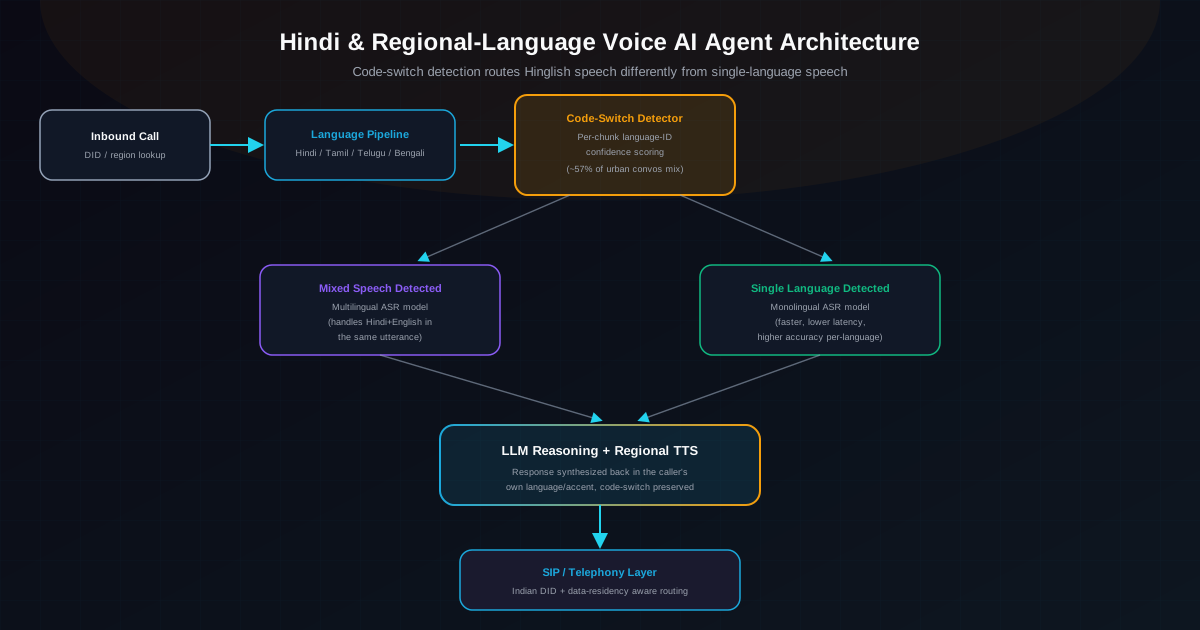
Architecture: Routing by Code-Switch Detection
The architecture shown in Fig. 1 above resolves the Hinglish problem without paying the multilingual-model latency cost on every single call:
- Inbound calls are routed by DID number or IVR menu selection to a language pipeline before any speech recognition runs — a caller dialing a Hindi-support line shouldn't need to state their language preference by voice first.
- A lightweight language-ID pass scores each audio chunk (typically 1-3 seconds) for language mix, running ahead of the full ASR decode so the routing decision doesn't add meaningful latency.
- Chunks scored as code-switched route to the multilingual, Hinglish-trained ASR path. Chunks scored as confidently single-language route to the faster monolingual path for that language.
- The LLM reasoning layer and TTS output preserve whatever register the caller used — a caller who mixed Hindi and English gets a response in the same mixed register, not a response forced into pure Hindi or pure English.
- SIP/telephony routing handles Indian DID number formats and can enforce data-residency requirements by keeping the entire pipeline — ASR, LLM, TTS, call recording — on infrastructure located in India when that's a contractual or regulatory requirement.
Code-Switch-Aware ASR Router (Python)
A simplified version of the routing logic described above — scores each audio chunk for language mix and picks the ASR path accordingly, falling back to the multilingual model whenever confidence is low:
#!/usr/bin/env python3
"""
hinglish_asr_router.py
Per-chunk language-ID routing between a monolingual ASR model
(faster, more accurate for a single language) and a multilingual
model trained on code-switched Hindi/English (Hinglish) audio.
"""

from dataclasses import dataclass

# Confidence below this threshold is treated as "mixed" rather than
# risking a wrong monolingual routing decision.
LANG_ID_CONFIDENCE_THRESHOLD = 0.85

@dataclass
class LangIDResult:
    primary_lang: str      # e.g. "hi", "en", "ta"
    primary_confidence: float
    is_code_switched: bool  # True if multiple languages detected in-chunk

def classify_chunk(audio_chunk: bytes, lang_id_model) -> LangIDResult:
    """Run a lightweight language-ID model over a short audio chunk
    (1-3s) ahead of full ASR decoding."""
    scores = lang_id_model.predict(audio_chunk)  # {"hi": 0.55, "en": 0.40, ...}
    top_lang, top_score = max(scores.items(), key=lambda kv: kv[1])
    second_score = sorted(scores.values(), reverse=True)[1] if len(scores) > 1 else 0.0

    # Two languages both scoring meaningfully = likely code-switched utterance
    is_mixed = (top_score < LANG_ID_CONFIDENCE_THRESHOLD) or (second_score > 0.25)

    return LangIDResult(
        primary_lang=top_lang,
        primary_confidence=top_score,
        is_code_switched=is_mixed,
    )

def route_to_asr(audio_chunk: bytes, lang_id_model, asr_models: dict):
    """
    asr_models = {
        "multilingual_hinglish": <model trained on code-switched data>,
        "hi": <monolingual Hindi model>,
        "en": <monolingual English model>,
        "ta": <monolingual Tamil model>,
        ...
    }
    """
    result = classify_chunk(audio_chunk, lang_id_model)

    if result.is_code_switched:
        # Always prefer the multilingual/Hinglish-trained model for
        # mixed-language speech, even if it's slightly slower.
        model = asr_models["multilingual_hinglish"]
    else:
        # Confidently single-language: use the faster monolingual model.
        model = asr_models.get(result.primary_lang, asr_models["multilingual_hinglish"])

    transcript = model.transcribe(audio_chunk)
    return transcript, result

# Example DID-based pipeline selection (routing config, not runtime code)
DID_LANGUAGE_MAP = {
    "+9122XXXXXXXX": "hi",   # Mumbai DID -> Hindi pipeline default
    "+9144XXXXXXXX": "ta",   # Chennai DID -> Tamil pipeline default
    "+9140XXXXXXXX": "te",   # Hyderabad DID -> Telugu pipeline default
    "+9133XXXXXXXX": "bn",   # Kolkata DID -> Bengali pipeline default
}
# Note: DID mapping sets the DEFAULT language pipeline and the
# monolingual fallback model — code-switch detection still runs
# per-chunk regardless of which DID the call arrived on.
India DND/DLT Compliance — Not the Same as US TCPA
Outbound voice AI calling in India runs through a completely different compliance regime than the US TCPA rules covered in our TCPA compliance guide — don't assume a system built for US outbound compliance automatically satisfies Indian requirements, or vice versa:
| Requirement | India (TRAI DLT / NDNC) | United States (TCPA) |
|---|---|---|
| Regulator | TRAI (Telecom Regulatory Authority of India) | FCC / FTC |
| Sender registration | Telemarketing entities must register sender headers and call/message templates on the DLT platform before dialing | No DLT-equivalent registration; consent and calling-window rules apply instead |
| Opt-out registry | NDNC (National Do Not Call) registry check required before outbound dialing | National Do Not Call Registry, separately administered |
| Consent model | Registered template + DLT compliance for commercial communication | Prior express written consent for autodialed/prerecorded marketing calls |
| Applies to voice AI agents? | Yes — an AI voice agent placing outbound commercial calls is still bound by DLT/NDNC rules | Yes — covered in detail in our TCPA guide |
If you operate outbound campaigns in both markets, build the DLT/NDNC check and the TCPA check as two independent compliance gates in the call-initiation flow — collapsing them into one shared "compliance check" step is a common architecture mistake that produces false confidence in one market or the other.
Use Cases by Industry
BFSI / Banking IVR
Balance inquiries, EMI reminders, and card-activation flows in Hindi and regional languages, often the highest-volume use case.
Healthcare Appointment Reminders
Regional-language appointment confirmation and reminder calls — see our HIPAA-compliant voice AI guide if PHI is involved in a cross-border deployment.
Read the guideGovernment / PSU Citizen Services
Multi-language citizen service lines where callers may use any of several regional languages within the same call center queue.
E-Commerce Order & Delivery Calls
Order confirmation and delivery-status calls, frequently the clearest real-world example of Hinglish code-switching in production traffic.
Outbound Collections / Reminders
Regional-language outbound calling with DLT/NDNC compliance built into the dialing flow, not bolted on afterward.
Multi-Region Contact Centers
A single contact-center queue serving callers across several states, routed to the correct language pipeline by DID or IVR selection.
Cost & Timeline
| Scope | Cost | Timeline |
|---|---|---|
| Single language, single workflow (e.g. Hindi-only reminders) | $20,000–$40,000 | 8–12 weeks |
| Hindi + Hinglish code-switching support | $30,000–$55,000 | 10–16 weeks |
| Multi-language (3+ regional languages) with code-switch support | $45,000–$95,000 | 14–20 weeks |
| Dedicated developer, ongoing language expansion | $3,500–$7,000/month per developer | Ongoing |
Cost scales primarily with the number of language pairs requiring dedicated tuning, not with raw call volume — a 2-language deployment with heavy code-switching can cost more to build correctly than a 4-language deployment where each language is used in isolation.
Accent & Data-Residency Considerations
- Regional accent variation within a single language is real and measurable — Hindi spoken with a Bihari, Punjabi, or Gujarati accent can show a meaningfully different word-error rate on a model tuned only on standard/Delhi-region Hindi.
- Don't assume a vendor's 'Hindi supported' claim covers accent diversity — ask specifically what training/tuning data underlies the claim, and test with call recordings representative of your actual caller base before committing.
- Data residency matters more in regulated or government-adjacent deployments — verify explicitly where a platform vendor hosts audio, transcripts, and model inference, not just where its company is headquartered.
- Regional code-switched variants (Tanglish, Tenglish) generally have less available training data than Hinglish — budget extra tuning time and testing if these are part of your language roadmap.
- Plan language rollout in phases — launching Hindi plus one regional language, validating in production, then adding further languages is lower-risk than a simultaneous 5-language launch.
Why an India-Based Team Matters Here
This is one of the few areas where CelloIP's Ahmedabad base is a direct, testable advantage rather than a boilerplate claim. Hinglish code-switching, regional accent variation, Indian DID number formats, and TRAI DLT/NDNC compliance aren't abstractions read about from documentation — they're everyday realities encountered while building and testing these systems locally.
- 200+ VoIP, WebRTC, and voice AI projects delivered since 2016, with the same SIP/telephony depth used across our Asterisk, FreeSWITCH, and LiveKit voice-agent guides applied here to Indian DID routing and regional language pipelines.
- Direct testing against real Hinglish call patterns and regional accents, not synthetic benchmark audio alone.
- Engagements deliver source code and model configuration you own outright — no vendor-hosted black box, consistent with the ownership model recommended in our voice AI development company evaluation guide.
- Dedicated-developer and staff-augmentation models available for phased language rollout, rather than a fixed-scope one-time delivery.
Frequently Asked Questions
Can voice AI agents handle Hindi and English in the same sentence?
Yes, with a code-switch-aware pipeline. Naive monolingual ASR mis-transcribes roughly 15-20% more words on Hinglish speech; a multilingual model trained on code-switched data with per-chunk language-ID handles it correctly.
What ASR model works best for Indian regional languages?
A multilingual model with explicit Hinglish training for code-switched speech, and a monolingual or regionally fine-tuned model for pure single-language speech — production systems route between both per-utterance.
Is it better to build custom or use a platform for Hindi voice AI?
Platforms are faster for straightforward single-language use cases. Custom development is better for correct code-switching, existing PBX/SIP integration, India-specific data residency, or full pipeline ownership.
What is the DND/DLT registry requirement for outbound voice AI calls in India?
TRAI's DLT platform requires registered sender headers/templates before dialing, plus an NDNC registry check — a separate regime from the US TCPA, not interchangeable with it.
How much does a custom Hindi/regional-language voice AI agent cost?
$20,000–$40,000 for a single-language deployment (8-12 weeks); $45,000–$95,000 for a multi-language deployment with code-switching support (14-20 weeks).
Why does CelloIP's India base matter for this project type?
Hinglish code-switching, regional accents, and DLT/NDNC compliance are tested locally during development, not discovered after a client's launch.
Which languages should a first release support?
Hindi plus one or two regional languages relevant to your customer base is realistic; testing effort scales roughly per language pair, especially for code-switched variants.
Does regional accent affect accuracy within one language?
Yes — a model tuned only on standard Hindi can show a different word-error rate on strongly regional accents; production systems benefit from accent-diverse training data.
Related Reading
Building a Hindi or Regional-Language Voice AI Agent?
CelloIP builds and tests these systems from Ahmedabad — Hinglish code-switching, regional accents, and India-specific compliance handled from day one, with code you own.