What should I look for in a voice AI agent development company?
Five things: a production track record of live deployments handling real call volume, full-stack SIP/telephony depth beyond the AI platform's own SDK, named compliance experience in your industry (HIPAA, TCPA), a clear code-ownership model after delivery, and a defined post-launch support arrangement rather than a one-time handoff.
How much does it cost to hire a voice AI agent development company?
A single-workflow production deployment typically runs $18,000–$45,000 over 6–10 weeks. A multi-workflow deployment with CRM/EHR integration and compliance logging runs $50,000–$120,000 over 12–20 weeks.
Best Voice AI Agent Development Companies (2026 Comparison)
Every "top 10 voice AI agent development company" listicle ranks names. Almost none of them tell you how to actually evaluate one. This guide is the evaluation framework instead of another ranking: five weighted criteria, a due-diligence scorecard you can run yourself, and the specific questions and red flags that separate a production-capable dev shop from a platform reseller with a good landing page.
This is deliberately not a company-by-company bake-off. Naming and disparaging competitors doesn't help you make a better hiring decision — a repeatable scorecard does. We show you how to build your own shortlist, score it, and validate the top choice with a small paid pilot before committing to a full engagement.
We also cover where CelloIP fits on this scorecard, transparently, alongside the criteria — so you can judge us by the same standard we're recommending you apply to everyone else on your list.
5 criteria
In the weighted evaluation scorecard
$18K–$120K
Typical production engagement range
6–20 wks
Single vs multi-workflow timeline
200+
Voice AI & VoIP projects delivered by CelloIP
Quick Answer
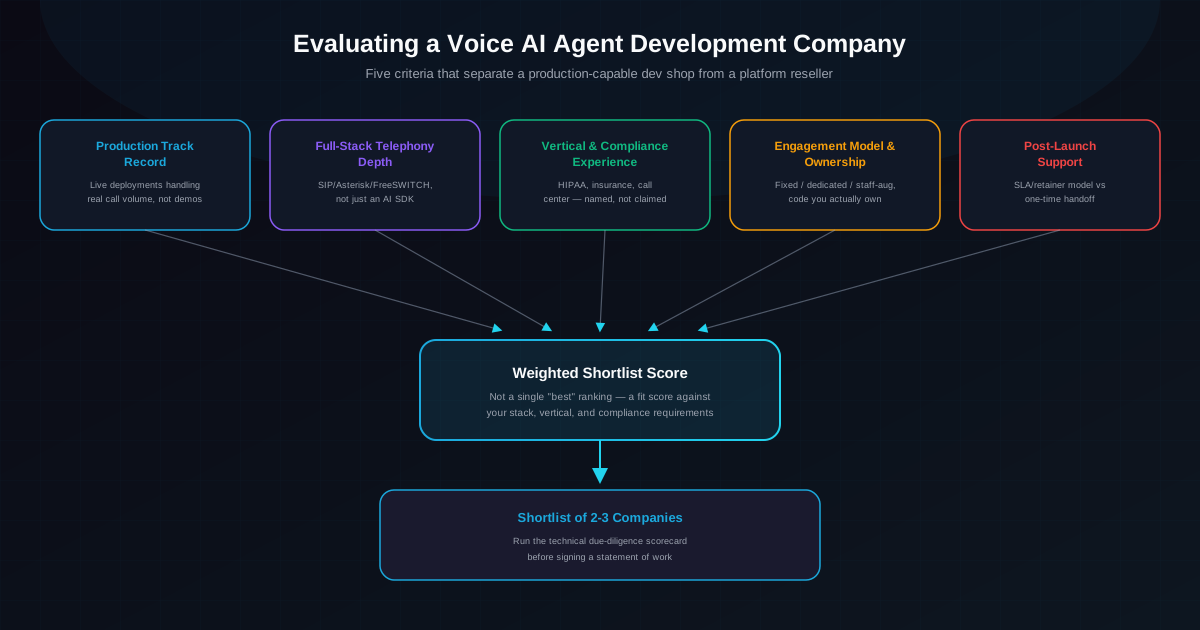
There is no single "best" voice AI agent development company — only a best fit for your stack, vertical, and compliance requirements. Score any candidate against five weighted criteria: a production track record of live deployments handling real call volume (not demos or short pilots), full-stack SIP/telephony depth beyond the AI platform's own SDK, named experience in your specific compliance regime (HIPAA, TCPA, PCI), a clear model for who owns the integration code after delivery, and a defined post-launch support arrangement. Build a shortlist of 2-3 companies from public listicles and referrals, run each through the scorecard below, then validate the top choice with a small, paid pilot before committing to a full statement of work.
Why "Top 10" Listicles Don't Answer the Real Question
Search "best voice AI agent development company" and you'll find a dozen listicles, several published by the companies they rank favorably, others by content agencies with no disclosed methodology. None of them tell you how the ranking was produced: whether project counts were independently verified, whether "500+ clients" means 500 production deployments or 500 total contracts of any size including a single consulting call, or whether the writer has ever actually spoken to a client of the companies being ranked.
That doesn't make the lists useless — they're a reasonable way to surface names you wouldn't have found otherwise. It does mean the ranking order itself carries almost no evidentiary weight. Two companies both claiming "top 3" status in different listicles is common, and unsurprising once you know the methodology behind most of them is undisclosed.
Compare that to how you'd evaluate the underlying AI orchestration platform instead — see our VAPI vs Retell vs LiveKit vs Bland AI comparison, which uses measurable criteria (latency, pricing, SDK ownership model) rather than a subjective ranking. This guide applies the same discipline to the development-company decision: replace the ranking with a scorecard you run yourself, on criteria you can actually verify.
The 5-Criteria Evaluation Framework
These five criteria, weighted according to your own priorities, replace a subjective "best company" ranking with a repeatable score:
| Criterion | What to Verify | Why It Predicts Fit |
|---|---|---|
| Production track record | Named, live deployments handling real call volume for 3+ months — ask for at least one reference you can call directly | Demos and short pilots don't surface the failure modes sustained production traffic does — codec drift, load spikes, escalation-rate creep |
| Telephony depth | Hands-on Asterisk, FreeSWITCH, Kamailio/OpenSIPS, or named CCaaS experience — not just fluency with the AI platform's own SDK | Most integration failures happen at the telephony/routing layer, not the AI-reasoning layer, and platform-only shops rarely have this depth |
| Vertical & compliance experience | A specific named deployment in your regulatory environment (HIPAA, TCPA, PCI) with the architecture they used, not a blanket claim | Compliance retrofitting after launch costs far more than architecting it in from the start |
| Engagement model & ownership | Whether you receive and own the integration code/IP after delivery, or the system stays hosted in their environment with no export path | Determines whether you can maintain, extend, audit, or migrate the system without the original vendor |
| Post-launch support | A defined SLA or retainer model for the weeks after go-live, not a one-time handoff with no support window | Production voice AI systems need tuning after real traffic arrives — escalation thresholds, prompt adjustments, latency issues that only show up at scale |
Production Track Record: Weak vs Strong Evidence
"500+ projects delivered" on a homepage is marketing copy until it's backed by something you can independently check. Here's the distinction that actually matters when you're evaluating the claim:
| Signal | Weak Evidence | Strong Evidence |
|---|---|---|
| Project count | Unverifiable total on a homepage ('500+ projects') | Named case studies with specific architecture, volume, and outcome metrics |
| Reference customers | Logos on a slide with no offer to connect you to them | A named contact willing to take a 15-minute reference call |
| Demo vs production | A polished demo call that works once, on a controlled script | A system handling real, unscripted caller traffic for 3+ months with published or shareable uptime/escalation metrics |
| Compliance claims | 'HIPAA compliant' as a bullet point with no detail | A named BAA-covered deployment with the specific architecture (on-device STT, encrypted storage, audit logging) described |
Telephony Depth vs Platform-Only Shops
A large share of the companies appearing in "voice AI agent development" listicles are, on inspection, platform-integration shops: teams fluent in one AI platform's SDK who wire up a phone number and a webhook. That's legitimate work for a greenfield, cloud-native deployment — but it breaks down the moment your call center runs on an existing PBX, a legacy CCaaS, or needs SIP-level control the platform's SDK doesn't expose.
| Your Situation | Platform-Only Shop | Full-Stack Telephony + AI Shop |
|---|---|---|
| Greenfield, cloud-native, no legacy PBX | Often sufficient — fastest time to launch | Also works, but may be more than you need |
| Existing Asterisk/FreeSWITCH PBX | Struggles with AGI/ARI/AudioSocket bridging — this is telephony work, not AI work | Native strength — see our AGI/ARI-level integration guides |
| Existing CCaaS (Genesys, Five9, NICE) | Limited to whatever native connector the platform ships | Can build custom SIP trunk or API-level routing when the native connector falls short |
| Multi-tenant / MSP telephony | Rarely has multi-tenant routing/isolation experience | Direct architectural overlap with multi-tenant VoIP platform design |
| Need for SIP-level failover to human queue | Dependent on the platform's own failover feature set | Can implement custom SBC/dialplan-level failover independent of the AI platform |
For the routing-layer detail behind that last row, see our SIP trunk + AI voice agent integration guide and our call-center partner evaluation guide, which covers this same distinction specifically for call-center buyers.
Vertical & Compliance Fit
A company that has already built a compliant architecture for your industry has solved problems your project will hit — before your project exists. Ask for the specific deployment, not the general claim:
Healthcare / HIPAA
Ask for a named BAA-covered deployment and the specific architecture used for PHI in transit and at rest.
HIPAA-Compliant Voice AI Agents guideInsurance
Ask for a named FNOL, claims-intake, or policy-servicing deployment integrated with a real claims system.
AI Voice Agents for Insurance guideCall Centers
Ask for a named deployment with warm-transfer to a human queue and CRM-context handoff, not just a standalone AI line.
Call-center partner evaluation guideEngagement Models & Cost Compared
| Model | Typical Cost / Timeline | Best Fit |
|---|---|---|
| Fixed-price, single workflow | $18,000–$45,000, 6–10 weeks | One call type, one integration point, clear requirements up front |
| Fixed-price, multi-workflow | $50,000–$120,000, 12–20 weeks | Multiple call types, CRM/EHR integration, compliance logging |
| Dedicated developer | $3,500–$7,500/month per developer | Ongoing feature development, single specialist embedded in your team |
| Team / staff augmentation | $3,500–$7,500/month per developer, scaled to team size | Multi-phase rollouts across several call queues, business units, or a sustained voice AI product roadmap |
These ranges assume a company with the telephony and compliance depth described above already in place. A company solving your industry's compliance architecture for the first time on your engagement should be priced and scheduled with meaningful contingency — that first-time learning cost lands on you either way, whether it's priced in up front or discovered as a delay later.
Due-Diligence Scorecard (Runnable Script)
A simple weighted-scorecard script you can run against each shortlisted company after a discovery call — score each criterion 0-5 based on the evidence they provide, adjust the weights to your own priorities, and compare totals objectively instead of by gut feel:
#!/usr/bin/env python3
"""
voice_ai_vendor_scorecard.py
Weighted due-diligence scorecard for evaluating a voice AI agent
development company. Score each criterion 0-5 based on VERIFIED
evidence from a discovery call, not sales-deck claims.
"""

# Adjust weights to your own priorities.
# Example below: compliance-heavy buyer (healthcare/insurance)
WEIGHTS = {
    "production_track_record": 0.25,
    "telephony_depth":         0.20,
    "vertical_compliance":     0.25,   # raise this if HIPAA/TCPA matters
    "ownership_model":         0.15,
    "post_launch_support":     0.15,
}

SCORING_GUIDE = {
    0: "No evidence / could not answer",
    1: "Vague claim, no specifics",
    2: "General example, not verifiable",
    3: "Named example, plausible but unverified",
    4: "Named example + willing to provide a reference",
    5: "Named example + verified reference call completed",
}

def score_vendor(name: str, scores: dict) -> float:
    assert set(scores) == set(WEIGHTS), "Score every criterion, 0-5"
    total = sum(scores[k] * WEIGHTS[k] for k in WEIGHTS)
    return round(total, 2)

if __name__ == "__main__":
    vendors = {
        "Vendor A": {
            "production_track_record": 4,
            "telephony_depth": 5,
            "vertical_compliance": 4,
            "ownership_model": 5,
            "post_launch_support": 3,
        },
        "Vendor B": {
            "production_track_record": 3,
            "telephony_depth": 2,
            "vertical_compliance": 2,
            "ownership_model": 3,
            "post_launch_support": 4,
        },
    }

    results = {name: score_vendor(name, s) for name, s in vendors.items()}
    for name, total in sorted(results.items(), key=lambda x: -x[1]):
        print(f"{name}: {total} / 5.00")
The point isn't the code — it's the discipline of scoring verified evidence instead of sales-deck impressions, and being explicit about which criteria matter most for your specific project before you start the calls, not after you've already developed a gut preference.
A 5-Step Process for Evaluating Candidates
Score production track record
Ask for named, live deployments handling real call volume for 3+ months, and verify at least one reference call.
Test telephony depth
Ask specifically about SIP/PBX/SBC experience — Asterisk, FreeSWITCH, Kamailio, or a named CCaaS — beyond the AI platform's SDK.
Verify vertical & compliance experience
Ask for the specific architecture used in a deployment matching your regulatory environment, not a blanket compliance claim.
Confirm the ownership model
Clarify in writing whether you own the integration code and IP after delivery, or the system stays hosted in their environment.
Weight, score, and pilot
Apply your own weights to the scorecard, then validate the top choice with a small paid pilot before a full statement of work.
Red Flags When Evaluating a Voice AI Development Company
- They can't describe a specific production incident they debugged at the telephony layer — codec mismatch, SBC misconfiguration, failover not triggering — because their experience is limited to the AI platform's SDK layer.
- They're vague about who owns the code after delivery, or the contract routes everything through their own hosted environment with no export path.
- They claim a system is 'HIPAA-compliant' or 'TCPA-compliant' as a blanket statement without naming a specific signed BAA or a specific compliance architecture they've implemented before.
- Every reference deployment they cite is a demo or a short pilot, not a system that has run in production for more than a few months.
- They quote a firm price before asking about your existing telephony stack, call volume, or compliance requirements.
- Their 'project count' or 'years in business' claims can't be tied to a single named, checkable reference.
Where CelloIP Fits on This Scorecard
We're publishing the same framework we'd want a buyer to apply to us, so here's how CelloIP scores against it, transparently — verify all of this yourself rather than taking it on faith, which is exactly the point of the scorecard above:
- Production track record: 200+ VoIP, WebRTC, and voice AI projects delivered since 2016, including a live AI voice agent contact center case study and a multi-tenant hosted PBX platform — see our case studies hub for specifics, not just a headline number.
- Telephony depth: founded by a VoIP architect with hands-on Asterisk, FreeSWITCH, Kamailio/OpenSIPS, and SBC experience predating the current voice AI wave — not a team that started with an AI platform's SDK and backed into telephony.
- Vertical & compliance experience: dedicated, publicly documented architecture guides for HIPAA-compliant healthcare deployments and insurance FNOL/claims automation, not a one-line compliance claim.
- Ownership model: engagements deliver source code you own outright — no vendor-hosted black box with an unclear export path.
- Post-launch support: dedicated-developer and staff-augmentation models available for ongoing tuning after go-live, not just a fixed-price handoff.
Best Fit by Company Profile
The right weighting of the five criteria shifts depending on your starting point — a greenfield SaaS startup and a regulated healthcare enterprise should not use the same scorecard weights:
Greenfield SaaS Startup
Weight speed and platform-agnostic flexibility highest — telephony depth matters less with no legacy PBX to integrate.
Enterprise with Legacy PBX/CCaaS
Weight telephony depth and named CCaaS/PBX integration experience highest — this is where platform-only shops struggle most.
Regulated Healthcare or Insurance
Weight vertical & compliance experience highest — a named BAA-covered or claims-integrated deployment is non-negotiable.
Multi-Country / MVNO Operator
Weight ownership model and post-launch support highest — long-lived infrastructure needs code you can maintain and extend independently.
Frequently Asked Questions
What should I look for in a voice AI agent development company?
A production track record of live deployments handling real call volume, full-stack SIP/telephony depth beyond the AI platform's own SDK, named compliance experience in your industry, a clear code-ownership model, and a defined post-launch support arrangement.
How much does it cost to hire a voice AI agent development company?
$18,000–$45,000 for a single-workflow production deployment (6–10 weeks); $50,000–$120,000 for a multi-workflow deployment with CRM/EHR integration (12–20 weeks). Dedicated-developer engagements run $3,500–$7,500 per developer per month.
What's the difference between a voice AI platform and a development company?
The platform is the STT/LLM/TTS orchestration layer (VAPI, Retell, LiveKit, Bland AI). The development company integrates it — or a self-hosted alternative — into your specific telephony stack, CRM, and compliance requirements.
Should I trust 'top 10' listicles?
Treat them as a source of names, not a ranking — most disclose no verification methodology. Use them to build a shortlist, then score each candidate yourself.
Is it better to build in-house or hire a company?
In-house only makes sense with existing engineers who have both telephony and LLM-orchestration experience. A development company is faster and lower-risk for most teams' first production deployment.
What red flags indicate a company isn't production-ready?
Vagueness about code ownership, blanket compliance claims with no named architecture, reference deployments that are only demos, and pricing quoted before they ask about your existing stack.
Do I need industry-specific experience?
It materially reduces risk in regulated industries — a company with a named HIPAA or insurance deployment has already solved the compliance-architecture problem your project will hit.
How long does it take to launch?
6-10 weeks for a single-workflow deployment; 12-20 weeks for a multi-workflow deployment with compliance logging and CRM/EHR integration.
Related Reading
Running Your Shortlist Through the Scorecard?
Score CelloIP against the same five criteria — production track record, telephony depth, compliance experience, ownership model, and support. Book a call and ask us anything on the list.