What can an AI voice agent do for an insurance company?
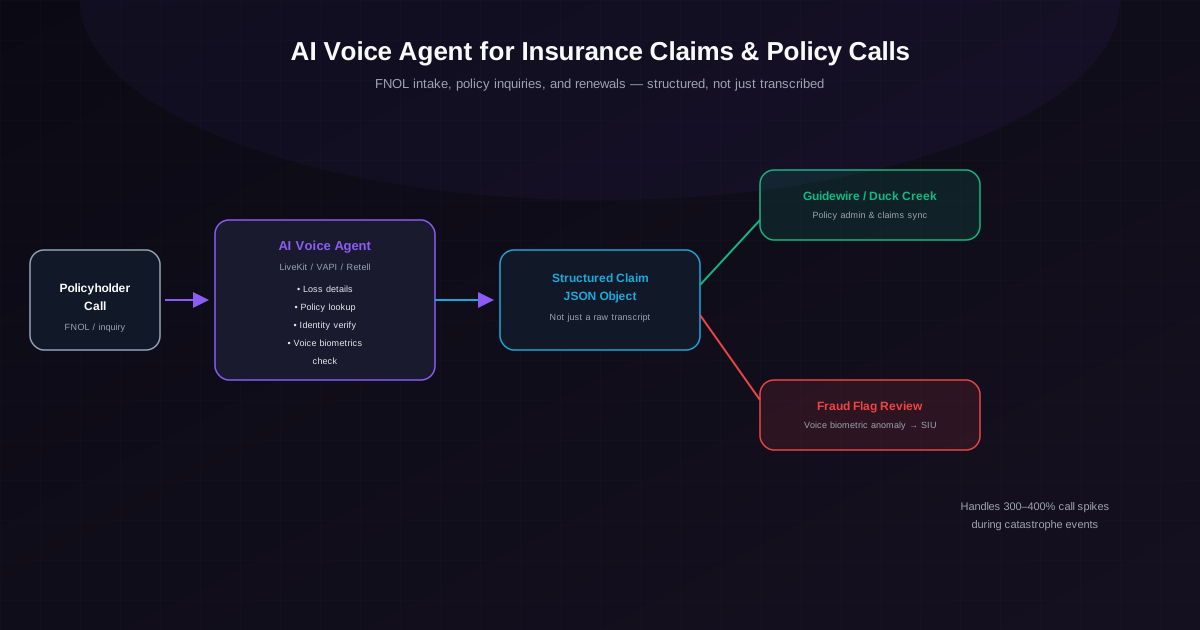
An AI voice agent for insurance handles First Notice of Loss (FNOL) intake, claims status updates, policy inquiries and quoting, renewal and retention outreach, and identity verification — extracting structured data from the call into a claims or policy admin system rather than just producing a raw transcript.
What is FNOL automation with voice AI?
FNOL automation uses a voice AI agent to answer the first call after an incident, walk the caller through structured questions, and output a structured claim object that syncs directly into a claims management system, including during the volume spikes that follow catastrophe events.
AI Voice Agents for Insurance: Claims Intake, FNOL & Policy Support
Insurance call centers spike 300–400% above baseline during catastrophe events — exactly when policyholders need a fast, calm first response and when human staffing is least able to keep up. A voice AI agent built for FNOL, policy inquiries, and renewals absorbs that spike without proportional headcount.
This isn't generic chatbot territory — a production insurance voice agent needs to extract structured claim data (not just a transcript), verify identity, flag fraud risk signals, and sync directly into Guidewire, Duck Creek, or whatever policy admin system your carrier runs on.
This guide covers the core use cases, a working FNOL agent architecture with runnable extraction code, the TCPA/HIPAA compliance layers that apply, fraud detection via voice biometrics, and a platform comparison for insurance-specific requirements.
300–400%
Call spike during catastrophes
24/7
FNOL intake availability
400K
Insurance workers leaving by 2026
$20K–$80K
Build cost range
Quick Answer
An AI voice agent for insurance handles First Notice of Loss (FNOL) intake, claims status updates, policy inquiries and quoting, renewal/retention outreach, and identity verification by phone — extracting structured claim and policy data from the conversation rather than producing a raw transcript, then syncing that data directly into a claims or policy admin system like Guidewire or Duck Creek. The highest-value deployment pattern is FNOL automation, because it directly addresses insurance's two hardest operational problems at once: catastrophe-driven call spikes of 300–400% above baseline, and a shrinking claims-adjuster workforce.
Why Insurance Needs Voice AI Now
Two structural pressures are converging on insurance call centers at the same time, and neither is solvable by simply hiring more staff:
- Catastrophe-driven volume spikes — insurance call centers see 300-400% higher call volumes during natural disasters, with average wait times reaching 45+ minutes during peak crisis periods, exactly when policyholders are most stressed and least tolerant of a bad experience.
- Workforce attrition — industry projections suggest roughly 400,000 insurance workers will leave the industry by 2026, much of that concentrated in experienced claims-adjuster and call-center roles that take months to backfill and train.
- Rising customer expectations for instant response, set by every other industry's AI-driven customer service, mean a policyholder waiting on hold during a loss event increasingly perceives that wait as a carrier failure, not a staffing reality.
A voice AI agent doesn't need to replace adjusters — it needs to absorb the intake and triage layer so human adjusters spend their time on judgment calls, not data collection.
Catastrophe Response: Surge Capacity Without Seasonal Staffing
The traditional answer to catastrophe-driven call spikes has been seasonal contract staffing — hiring and training temporary intake agents ahead of hurricane season, then laying them off a few months later. This is expensive, slow to scale (a new hire can take 2-3 weeks to reach full productivity on claims intake scripts), and structurally mismatched to how disasters actually happen, since a wildfire or flood event doesn't wait for your staffing plan to catch up.
A voice AI agent scales differently: capacity isn't bounded by how many people you can hire and onboard in a week, it's bounded by API/infrastructure throughput, which scales near-instantly. In practice this means:
- 24/7 availability from day one of an event, with no shift-scheduling gap during the first critical night when call volume is highest.
- Consistent intake quality across the entire surge — no fatigue-driven data-quality drop-off that happens when human agents work back-to-back extended shifts during a crisis.
- Immediate triage — injury or total-loss signals get escalated to a human adjuster in minutes, not after a multi-hour hold queue that catastrophe events routinely produce.
- Multi-language coverage without proportionally scaling bilingual staff — a common gap in catastrophe response for regions with significant non-English-speaking policyholder populations.
This doesn't replace the adjuster workforce — it changes what they spend their first 48 hours after an event doing. Instead of taking intake calls, they're working the escalated, high-severity queue the AI agent has already triaged and pre-filled with structured loss data.
Core Use Cases
FNOL (First Notice of Loss) Intake
Structured incident capture — what happened, when, where, injuries, other parties — output as a claim-ready object.
Claims Status Updates
Policyholders check claim status by phone without waiting for an adjuster callback.
Policy Inquiry & Quoting
Answers coverage questions, retrieves policy details, and can walk through basic quote scenarios.
Renewal & Retention Calls
Outbound calls ahead of renewal dates, TCPA-compliant pacing and consent handling.
Identity Verification
Voice biometric matching against the policyholder on file before releasing sensitive claim details.
Fraud Risk Flagging
Voiceprint mismatch or synthetic-voice signals route the claim to SIU for human review.
FNOL Voice Agent Architecture
An FNOL agent that just transcribes the call and hands the transcript to an adjuster hasn't actually automated anything — the value is in structured extraction at call time:
- Identity & policy lookup — caller ID or verbal policy number resolves the caller against the policy admin system before proceeding.
- Guided loss narrative — structured prompts capture incident type, date/time, location, injuries, other parties, and police report status without a rigid script feeling like an interrogation.
- Real-time structured extraction — the LLM layer extracts fields into a claim object (not just a transcript) as the conversation progresses, so a partial claim exists even if the call is dropped.
- Severity triage — injury mentions or high-value loss indicators automatically flag the claim for immediate human escalation rather than staying in the automated queue.
- Claim system sync — the structured object posts to Guidewire ClaimCenter, Duck Creek Claims, or the carrier's claims system via API the moment the call ends, appearing in the adjuster's queue with zero re-entry.
Structured Claim Extraction (Python)
A minimal structured-extraction pattern that runs incrementally during the call, not as a post-call summarization step:
from pydantic import BaseModel
from typing import Literal, Optional

class FnolClaim(BaseModel):
    policy_number: Optional[str] = None
    loss_type: Optional[Literal["auto", "property", "liability", "other"]] = None
    loss_date: Optional[str] = None
    loss_location: Optional[str] = None
    injuries_reported: bool = False
    other_parties_involved: bool = False
    police_report_filed: Optional[bool] = None
    narrative_summary: Optional[str] = None
    severity_flag: Literal["standard", "escalate_immediately"] = "standard"

async def extract_claim_fields(transcript_so_far: str, current: FnolClaim) -> FnolClaim:
    """Called after each caller turn — incrementally fills the claim object."""
    extraction = await llm_client.extract(
        schema=FnolClaim,
        prompt=f"Update the claim record from this call transcript. "
               f"Only fill fields explicitly stated by the caller:\n{transcript_so_far}",
        existing=current,
    )
    if extraction.injuries_reported or extraction.other_parties_involved:
        extraction.severity_flag = "escalate_immediately"
    return extraction

async def sync_to_claims_system(claim: FnolClaim, call_id: str) -> str:
    """Posts the structured claim to the policy admin / claims system."""
    response = await guidewire_client.claims.create(
        policy_number=claim.policy_number,
        loss_type=claim.loss_type,
        loss_date=claim.loss_date,
        narrative=claim.narrative_summary,
        source="ai_voice_agent",
        source_call_id=call_id,
        priority="urgent" if claim.severity_flag == "escalate_immediately" else "standard",
    )
    return response.claim_id
Compliance Considerations
- TCPA — outbound renewal, retention, and follow-up calls need the same consent, calling-window, and abandonment-rate handling as any outbound automated calling campaign. See our TCPA compliance guide for the dial-time compliance gate pattern.
- HIPAA — health and life insurance calls that touch health-related claim details (injury specifics, medical treatment) can trigger HIPAA obligations if PHI is processed; property & casualty claims typically don't unless injury details are involved. See our HIPAA-compliant voice AI guide for the BAA and encryption requirements this adds.
- State insurance regulations — many states have specific rules on claims-handling timelines and required disclosures during a claims call that an automated agent's script needs to encode explicitly, not assume.
- Call recording consent — two-party consent states require disclosure that the call may be recorded before substantive conversation begins, standard practice but easy to omit in a fast-shipped agent script.
Fraud Detection & Voice Biometrics
Insurance fraud detection is one of the strongest ROI cases for adding voice AI to a claims pipeline, because the same call that captures the FNOL narrative can simultaneously run risk signals a human intake agent wouldn't catch in real time:
- Voiceprint matching — comparing the caller's voice against a previously enrolled policyholder voiceprint flags a mismatch for identity-related fraud review.
- Synthetic/deepfake voice detection — acoustic artifacts consistent with an AI-cloned voice route the call to SIU rather than blocking it outright, since these are risk signals, not proof.
- Narrative consistency scoring — inconsistencies between the stated timeline and other data points (location pings, weather data for the claimed loss date) can be surfaced for adjuster review.
- Pattern matching across prior claims — repeat callers, claim clustering, or narrative similarity to known fraud patterns can be flagged programmatically at intake time, not after adjuster review weeks later.
See our voice biometrics & deepfake detection guide for the enrollment and liveness-detection architecture behind this.
Platform Fit for Insurance Voice AI
| Platform | Insurance Fit | Notes |
|---|---|---|
| Retell AI | Strong for inbound FNOL/policy inquiries | HIPAA-ready via self-service BAA if health-adjacent |
| VAPI | Strong for engineering teams needing custom extraction logic | Best when you need fine control over the structured-extraction prompt chain |
| Bland AI | Best for high-volume outbound renewal campaigns | Built for enterprise outbound at scale, strong CRM integrations |
| LiveKit (self-hosted) | Best for carriers needing full data residency/control | Highest control, longer build timeline |
For the full head-to-head, see our VAPI vs Retell vs LiveKit vs Bland AI comparison, and for how to evaluate an implementation partner rather than just the platform, see our voice AI development partner guide.
Policy Admin & Claims System Integration
| System | Integration Method | What Syncs |
|---|---|---|
| Guidewire ClaimCenter | REST API | New claims, status updates, notes from the call |
| Guidewire PolicyCenter | REST API | Policy lookups, coverage detail retrieval |
| Duck Creek Claims | SOAP/REST API | FNOL claim creation, document attachment |
| CRM (Salesforce/HubSpot) | Webhook / native connector | Call logs, renewal outreach outcomes |
Cost & ROI
- Single-workflow build (FNOL only, or policy inquiry only) — $20,000–$35,000, 6–9 weeks.
- Multi-workflow deployment (FNOL + renewals + fraud flagging + policy admin integration) — $40,000–$80,000, 10–14 weeks.
- ROI driver: absorbing catastrophe-event call spikes without seasonal contract staffing, plus consistent structured data reducing adjuster data-entry time per claim.
- Ongoing cost scales with call minutes/API usage — typically far below the fully-loaded cost of proportional human intake staffing at catastrophe-event volumes.
- Data-entry time reduction is the easiest ROI line item to measure directly — an adjuster manually re-keying a phoned-in FNOL from notes or a recording typically spends 8-15 minutes per claim on data entry alone; a structured-extraction agent delivers that same claim pre-filled, cutting adjuster intake time to review-and-confirm rather than transcribe-and-enter.
- The harder-to-quantify but often larger ROI driver is what doesn't happen: catastrophe events with a fast, calm first response measurably reduce complaint volume to state insurance regulators and improve retention at the next renewal cycle, both of which are easier to track over a full policy year than in a single-quarter ROI model.
Frequently Asked Questions
What can an AI voice agent do for an insurance company?
Handles FNOL intake, claims status, policy inquiries, renewals, and identity verification — extracting structured claim data into a policy admin system rather than just producing a raw transcript for someone else to re-key later.
What is FNOL automation with voice AI?
A voice agent answers the first call after a loss, walks the caller through a guided narrative, captures structured incident details as the conversation happens, and syncs a claim-ready object directly into the claims system the moment the call ends.
How does voice AI help during catastrophe-driven call spikes?
It absorbs 300-400% volume spikes without proportional headcount, running 24/7 FNOL intake and triage while flagging urgent claims for human follow-up.
Is TCPA compliance required for outbound insurance voice AI calls?
Yes — renewal, retention, and follow-up calls need the same TCPA consent, calling-window, and abandonment-rate handling as any outbound campaign.
Does insurance voice AI need to be HIPAA-compliant?
Health/life insurance calls touching PHI generally do; P&C claims typically don't unless injury details are involved.
How does voice AI help detect insurance fraud?
Voice biometric mismatches and synthetic-voice signals flag claims for SIU review as risk signals, not proof of fraud.
Can insurance voice AI integrate with Guidewire or Duck Creek?
Yes, via REST/SOAP APIs, so a claim opened by phone appears in the adjuster's queue with zero manual re-entry.
How much does it cost to build?
$20,000–$35,000 for a single workflow (6–9 weeks); $40,000–$80,000 for a multi-workflow deployment (10–14 weeks).
How does it avoid replacing seasonal staffing with something worse?
Capacity scales near-instantly with infrastructure rather than hiring/training timelines, giving 24/7 availability and consistent quality from hour one of a catastrophe event.
Can it support multiple languages?
Yes — most platforms support multilingual STT/TTS pairs, covering languages like Spanish without proportionally scaling bilingual human staff.
Related Reading
Building a Voice AI Agent for Insurance?
CelloIP engineers build FNOL, policy inquiry, and renewal voice agents with structured claims-system integration.