AI Calling Laws by Country: US, UK, EU, India, UAE and More
An AI voice agent that calls customers is subject to the same rules as any automated or telemarketing call, and in some places to new AI-specific rules too. Those rules differ by country, and getting them wrong is expensive. This guide summarises what applies in seven major markets and how to build the checks into your calling system.
Quick answer
What laws apply to AI voice agent calls?
Most countries regulate AI-voiced calls through their existing rules for automated, prerecorded or telemarketing calls, with a growing number adding AI-specific disclosure duties. In the US, the FCC confirmed in February 2024 that AI-generated voices count as artificial voices under the TCPA, so consent rules apply. The UK's PECR requires prior consent for automated marketing calls. In the EU, Article 50 of the AI Act requires telling people they are interacting with an AI system from 2 August 2026, alongside national ePrivacy rules. India separates promotional (140 series) and service calls (1600 series for regulated financial firms) under TRAI rules, and the UAE limits telemarketing to 9 am–6 pm from registered numbers. This is a summary, not legal advice.
What the rules usually cover
Not legal advice. This is a planning summary of public sources as of November 2026. Rules change, and the details depend on your industry and your calls. Confirm your approach with a lawyer qualified in each country you call.
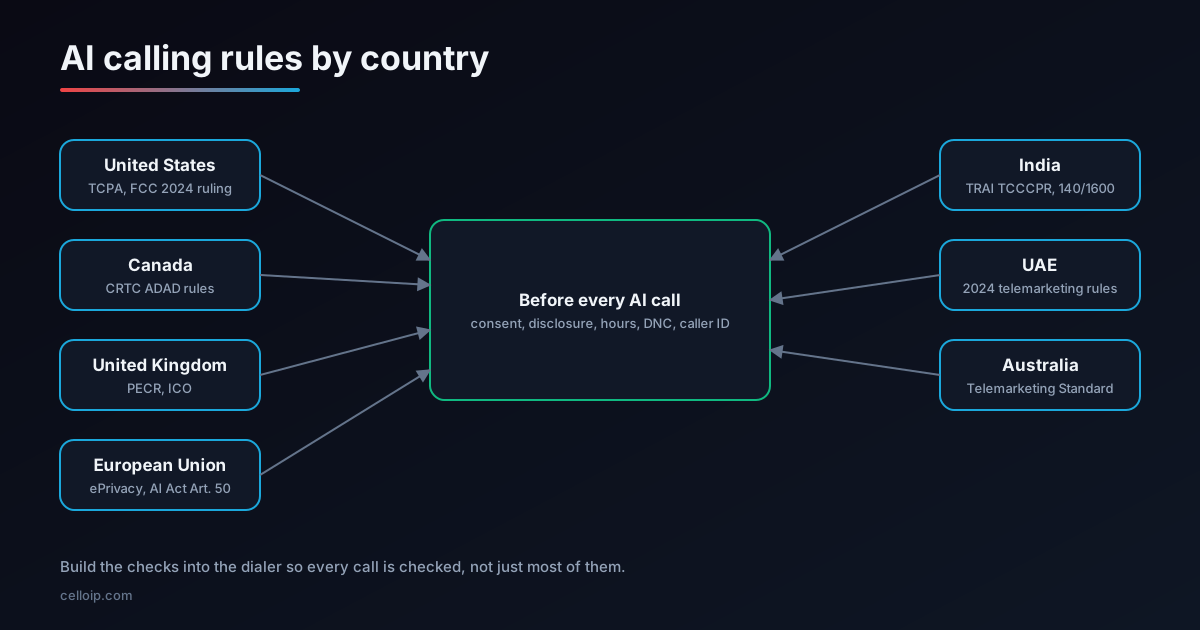
Almost every country's rules for automated and telemarketing calls come down to the same questions. Answer them for each country before an AI agent dials anyone there.
Consent
Has the person agreed to receive this kind of call, and can you prove it? Marketing calls usually need more than service calls.
Disclosure
Does the call say who is calling, and that the caller is an AI? Is there an easy way to reach a person or opt out?
Calling hours
Is it within permitted hours in the recipient's time zone, not yours?
Do-not-call registers
Has the number been checked against the national register and your own opt-out list?
Caller ID and numbers
Is the call from a registered, recognisable number of the right type?
Recording and data
Are recordings and transcripts handled under local recording and data protection rules?
One distinction runs through all of them: inbound calls customers make to your AI receptionist are far less regulated than outbound calls your AI makes to them, and marketing calls are regulated more strictly than service calls about an existing account or order.
Country summary
| Country or region | Main rules | Key points for AI calls |
|---|---|---|
| United States | TCPA, FCC rules, state laws | AI voices are 'artificial' voices (FCC, Feb 2024); prior express written consent for telemarketing; National DNC Registry; state rules on hours and disclosure |
| Canada | CRTC Unsolicited Telecommunications Rules | Automated (ADAD) solicitation calls need prior express consent; National DNCL; AI definition under review |
| United Kingdom | PECR, enforced by the ICO | Automated marketing calls need specific prior consent, even to numbers not on TPS; higher fines under the 2025 Data (Use and Access) Act |
| European Union | ePrivacy rules, GDPR, AI Act | Automated calling systems need prior consent for marketing; AI Act Article 50 disclosure from 2 Aug 2026 |
| India | TRAI TCCCPR | 140 series for promotional calls (DND applies); 1600 series for service and transactional calls from regulated financial entities |
| UAE | Cabinet Resolutions 56 and 57 of 2024 | Telemarketing 9 am–6 pm, from registered local numbers; respect the Do Not Call Registry |
| Australia | Telemarketing and Research Calls Industry Standard 2017, Do Not Call Register Act | Restricted calling hours; no telemarketing on Sundays; Do Not Call Register; identification rules |
United States
The Telephone Consumer Protection Act (TCPA) restricts calls using an "artificial or prerecorded voice". On 8 February 2024 the FCC issued a unanimous declaratory ruling confirming that AI-generated voices fall within that term. That didn't ban AI calls; it means they follow the same consent rules as prerecorded calls.
- Telemarketing calls using an artificial or AI voice need prior express written consent.
- Informational calls, such as appointment reminders, generally need prior express consent; calls to mobile numbers have stricter rules.
- Scrub against the National Do Not Call Registry and your internal opt-out list.
- Respect calling hours (the federal rule is 8 am–9 pm in the recipient's time zone) and stricter state rules.
- Several states have their own telemarketing ('mini-TCPA') and AI or bot disclosure laws.
An FCC rule requiring "one-to-one" consent for each seller was vacated by the Eleventh Circuit in January 2025, so it does not apply. Our TCPA rules for AI outbound calls guide covers the US in depth, and our USA AI voice agent page covers local telephony.
Canada
Canada's Unsolicited Telecommunications Rules, enforced by the CRTC, cover telemarketing and automatic dialing-announcing devices (ADADs). Telemarketers may use an ADAD for solicitation calls only with the consumer's prior express consent, and must respect the National Do Not Call List.
The existing ADAD definition predates modern AI, and the CRTC opened a consultation in 2026 on modernising the rules, including how they apply to AI and synthesised voices. Until it concludes, the cautious reading is to treat AI-voiced outbound solicitation calls as ADAD calls that need prior express consent.
United Kingdom
The Privacy and Electronic Communications Regulations (PECR), enforced by the Information Commissioner's Office (ICO), treat automated marketing calls separately from live calls.
- Automated marketing calls need prior consent specifically for automated calls; general marketing consent isn't enough.
- This applies whether or not the number is registered with the Telephone Preference Service (TPS).
- Live marketing calls must screen against TPS and your own opt-out list.
- The Data (Use and Access) Act 2025 raised the maximum PECR fines to GDPR levels: up to £17.5 million or 4% of global turnover.
- The ICO actively fines companies for unsolicited automated calls.
Service calls about an existing account are generally not marketing, but adding offers to them can change that. See our UK AI voice agent page for telephony and hosting details.
European Union
In the EU, two layers apply. The ePrivacy rules, implemented in each member state's law, require prior consent for marketing through automated calling systems without human intervention, alongside GDPR for any personal data. On top of that, the EU AI Act adds an AI-specific duty.
| Rule | What it requires | From |
|---|---|---|
| ePrivacy (national laws) | Prior consent for automated marketing calls; national do-not-call schemes vary by country | In force |
| GDPR | A lawful basis for processing call data, transparency, retention limits and data subject rights | In force |
| AI Act, Article 50(1) | People must be informed they are interacting with an AI system, unless it is obvious from the context | 2 August 2026 |
Fines for breaching Article 50 can reach €15 million or 3% of worldwide annual turnover. The simplest compliance step for voice agents is a clear disclosure at the start of each call, for example "I'm an AI assistant for…", with an easy path to a person.
India
India regulates commercial calls through TRAI's Telecom Commercial Communications Customer Preference Regulations (TCCCPR), amended in 2025 to separate promotional and service traffic by number series.
| Number series | Used for | Blocking |
|---|---|---|
| 140xx | Promotional calls by entities in any sector | Customers can block them through do-not-disturb (DND) preferences |
| 1600xx | Service and transactional calls by banks, insurers and other regulated financial entities, and government communication | TRAI has said they may not be blocked or filtered |
- Register as required and use the correct number series for the type of call.
- Respect DND preferences for promotional calls.
- Regulated financial entities were required to move service calls to 1600 numbers, with banks onboarding by January 2026.
- Personal data handling falls under the Digital Personal Data Protection Act.
Our AI calling agents for India page and Hindi and regional language voice AI guide cover Indian deployments in more depth.
United Arab Emirates
The UAE introduced new telemarketing regulations under Cabinet Resolutions 56 and 57 of 2024, in force since August 2024 and enforced with the TDRA and the Ministry of Economy.
- Telemarketing calls only between 9 am and 6 pm.
- Calls must come from local numbers registered under the company's commercial licence with a licensed telecom provider; personal numbers are not allowed.
- Do not call numbers on the Do Not Call Registry (DNCR).
- Limits apply to repeat calls to the same person; sources differ on the exact limits, so check the official text.
- Fines escalate for repeat violations; reported amounts vary between sources, so confirm them in the resolutions.
Our UAE AI voice agent and Arabic AI voice agent pages cover licensing, hosting and languages.
Australia
Australia regulates telemarketing through the Telecommunications (Telemarketing and Research Calls) Industry Standard 2017 and the Do Not Call Register Act, enforced by the ACMA.
- Calling hours are restricted, reported as 9 am–8 pm on weekdays and 9 am–5 pm on Saturdays, with no telemarketing calls on Sundays or national public holidays; confirm against the current standard.
- Hours apply in the recipient's time zone.
- Check numbers against the Do Not Call Register.
- Calls must identify the caller and allow caller ID.
- Rules for calls using recorded or synthetic voices should be checked in the current standard before launching AI outbound calls.
The same AI agent, different rules by call type
| Call type | Example | Typical regulatory weight |
|---|---|---|
| Inbound | A customer calls your AI receptionist | Lightest: disclosure, recording and data rules |
| Outbound service | Appointment reminder or delivery update to an existing customer | Moderate: consent or existing relationship, hours, caller ID |
| Outbound debt collection | Payment reminder on an existing account | Specific rules in many countries, often strict on hours and frequency |
| Outbound marketing | Offer to a prospect or existing customer | Heaviest: prior consent for automated calls, do-not-call registers, hours |
Keep these separate in your system. Adding a sales offer to a service call can turn it into a marketing call in the eyes of the regulator.
Recording and transcripts
AI agents record and transcribe calls by design, so recording rules matter even for inbound calls. In the US, some states require consent from everyone on the call rather than one party; in the UK and EU, recording must have a lawful basis, be explained to callers, and follow data protection rules on retention and access.
- Tell callers at the start that the call is recorded and transcribed, and why.
- Apply the strictest rule when callers may be in several states or countries.
- Set retention periods for audio and transcripts, and delete them on schedule.
- Limit who can access recordings, and log access.
Building the checks into your calling system
Compliance that depends on people remembering rules fails at scale. The reliable approach is a dial-time check that every outbound AI call must pass, using rules per country and per call type.
# Rules per country and call type; keep them in config, reviewed by your legal team
RULES = {
  "US": {"hours": ("08:00", "21:00"), "needs_consent": {"marketing": "written", "service": "express"}, "dnc": "us_national"},
  "GB": {"hours": ("08:00", "21:00"),  # no statutory hours in the UK: this is a company policy choice
         "needs_consent": {"marketing": "automated_specific", "service": None}, "dnc": "tps"},
  "AE": {"hours": ("09:00", "18:00"), "needs_consent": {"marketing": None, "service": None}, "dnc": "dncr"},
  # ... reviewed and updated whenever the rules change
}

def may_dial(call) -> tuple[bool, str]:
    rule = RULES.get(call.country)
    if rule is None:
        return False, "no rules configured for this country"
    if not within_hours(call.local_time, rule["hours"]):
        return False, "outside permitted hours in the recipient's time zone"
    needed = rule["needs_consent"].get(call.purpose)
    if needed and not has_consent(call.contact_id, needed):
        return False, f"missing {needed} consent"
    if on_dnc(call.number, rule["dnc"]) and call.purpose == "marketing":
        return False, "number is on the do-not-call register"
    return True, "ok"
Fail closed
If the rules for a country aren't configured, don't dial. Unknown means no.
Log every decision
Record why each call was allowed or blocked; it is your evidence if a complaint arrives.
Disclose at the start
Script the opening: who is calling, that it is an AI assistant, and how to reach a person or opt out.
Honour opt-outs instantly
If someone says 'stop calling', record it during the call and block future calls.
Launch checklist for AI outbound calling
- List the countries you will call and the purpose of each call type: marketing or service.
- Confirm consent requirements for each, and how you collect, store and prove consent.
- Script the AI disclosure and the route to a person or opt-out.
- Configure calling hours by the recipient's time zone, including public holidays where relevant.
- Connect do-not-call register checks and your own opt-out list.
- Use registered caller IDs of the right type in each country.
- Set recording notices, retention periods and access rules.
- Have a lawyer qualified in each country review the set-up before launch, and again when rules change.
For handling the calls themselves, see our guides to answering machine detection and AI debt collection voice agents, which covers collection-specific rules.
Frequently asked questions
Are AI voice agent calls legal?
Generally yes, when they follow the rules for automated or telemarketing calls in the country you call: consent where required, disclosure, calling hours, do-not-call registers and caller ID. Inbound calls that customers make to you are far less restricted than outbound calls you make to them.
Do we have to tell callers they are talking to an AI?
Increasingly, yes. The EU AI Act requires it for AI systems that interact with people from 2 August 2026, unless it is obvious. Several US states have their own AI or bot disclosure laws, and many businesses disclose by default because it builds trust. Disclose at the start of the call and offer a person.
Does the FCC's 2024 ruling ban AI calls in the US?
No. The February 2024 declaratory ruling confirmed that AI-generated voices are 'artificial' voices under the TCPA, so the existing consent rules apply. AI calls that need consent under the TCPA must have it, just like prerecorded calls.
What is the difference between India's 140 and 1600 number series?
Under TRAI's rules, 140-series numbers are for promotional calls, which people can block through the do-not-disturb registry. The 1600 series is for service and transactional calls from banks, insurers and other regulated financial entities, and government communication; TRAI has said 1600 calls can't be blocked by filtering.
Do inbound AI receptionists need consent?
Inbound calls are usually much less regulated than outbound ones, because the caller chose to call. You still need to follow recording and data protection rules, and disclosure rules where they apply, such as the EU AI Act.
Who is responsible if an AI platform makes non-compliant calls?
Usually the business on whose behalf the calls are made, and often the platform or dialer operator as well. Contracts with AI and calling vendors should cover compliance responsibilities, but they don't remove your own.
Is this legal advice?
No. This guide summarises public sources as of November 2026 to help you plan. Rules change and depend on your industry and the details of your calls, so confirm your approach with a lawyer qualified in each country you call.
Work with CelloIP
Building an AI calling system that stays within the rules?
CelloIP builds AI voice agents with dial-time compliance checks, AI disclosure, opt-out handling, calling-hour rules and the right number types for each country. Your legal team sets the rules; we build them into the system. You own the code.