How much does it cost to build a video calling app?
A video calling app MVP costs $30,000–$50,000 to build in 2026. A mid-range app with group calls, screen sharing, and recording costs $50,000–$120,000. A full Zoom-grade enterprise platform costs $120,000–$200,000 or more. Self-hosted WebRTC infrastructure adds $5,000–$15,000 in development cost but reduces ongoing infrastructure to $200–$400/month flat — saving 30–40% versus Agora ($3.99/1,000 HD minutes) after 9–15 months.
Is it cheaper to build with WebRTC or use Agora for a video calling app?
Agora is cheaper upfront (development cost $8,000–$25,000) but expensive at scale at $3.99 per 1,000 HD minutes. Custom WebRTC or self-hosted LiveKit costs more to develop ($30,000–$80,000) but has flat monthly infrastructure of $200–$600 regardless of call volume. The crossover point is 9–15 months of operation, after which custom WebRTC saves 30–40%.
How much does it cost to build an app like Zoom?
Building a Zoom-equivalent app with group conferencing for 100+ participants, recording, screen sharing, and enterprise features costs $120,000–$200,000+ in development and $500–$2,000/month in infrastructure. A simplified Zoom-like MVP costs $50,000–$90,000 and takes 5–7 months to build.
How Much Does It Cost to Build a Video Calling App in 2026?
Short answer: a video calling app MVP costs $30,000–$50,000. A full Zoom-grade conferencing platform costs $120,000–$200,000 or more. But the build cost is only half the picture — ongoing infrastructure is where most teams get surprised. Managed APIs like Agora charge $3.99 per 1,000 HD minutes. At scale, that bill can exceed your entire development cost every six months.
This guide breaks down exactly what drives cost at each tier, how the tech stack choices (WebRTC vs Agora vs LiveKit) affect your 5-year total cost of ownership, what each feature adds, and how to get a Zoom-quality product without Zoom's infrastructure budget. Based on 40+ real video calling app projects built by CelloIP Technologies.
$30k–$50k
MVP video calling app
$200k+
Zoom-grade enterprise app
30–40%
Savings: custom WebRTC vs Agora
3–5 mo
Typical MVP build time

Quick Answer: Video Calling App Cost Summary
A video calling application is a software platform that enables real-time audio and video communication between two or more users over the internet. The technology underpinning it is WebRTC (Web Real-Time Communication) — an open-source protocol used by Google Meet, WhatsApp, Discord, and virtually every modern video platform. Building one from scratch means combining a mobile or web client, a WebRTC media server (SFU) for group calls, a TURN relay server for NAT traversal, and a signalling backend.
MVP (1:1 calls, basic features)
$30,000–$50,000
Build time: 3–5 months
Mid-range (group calls, screen share)
$50,000–$120,000
Build time: 5–8 months
Full-featured (100+ users, AI, recording)
$80,000–$150,000
Build time: 8–12 months
Enterprise / Zoom-grade
$120,000–$200,000+
Build time: 12–18 months
Key insight: These costs cover design + engineering + backend deployment. Ongoing infrastructure (SFU, TURN, database, storage) adds $200–$600/month for a self-hosted setup serving up to 500 concurrent users — not the $3.99/1,000-minute fee that API vendors charge. The infrastructure model you choose has a bigger long-term cost impact than the app itself.
What Drives the Cost of a Video Calling App?
The five biggest cost drivers in video calling app development — in order of impact:
Call type: 1:1 vs group vs large-scale conference
A 1:1 video call uses WebRTC P2P — two devices connect directly with no server in the media path. This is technically simple and cheap. Group calls require a Selective Forwarding Unit (SFU) — a media server that receives everyone's streams and forwards the right ones to each participant. Adding SFU support (LiveKit, Mediasoup, Janus) adds $10,000–$40,000 depending on participant count and features like simulcast and adaptive bitrate.
Platform: iOS only, Android only, or cross-platform
Building two separate native apps (Swift for iOS, Kotlin for Android) costs 70–90% more than a single Flutter or React Native codebase that runs on both. CelloIP recommends Flutter for most video calling apps — it has official LiveKit and WebRTC SDKs, excellent performance, and a single codebase for iOS, Android, and Web. The cost difference on a $50,000 project can be $20,000–$35,000.
Infrastructure model: managed API vs self-hosted
Using Agora, Twilio, or LiveKit Cloud means lower development cost (no SFU ops) but ongoing per-minute fees. Self-hosting LiveKit or a custom WebRTC stack means higher upfront development ($5,000–$15,000 extra) but a flat monthly cost. For any app with more than ~1,000 active daily users, self-hosted infrastructure is always cheaper within 12 months.
Feature scope: what's in the app
Each major feature is a separate workstream. Screen sharing on mobile requires iOS ReplayKit and Android MediaProjection — 2–4 weeks. Call recording requires media server egress, S3 storage, and a playback UI — 3–5 weeks. Virtual backgrounds need on-device ML segmentation — 3–6 weeks. Push notifications for incoming calls when the app is killed (PushKit on iOS, FCM high-priority on Android) are 1–3 weeks but required for any real-world VoIP app.
Compliance requirements: HIPAA, GDPR, SOC2
A standard consumer video app has no compliance overhead. A telemedicine platform requires HIPAA compliance — Business Associate Agreements, audit logs, encrypted data at rest, access controls, and session retention policies — adding $20,000–$40,000 to the project. GDPR adds 2–4 weeks of data handling, consent flows, and right-to-erasure implementation. SOC2 Type II readiness adds 3–6 months of process work on top of technical controls.
Video Calling App Cost by Tier
Every video calling project falls into one of four tiers. Here's what you get at each price point, the team size required, and the realistic timeline from design kick-off to App Store submission.
MVP / Basic
$30,000–$50,000
Timeline
3–5 months
Includes: 1:1 video calls, audio calls, basic chat, push notifications, iOS + Android
Team: 2 engineers + 1 designer
Mid-Range / Startup
$50,000–$120,000
Timeline
5–8 months
Includes: Group calls (up to 16), screen sharing, recording, file sharing, admin dashboard
Team: 3–4 engineers + designer + QA
Full-Featured / Scale
$80,000–$150,000
Timeline
8–12 months
Includes: 100+ participants, virtual backgrounds, AI noise cancel, custom branding, analytics
Team: 4–6 engineers + designer + QA + DevOps
Enterprise / Zoom-Grade
$120,000–$200,000+
Timeline
12–18 months
Includes: SSO/SAML, AI meeting summaries, whiteboard, compliance (HIPAA/SOC2), SLA infrastructure
Team: 6–8+ engineers + PM + designer + QA + DevOps
Feature-by-Feature Cost Breakdown
Use this table to build your own cost estimate. Start with a base MVP ($30,000–$50,000) and add the cost of each feature your product requires. Features that touch mobile OS APIs (screen sharing, push notifications, virtual backgrounds) are consistently underestimated by teams that haven't built video apps before.
| Feature | Added Cost | Added Time | Notes |
|---|---|---|---|
| 1:1 video calling (P2P WebRTC) | Included in base | — | Foundation of every tier |
| Group video (SFU, up to 8) | +$10,000–$20,000 | +3–5 wks | Adds SFU (LiveKit/Mediasoup) |
| Group video (100+ participants) | +$20,000–$40,000 | +5–8 wks | Simulcast, adaptive bitrate |
| Screen sharing (mobile) | +$8,000–$15,000 | +2–4 wks | iOS ReplayKit, Android MediaProjection |
| Call recording + cloud storage | +$10,000–$20,000 | +3–5 wks | Egress + S3/GCS + playback UI |
| Push notifications (PushKit/FCM) | +$5,000–$10,000 | +1–3 wks | Incoming call when app is killed |
| Virtual backgrounds (AI) | +$12,000–$25,000 | +3–6 wks | On-device ML segmentation |
| End-to-end encryption | +$8,000–$18,000 | +2–4 wks | Beyond DTLS-SRTP; key mgmt |
| AI noise cancellation | +$5,000–$12,000 | +2–3 wks | WebRTC insertable streams |
| Live transcription / captions | +$10,000–$20,000 | +2–4 wks | ASR integration (Whisper/Deepgram) |
| Admin dashboard + analytics | +$8,000–$15,000 | +2–3 wks | Web only, React/Next.js |
| HIPAA compliance (telemedicine) | +$20,000–$40,000 | +4–8 wks | BAA, audit logs, data handling |
Tech Stack Comparison: WebRTC vs Agora vs LiveKit
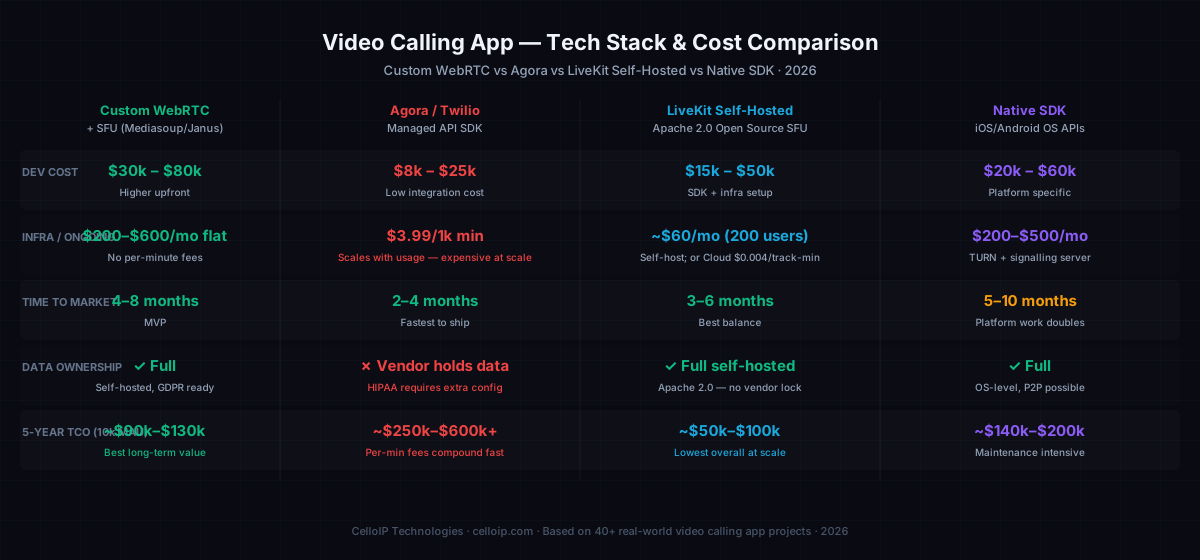
The single most consequential decision in video app development is the infrastructure model. This choice determines not just your build cost but your cost structure for the next 3–5 years. Here are the five main options, with honest cost and trade-off analysis:
Custom WebRTC + SFU (Mediasoup / Janus)
Build your own WebRTC stack with a self-hosted SFU (Selective Forwarding Unit). Mediasoup and Janus are the two leading open-source SFUs for custom deployments. Development cost is higher ($30,000–$80,000) because you own the SFU configuration, TURN setup, and scaling logic. But ongoing infrastructure is a flat $200–$600/month regardless of usage. Best for platforms expecting rapid user growth where per-minute fees would compound aggressively.
Agora / Twilio Video / ZEGOCLOUD (Managed API)
Managed video APIs are the fastest path to a working video app. Agora charges $3.99 per 1,000 HD minutes. Twilio Video charges similarly. Integration is straightforward — a few SDK calls and you have working video in days. This model is economical for low-usage MVPs (under 50,000 monthly minutes). Beyond that, the bill compounds: at 1 million monthly minutes that's $3,990/month in API fees, every month, growing linearly with usage. Also: Agora routes media through its own global network — you do not own the infrastructure or the data path.
LiveKit Self-Hosted (Recommended for most projects)
LiveKit is an Apache 2.0 open-source WebRTC SFU with official Flutter, React Native, iOS, Android, and Web SDKs. Self-hosting on a single $60/month AWS EC2 t3.xlarge handles approximately 200 concurrent users. Self-hosted LiveKit gives you: no per-minute fees, full data sovereignty, and 30–50% lower infrastructure cost versus Agora. The development cost is $15,000–$50,000 depending on features — significantly less than raw WebRTC because LiveKit's SDKs handle the peer connection management, ICE, and codec negotiation. CelloIP recommends LiveKit self-hosted for any video app expecting meaningful user growth.
| Stack | Dev Cost | Monthly Infra | Time to MVP | Data Ownership | Best For |
|---|---|---|---|---|---|
| Custom WebRTC + SFU | $30k–$80k | $200–$600/mo | 4–8 mo | ✓ Full | Best long-term |
| Agora / Twilio SDK | $8k–$25k | $3.99/1k min | 2–4 mo | ✗ Vendor | Expensive at scale |
| LiveKit Self-Hosted | $15k–$50k | ~$60–200/mo | 3–6 mo | ✓ Full | Best balance |
| LiveKit Cloud | $10k–$35k | $0.004/track-min | 3–5 mo | Partial | Good for early stage |
| Native OS SDK (WebRTC lib) | $20k–$60k | $200–$500/mo | 5–10 mo | ✓ Full | Maximum control |
Ongoing Infrastructure Cost Breakdown
Once the app is built, the recurring infrastructure costs are what determine your unit economics. Here's the full server-side cost breakdown for a self-hosted setup serving 50–200 concurrent users — the typical range for an early-stage video platform:
| Component | Recommended Instance | Monthly Cost |
|---|---|---|
| SFU Server (LiveKit, 200 CCU) | AWS t3.xlarge | ~$60–80/mo |
| TURN/STUN (coturn) | VPS 4 vCPU / 8 GB | ~$20–40/mo |
| Signalling + API Server | AWS t3.medium | ~$30–50/mo |
| Recording Storage (S3) | Per GB: ~$0.023 | ~$20–100/mo |
| CDN for playback | Per TB egress | ~$20–80/mo |
| Database (PostgreSQL) | RDS t3.small or managed | ~$25–60/mo |
| Total (50–200 CCU) | — | $175–$430/mo |
These costs are largely flat as long as you stay within the server's capacity. Scale beyond 200 CCU by adding more SFU nodes — typically $60–$80/month each. This is fundamentally different from the Agora model, where cost scales linearly with every additional minute of usage.
The Real Math: Agora vs WebRTC vs LiveKit at Scale
Let's run the numbers for three realistic usage scenarios. Assume a video calling app with users averaging 45 minutes of video per month:
1,000 MAU · 45 min/user/mo = 45,000 min/mo
Agora monthly cost
$179/mo
LiveKit self-hosted
$175/mo (self-hosted flat)
Savings
Similar — use Agora/LiveKit Cloud for simplicity at this scale
Verdict: Agora / LiveKit Cloud wins (simpler, similar cost)
10,000 MAU · 45 min/user/mo = 450,000 min/mo
Agora monthly cost
$1,796/mo
LiveKit self-hosted
$200–$350/mo (1–2 SFU nodes)
Savings
80% cheaper self-hosted · saves ~$17,952/year
Verdict: Self-hosted LiveKit wins clearly
100,000 MAU · 45 min/user/mo = 4.5M min/mo
Agora monthly cost
$17,955/mo
LiveKit self-hosted
$400–$800/mo (4–6 SFU nodes)
Savings
95% cheaper self-hosted · saves ~$200,000/year
Verdict: Self-hosted — Agora is unsustainable
CelloIP's recommendation: Start with LiveKit Cloud for the first 6 months (lowest ops overhead, easy to validate product-market fit). Once you exceed 5,000 MAU, migrate to self-hosted LiveKit — we typically complete that migration in 2–3 weeks and the savings pay for it within the first month.
Realistic Build Timeline for Each Tier
The most common mistake teams make is underestimating time for mobile-specific complexity: handling incoming calls when the app is killed (PushKit/FCM), background mode audio, and screen sharing via OS APIs. These always take 2–4x longer than expected if the team hasn't done it before.
Discovery & Design
3–4 weeksUX wireframes, call flow design, architecture decision, infrastructure planning
Core calling (1:1 P2P)
4–6 weeksWebRTC peer connection, camera/mic management, ICE/TURN, basic call UI
Signalling server
2–3 weeksRoom management, offer/answer exchange, user presence, WebSocket server
Push notifications
2–4 weeksPushKit (iOS VoIP), FCM high-priority (Android), CallKit integration for native incoming call UI
Group calling (SFU)
4–8 weeksLiveKit/Mediasoup integration, participant management, bandwidth adaptation
Screen sharing
2–4 weeksiOS ReplayKit broadcast extension, Android MediaProjection service
Recording
3–5 weeksSFU-side egress recording, S3/GCS storage, playback UI
QA, store submission
2–4 weeksDevice testing, crash logging, App Store + Play Store review cycle
How Much Does It Cost to Build an App Like Zoom?
"Build us something like Zoom" is the most common brief CelloIP receives for video conferencing projects. Here's what Zoom actually has under the hood — and the realistic cost to replicate each layer:
Group video (100+ participants)
$30k–$50kSFU with simulcast + bandwidth adaptation
Screen sharing + annotation
$12k–$20kiOS/Android/Web + cursor sync
Cloud recording + playback
$10k–$20kSFU egress + S3 + transcript
Virtual backgrounds
$12k–$25kOn-device ML segmentation
AI meeting summary
$15k–$30kASR (Whisper) + LLM summary pipeline
Whiteboard
$15k–$25kReal-time collaborative canvas (Y.js/CRDT)
Enterprise SSO / SAML
$10k–$18kOkta/Azure AD integration
Admin dashboard + analytics
$10k–$15kWeb app, usage reporting
Total for Zoom-equivalent: $120,000–$200,000+ development cost · 12–18 months · team of 6–8 engineers. Realistic MVP of Zoom core features (group video + screen share + recording): $50,000–$80,000 · 5–7 months.
Warning on white-label Zoom clones: Several vendors sell "Zoom clone scripts" for $500–$5,000. These are typically based on Jitsi or Agora with a reskinned UI. They have no source code ownership, hidden per-minute costs, and cannot be customised beyond the surface. If you need a video platform you control, you need a custom build — not a reskin.
Frequently Asked Questions
How much does it cost to build a video calling app?
A video calling app MVP costs $30,000–$50,000. A mid-range app with group calls and screen sharing costs $50,000–$120,000. A full Zoom-grade enterprise platform costs $120,000–$200,000 or more. These figures cover design, engineering, backend, and initial deployment — not ongoing monthly infrastructure, which runs $200–$600/month for self-hosted setups.
Is it cheaper to use WebRTC or Agora?
Agora is cheaper upfront — integration cost is $8,000–$25,000 vs $30,000–$80,000 for custom WebRTC. But Agora charges $3.99 per 1,000 HD minutes. At 100,000 MAU averaging 60 minutes/month, that's ~$24,000/month vs $200–$400/month for self-hosted WebRTC. Custom WebRTC crosses the break-even point in 9–15 months and saves 30–40% over a 2–5 year horizon.
How much does it cost to build an app like Zoom?
A Zoom-equivalent app — group conferencing for 100+ participants, recording, screen sharing, virtual backgrounds, AI summaries, and enterprise SSO — costs $120,000–$200,000+ to develop and $500–$2,000/month to operate. A simplified Zoom-like MVP with group video and basic meeting controls can be built for $50,000–$90,000 in 5–7 months.
How long does it take to build a video calling app?
A basic 1:1 video calling MVP takes 3–5 months. A mid-range group calling app takes 5–8 months. A full enterprise conferencing platform takes 10–18 months. These assume a dedicated team of 2–6 engineers; part-time teams take 1.5–2x longer.
What is the cheapest way to build a video calling app?
The cheapest approach upfront is a Flutter app integrating Agora or LiveKit Cloud — development cost as low as $8,000–$25,000. For sustained usage, self-hosted LiveKit (Apache 2.0, free to deploy) with a Flutter/React Native frontend is cheapest long-term. LiveKit's official Flutter and React Native SDKs reduce integration effort significantly versus raw WebRTC.
Does LiveKit cost money?
LiveKit is Apache 2.0 open source — free to self-host with no per-minute fees. A $60/month AWS EC2 t3.xlarge handles approximately 200 concurrent users. LiveKit Cloud charges $0.004/audio track-minute and $0.006–$0.024/video track-minute — roughly $1.50–$2.00 per 1-hour 1:1 video call. CelloIP recommends self-hosted LiveKit for any app with >500 daily active users.
What tech stack do you need to build a video calling app?
The standard 2026 stack: Flutter or React Native (mobile client), LiveKit or Mediasoup (WebRTC SFU for group calls), Node.js or Go (API/signalling server), coturn (STUN/TURN for NAT traversal), Redis (session state), PostgreSQL (user/room data), and S3-compatible storage (recordings). For 1:1 only, a managed SDK removes the SFU and TURN complexity.
What adds the most cost to a video calling app?
The top cost drivers are: group call SFU (adds $10,000–$40,000 vs 1:1 P2P), call recording with cloud storage, screen sharing on mobile (iOS ReplayKit + Android MediaProjection), virtual backgrounds using on-device ML, HIPAA compliance (adds $20,000–$40,000 for telemedicine), and support for 100+ participants (simulcast + adaptive bitrate). Each major feature adds 3–8 weeks of engineering time.
Get an Accurate Quote for Your Video App
CelloIP Technologies has built 40+ video calling and conferencing platforms — from telemedicine MVPs to enterprise Zoom alternatives. We use Flutter and React Native with self-hosted LiveKit on every project. Tell us what you're building and we'll give you a detailed cost and timeline estimate within 48 hours — free, no commitment.
Fixed-Price MVP
Full 1:1 + group video MVP on Flutter + LiveKit. Delivered in 16 weeks. Flat price, no surprises.
Dedicated Video Team
Embed 2–4 senior WebRTC + mobile engineers in your team. No agency overhead.
Architecture Review
Review your current tech stack, cost model, and infra — identify savings before you build.