Can I connect an AI voice agent to my existing SIP trunk without switching carriers?
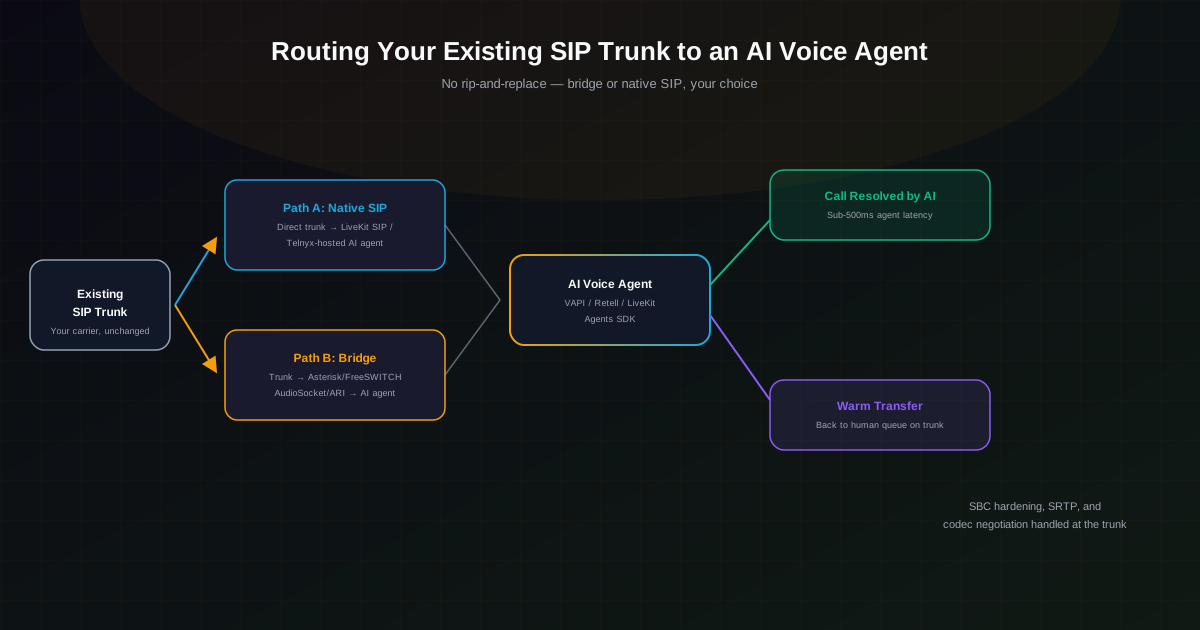
Yes — most AI voice agent platforms either support native SIP trunking or can be bridged in via Asterisk or FreeSWITCH sitting between your trunk and the AI agent. Neither approach requires switching SIP trunk providers or carriers.
What's the difference between native SIP support and a bridge architecture?
Native SIP support means the AI platform accepts a SIP INVITE directly, so your trunk routes straight to it. A bridge architecture puts Asterisk or FreeSWITCH between your trunk and the AI platform, using AudioSocket or ARI to stream audio to the agent — useful for custom call logic or multi-tenant routing.
SIP Trunk + AI Voice Agents: Route AI Through Your Existing PBX
You don't need to rip out your existing SIP trunk or PBX to add an AI voice agent. Every production deployment we've built routes AI agents through the telephony infrastructure that's already there — either natively, or bridged through Asterisk/FreeSWITCH.
This matters because most teams evaluating voice AI assume they need a greenfield telephony stack. They don't. Your carrier relationship, your numbers, and your existing PBX investment stay exactly where they are — only the call routing changes.
This guide covers native SIP support vs Asterisk/FreeSWITCH bridging, runnable inbound and outbound routing code, latency and codec considerations, failover to a human queue, and the SBC hardening an AI agent endpoint needs.
2 paths
Native SIP or Asterisk/FreeSWITCH bridge
20–60ms
Typical bridge latency overhead
$10K–$50K
Integration cost range
0 rip-outs
Existing trunk/carrier stays in place
Quick Answer
You can route an AI voice agent through your existing SIP trunk two ways: natively, if the AI platform (LiveKit SIP, and to varying degrees VAPI/Retell) accepts a direct SIP INVITE from your trunk, or bridged, by putting Asterisk or FreeSWITCH between your trunk and the AI agent using AudioSocket or ARI to stream the call audio. Neither path requires switching SIP trunk providers, porting numbers, or replacing your existing PBX — only the inbound (and outbound) routing rules change to point at the AI agent endpoint, with a health-checked failover to your existing human queue if the agent is unreachable.
Why Route Through Your Existing Trunk, Not Replace It
Teams new to voice AI often assume they need to migrate telephony providers to adopt an AI agent, because most platform marketing pages show a phone number provisioned directly from the AI vendor. In practice, that's the demo path, not the production path:
- Your existing carrier relationship, contract terms, and number inventory (including ported numbers with history) stay intact — no porting risk or downtime.
- Your existing PBX/CCaaS routing, IVR trees, and human-agent queues remain the fallback and coexist with the AI agent rather than being replaced wholesale.
- Compliance and call-recording infrastructure already built around your trunk (call recording, E911, CDR/billing systems) doesn't need to be rebuilt for a new provider.
- You can pilot the AI agent on a subset of call types or a single number, then expand — much lower risk than a full telephony migration to validate a new capability.
Native SIP vs Asterisk/FreeSWITCH Bridge
There are two architecturally distinct ways to connect your trunk to an AI agent:
- Native SIP — your SIP trunk's inbound routing points directly at the AI platform's SIP endpoint (e.g. LiveKit SIP). Simplest path, fewest moving parts, but you're limited to whatever call-control features the platform's native SIP layer supports (transfer, hold, DTMF handling).
- Asterisk/FreeSWITCH bridge — your trunk terminates on Asterisk or FreeSWITCH as it always has, and a dialplan/ARI application streams the call audio to the AI agent via AudioSocket (Asterisk) or an ESL-driven media bridge (FreeSWITCH). More moving parts, but full control over call routing, multi-tenant logic, and custom failover behavior.
For the deeper technical tradeoffs, see our OpenAI Realtime native SIP vs bridge comparison, Asterisk AudioSocket AI voice agent guide, and Pipecat + Asterisk/FreeSWITCH integration guide.
Platform SIP Support Comparison
| Platform | Native SIP? | Bridge Needed For |
|---|---|---|
| LiveKit SIP | Yes, native | Rarely — bridge only for legacy multi-tenant routing needs |
| VAPI | Yes, via SIP trunk config | Custom call-control features beyond VAPI's SIP feature set |
| Retell AI | Yes, via SIP trunk config | Advanced transfer/hold logic beyond native support |
| Bland AI | Partial — primarily outbound-focused | Inbound routing typically bridged for full control |
| Custom Pipecat/OpenAI Realtime stack | No — needs a bridge | Always — Asterisk/FreeSWITCH AudioSocket or ARI required |
Inbound Routing: Asterisk Dialplan to AI Agent
A realistic Asterisk dialplan snippet routing an inbound trunk call to an AI agent via AudioSocket, with a human-queue fallback:
; extensions.conf — inbound trunk call routed to AI agent via AudioSocket
; with fallback to the existing human support queue

[from-trunk-inbound]
exten => _X.,1,NoOp(Inbound call from SIP trunk: ${CALLERID(num)})
 same => n,Set(CALL_ID=${UNIQUEID})
 same => n,Set(AI_AGENT_HOST=127.0.0.1:8090)
 same => n,TrySystem(curl -sf --max-time 1 http://${AI_AGENT_HOST}/health)
 same => n,GotoIf($["${SYSTEMSTATUS}" = "SUCCESS"]?ai_agent:human_queue)

exten => _X.,n(ai_agent),NoOp(Routing to AI voice agent)
 same => n,Set(AUDIOSOCKET_ID=${CALL_ID})
 same => n,AudioSocket(${AUDIOSOCKET_ID},${AI_AGENT_HOST})
 same => n,Goto(post_ai_call,1)

exten => _X.,n(human_queue),NoOp(AI agent unavailable, routing to human queue)
 same => n,Queue(support-queue,t,,,300)
 same => n,Hangup()

[post_ai_call]
exten => 1,1,NoOp(AI agent signaled transfer request)
 same => n,GotoIf($["${AI_TRANSFER_REQUESTED}" = "1"]?transfer:end)
 same => n(transfer),Set(TRANSFER_CONTEXT=${AI_CALL_SUMMARY})
 same => n,Queue(support-queue,t,,,300)
 same => n(end),Hangup()
Outbound AI Agent Calls Through Your Existing Trunk
Outbound is architecturally the mirror image of inbound — the AI agent (or your dialer) originates a call that terminates on your trunk exactly like any other outbound call your PBX places today:
- The AI agent's outbound dialer originates via your trunk's outbound peer/gateway, so caller ID, outbound routing rules, and per-minute billing all flow through your existing carrier setup unchanged.
- TCPA compliance gating (consent, calling window, abandonment rate) should run before the call is originated, not after — see our TCPA compliance guide for the dial-time gate pattern.
- Answering machine detection (AMD) runs on the answered call before handing off to the AI agent's conversation logic, so voicemail doesn't waste an agent session — see our AMD guide for Asterisk AMD() and FreeSWITCH mod_avmd implementation.
One detail teams miss on the outbound side: your trunk's own outbound concurrent-call-channel limit still applies to AI-originated calls exactly as it does to human-agent calls. If your trunk is provisioned for 30 concurrent channels, an AI outbound campaign that tries to fire 60 simultaneous calls will simply fail to place half of them — the AI agent's own throughput has nothing to do with it. Pacing logic needs to respect the trunk's actual channel capacity, not just the AI platform's theoretical concurrency limit.
Latency & Codec Considerations
A bridge architecture adds a real but usually negligible latency cost, and codec mismatches are the more common source of noticeable quality issues:
- Bridge overhead — a well-configured Asterisk/FreeSWITCH bridge adds roughly 20-60ms versus native SIP, generally imperceptible against the AI agent's own 300-800ms response latency.
- Codec matching — matching your trunk's codec (commonly G.711 or G.722) end-to-end with the AI agent's expected input avoids per-packet transcoding, which is the more likely source of added latency and quality loss than the bridge itself.
- Opus for internal legs — where the AI agent supports Opus, using it on the internal (bridge-to-agent) leg while keeping G.711/G.722 on the external trunk leg often gives the best quality/latency balance.
- Jitter buffer tuning — an AI agent's turn-taking logic is sensitive to jitter; tuning the jitter buffer on the bridge leg tighter than a typical human-call configuration reduces perceived response lag.
Failover & Human Handoff Patterns
- Health-checked destination sets — Kamailio's ds_select_dst or an Asterisk dialplan health check routes to a human queue automatically if the AI agent endpoint fails to respond within a defined timeout.
- Mid-call escalation — the AI agent itself can trigger a transfer (via a tool call or explicit signal) when it detects it can't resolve the caller's request, rather than only failing over on outright unavailability.
- Warm transfer with context — SIP REFER or a bridged three-way call moves the caller to a human while a side channel (CRM note, call-summary API) passes context so the human doesn't start from zero.
- Graceful degradation — if the AI agent is degraded but not fully down (e.g. elevated latency), routing logic can prefer the human queue proactively rather than waiting for a hard failure.
SBC Security for an AI Agent Endpoint
An AI agent SIP endpoint should be folded into your existing SBC security policy, not treated as a special case:
- Trunk-level authentication (IP allowlisting or digest auth) between your SBC and the AI agent endpoint, matching the standard applied to your other internal SIP destinations.
- SRTP/DTLS-SRTP for the media stream on the bridge or native-SIP leg, especially where any PHI (see our HIPAA voice AI guide) or financial data may be discussed.
- Rate limiting and SIP-scanning protection at the SBC — an AI agent endpoint is a new destination, and worth confirming it inherits the same toll-fraud protections as your existing extensions.
- Static egress IP allowlisting where the AI platform publishes one, tightening the attack surface versus an open destination.
Testing the Integration Before Go-Live
A SIP trunk + AI agent integration has more failure surface than a typical API integration, because it spans two systems (telephony and AI) that are usually tested separately by different teams. A pre-launch checklist that's caught real issues in our own deployments:
- Load test the failover path deliberately — kill the AI agent endpoint mid-call-volume and confirm calls actually reach the human queue within the configured timeout, not just that the health check reports correctly in isolation.
- Test DTMF passthrough end-to-end — a common gap in bridge architectures is DTMF tones (for IVR menu selection before or after the AI agent) getting lost or garbled across the AudioSocket/ARI hop.
- Verify caller ID and any SIP headers your compliance logging depends on survive the bridge — some AudioSocket implementations strip headers that a native SIP leg would have preserved.
- Run a real call from an actual cell network, not just a softphone on the office WiFi — cellular jitter and packet loss patterns surface latency and dropped-audio issues that a clean office connection won't.
- Confirm warm transfer actually passes context — place a test call, let the AI agent trigger a transfer, and verify the human agent's screen shows the call summary before they pick up, not after.
None of this replaces a proper staged rollout — route a small percentage of inbound traffic to the new integration first, watch failure and escalation rates for a week, then expand, rather than cutting over 100% of trunk traffic on day one.
Cost & Timeline
- Native SIP integration with basic failover — $10,000–$20,000, 4–6 weeks.
- Asterisk/FreeSWITCH bridge with custom routing, warm transfer, and multi-tenant support — $25,000–$50,000, 8–12 weeks.
- Outbound dialer integration (TCPA gating + AMD + AI agent handoff) — $15,000–$30,000 additional, 6–8 weeks, often run in parallel with inbound work.
Frequently Asked Questions
Can I connect an AI voice agent to my existing SIP trunk without switching carriers?
Yes — via native SIP support or an Asterisk/FreeSWITCH bridge, neither of which requires switching trunk providers, porting numbers, or replacing your existing PBX investment.
What's the difference between native SIP and a bridge?
Native SIP means the AI platform accepts a direct SIP INVITE from your trunk, with the fewest moving parts. A bridge puts Asterisk/FreeSWITCH in between using AudioSocket or ARI, trading simplicity for full call-control flexibility.
Which platforms support native SIP trunking?
LiveKit SIP supports it natively out of the box; VAPI and Retell AI support it via SIP trunk configuration with varying feature depth; custom Pipecat or OpenAI Realtime stacks generally need a bridge instead.
Does bridging add noticeable latency?
Roughly 20-60ms of additional overhead, generally imperceptible against the AI agent's own 300-800ms response latency — mismatched codecs forcing transcoding are a more common source of quality loss than the bridge hop itself.
How do I handle failover if the AI agent is unreachable?
Health-checked destination sets (Kamailio ds_select_dst or Asterisk dialplan timeout) route to a human queue automatically.
Is it secure to expose an AI agent endpoint on my SIP trunk?
Yes, when it inherits the same SBC hardening — authentication, SRTP, rate limiting — as any other SIP destination.
Can a call warm-transfer from the AI agent back to a human?
Yes, via SIP REFER or a bridged three-way call, ideally with call context passed via a CRM lookup keyed on the call ID.
How much does this integration cost?
Typically $10,000–$20,000 for native SIP with basic failover (4–6 weeks), or $25,000–$50,000 for a full Asterisk/FreeSWITCH bridge architecture with custom routing and multi-tenant support (8–12 weeks).
What should I test before going live?
Load-test failover, verify DTMF passthrough, confirm SIP headers survive the bridge, test on a real cellular connection, and stage the rollout before a full cutover.
Should I cut over all traffic at once or roll out gradually?
Gradually — route a small percentage of traffic first, monitor failure/escalation rates for a week, then expand.
Related Reading
Routing an AI Voice Agent Through Your SIP Trunk?
CelloIP engineers build native-SIP and Asterisk/FreeSWITCH-bridged AI voice agent integrations on your existing trunk.