What's the difference between a voice AI platform and a voice AI development partner?
The platform is the orchestration layer connecting STT, LLM, and TTS. The development partner is the team that integrates that platform into your specific call-center stack — existing PBX or CCaaS, CRM, compliance requirements, and telephony infrastructure. These are two separate decisions, not one.
Should I hire a certified platform partner or a full-stack development shop?
Certified platform partners are optimized for fast deployment on one platform. A full-stack shop with SIP/telephony depth is better for legacy Asterisk/FreeSWITCH infrastructure, platform flexibility, or compliance requirements needing custom architecture beyond a platform's defaults.
Best Voice AI Development Partners for Call Centers
"Best voice AI platform" and "best voice AI development partner" are different questions with different answers. Dozens of listicles rank VAPI, Retell, and Bland AI against each other. Almost none help you evaluate who should actually build and integrate the thing into your call center.
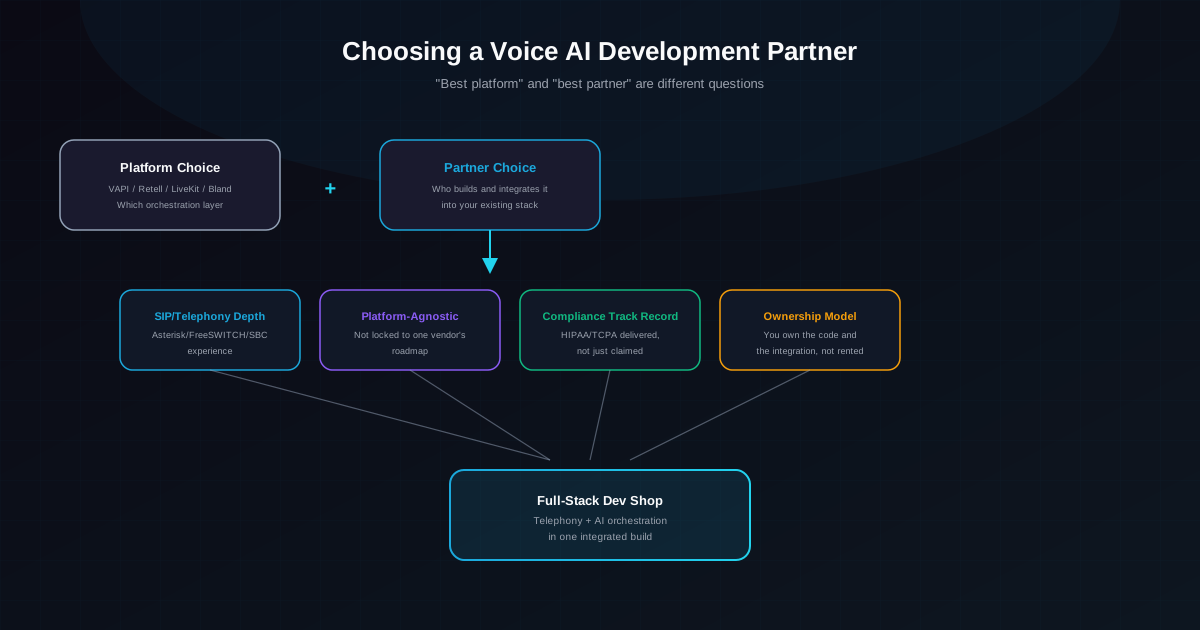
That's the gap this guide fills: a framework for evaluating an implementation partner — SIP/telephony depth, platform-agnostic integration ability, compliance track record, and ownership model — independent of which orchestration platform you eventually pick.
We cover certified platform partners vs full-stack dev shops, what a production call-center integration technically requires, integration patterns by existing PBX/CCaaS stack, and the exact questions to ask before signing a statement of work.
4 criteria
That actually predict partner fit
$18K–$85K
Typical integration cost range
6–14 wks
Single vs multi-queue timeline
0
CelloIP listicles competing with this list
Quick Answer
The best voice AI development partner for a call center isn't determined by which underlying platform (VAPI, Retell, LiveKit, Bland AI) they use — it's determined by four things: real SIP/telephony integration experience beyond the AI platform's own SDK, the ability to work platform-agnostically rather than pushing you toward whichever platform they're certified on, a demonstrable track record with your compliance requirements (HIPAA, TCPA), and a clear ownership model where you keep the integration code and IP after delivery rather than renting a black-box deployment. Certified platform partners move fastest on a single platform; full-stack development shops with telephony depth handle the messier reality of legacy PBX integration and compliance-heavy environments better.
Why "Best Platform" Isn't the Same Question as "Best Partner"
A search for "best voice AI platform for call centers" returns dozens of self-published rankings — several from the platforms themselves — comparing latency, pricing, and voice quality across VAPI, Retell, Bland AI, and others. That's a useful comparison, and we've written our own version: our VAPI vs Retell vs LiveKit vs Bland AI comparison covers exactly that ground.
But picking the platform answers only half the problem. The platform is an API and an SDK — it doesn't know how to route a call from your existing Genesys or Five9 queue, doesn't know your HIPAA BAA requirements, and doesn't know how to warm-transfer a caller to a human agent without them repeating their whole story. That's implementation work, and it's a completely separate evaluation from "which platform has the best latency benchmark."
Evaluation Criteria for a Voice AI Development Partner
| Criterion | What to Look For | Why It Matters |
|---|---|---|
| SIP/telephony depth | Hands-on Asterisk, FreeSWITCH, Kamailio/OpenSIPS, SBC experience — not just the AI platform's SDK | Most integration failures happen at the telephony layer (codec negotiation, routing, failover), not the AI layer |
| Platform-agnostic ability | Has shipped on 2+ platforms (VAPI, Retell, LiveKit), doesn't push you toward one they're locked into | Avoids you inheriting the partner's vendor lock-in as your own |
| Compliance track record | Named examples of HIPAA or TCPA-compliant deployments, not just a claim in a sales deck | Compliance retrofitting after launch is far more expensive than building it in |
| Ownership model | You receive and own the integration code/IP, not a black-box hosted deployment you can't leave | Determines whether you can maintain, extend, or migrate the system without the original partner |
Certified Platform Partners vs Full-Stack Dev Shops
Voice AI platforms increasingly run their own certified-partner programs — a legitimate, fast path for a straightforward deployment. But it's worth understanding what each model optimizes for:
- Certified platform partners are vetted and trained specifically on one platform's SDK — fast to start, but their solution space is bounded by that platform's architecture and pricing model, and they have limited incentive to recommend a different platform even when it fits better.
- Full-stack development shops with telephony depth (SIP/Asterisk/FreeSWITCH background) evaluate the platform as one component of a larger system, and are more likely to catch integration issues at the PBX/SBC layer before they become production incidents.
- The right choice depends on your stack: greenfield cloud-native call centers with no legacy PBX often do fine with a certified platform partner; call centers running Asterisk, FreeSWITCH, Genesys, or Five9 benefit from a partner with direct experience integrating AI agents into that specific infrastructure.
What a Production Call-Center Voice AI Integration Actually Requires
A voice AI demo is a phone number connected to an agent. A production call-center integration is considerably more:
- SIP trunk or SBC connection into your existing PBX/CCaaS, routing calls to the AI agent without ripping out your current telephony investment.
- Call-routing logic that decides which calls go to the AI agent vs a human queue, and re-routes based on the AI's own confidence or escalation triggers.
- Warm-transfer mechanism — when a call needs a human, context (transcript, extracted data) transfers with it so the caller doesn't repeat themselves.
- CRM/ticketing integration so the agent has caller history and writes call outcomes back automatically.
- Monitoring and observability — latency, failure rate, and escalation-rate dashboards, not just a demo that worked once.
- Compliance logging appropriate to your industry (HIPAA audit trail, TCPA consent/DNC checks) built into the call flow, not bolted on after launch.
- Load and failure testing before go-live — not just a happy-path demo call, but a deliberate test of what happens when the AI agent endpoint is slow, unreachable, or the transcript extraction returns malformed data mid-call.
None of these six items are optional add-ons you bolt on after the AI agent is "working" in a demo — they're the difference between a proof of concept and a system a real call center can depend on. A partner who scopes a project around only the AI conversation logic, without pricing in the routing, monitoring, and compliance layers, is scoping a demo, not a production system.
SIP Dispatch to AI Agent (Kamailio Routing Snippet)
A realistic example of the routing-layer work a telephony-capable partner handles — dispatching an inbound call to an AI agent endpoint while preserving fallback to a human queue:
# Kamailio routing block: dispatch inbound call to AI voice agent
# with automatic fallback to human queue if the agent endpoint is down

route[AI_AGENT_DISPATCH] {
    if (!ds_is_from_list("2")) {
        # Not a known AI-agent SIP endpoint — check destination set health
        if (!ds_select_dst("1", "4")) {
            xlog("L_ERR", "AI agent cluster unreachable, routing to human queue\n");
            $du = "sip:[email protected]:5060";
            route(RELAY);
            exit;
        }
    }

    # Tag call metadata the AI agent uses for context/compliance logging
    $var(call_id) = $ci;
    $var(caller_id) = $fU;
    append_hf("X-Call-Context: call_id=$var(call_id);caller=$var(caller_id)\r\n");

    # Health-checked dispatch with failover across the AI agent cluster
    if (!ds_select_dst("1", "4")) {
        send_reply("503", "AI agent cluster unavailable");
        exit;
    }

    t_on_failure("AI_AGENT_FAILOVER");
    route(RELAY);
}

failure_route[AI_AGENT_FAILOVER] {
    if (t_check_status("5[0-9][0-9]")) {
        xlog("L_WARN", "AI agent failed for $var(call_id), failing over to human queue\n");
        $du = "sip:[email protected]:5060";
        t_relay();
    }
}
Integration Patterns by Existing Stack
| Existing Stack | Integration Pattern | Partner Type Needed |
|---|---|---|
| Legacy Asterisk/FreeSWITCH PBX | AGI/ARI or AudioSocket bridge into the AI agent | Full-stack shop with telephony + AI experience |
| Cloud CCaaS (Genesys, Five9, NICE) | SIP trunk or native connector into the CCaaS routing layer | Partner with CCaaS API + AI orchestration experience |
| Greenfield cloud-native | Direct platform SDK integration, minimal legacy constraints | Certified platform partner often sufficient |
| Multi-tenant / MSP telephony | Per-tenant routing and isolation on top of the AI agent layer | Full-stack shop with multi-tenant VoIP architecture experience |
See our SIP trunk + AI voice agent integration guide for the technical detail behind routing an AI agent through an existing SIP trunk without rip-and-replace.
Questions to Ask Before Hiring a Voice AI Partner
- Do you have hands-on SIP/telephony experience beyond the AI platform's own SDK — can you show a production PBX/CCaaS integration?
- Can I see a reference deployment integrated with infrastructure similar to mine (legacy PBX, specific CCaaS, multi-tenant)?
- Who owns the integration code and IP after delivery — can I maintain or migrate it without you?
- What's your experience with my industry's specific compliance regime (HIPAA, TCPA), and can you name a deployment where you built it in?
- What's the support/SLA model after go-live — ongoing retainer, or a one-time handoff with no support?
- How do you handle platform lock-in risk — if the AI platform changes pricing or shuts down a feature, what's the migration path?
Red Flags When Evaluating a Voice AI Partner
Beyond the criteria and questions above, a few specific answers in a sales conversation are worth treating as disqualifying rather than just a minor concern:
- They can't describe a specific production incident they've debugged at the telephony layer — codec mismatch, SBC misconfiguration, failover not triggering — because they've only ever worked at the AI-platform SDK layer, not the SIP/PBX layer underneath it.
- They're vague about who owns the code after delivery, or the contract routes all infrastructure through their own hosted environment with no export path — a sign you're buying a rental, not a build.
- They claim a platform is 'HIPAA-compliant' or 'TCPA-compliant' as a blanket statement rather than pointing to a specific signed BAA or a specific compliance architecture they've implemented before.
- Their reference deployments are all demos or pilots, not production systems handling real call volume for more than a few months — pilots don't surface the failure modes production traffic does.
- They push a single platform regardless of your stack, without first asking about your existing PBX/CCaaS, compliance requirements, or call volume — a sign the recommendation is about their own certification, not your fit.
Cost Models Compared
- Single-queue integration (one call type, warm transfer to existing human queue) — $18,000–$35,000, 6–8 weeks.
- Multi-queue, multi-integration deployment (CRM sync, compliance logging, multiple call types) — $40,000–$85,000, 10–14 weeks.
- Fixed-price project — best for well-scoped single-workflow integrations with clear requirements.
- Dedicated developer / staff augmentation — best for ongoing multi-phase rollouts across several call queues or business units.
Use Cases by Call Center Type
The right partner profile shifts depending on which of these use cases you're solving for first — an inbound-support-overflow deployment is largely a platform-and-routing problem, while an FNOL or outbound-collections deployment adds compliance and structured-data-extraction requirements that favor a partner with telephony and regulatory depth over one optimized purely for fast platform onboarding.
Inbound Support Overflow
AI agent absorbs overflow volume during peak hours, warm-transferring complex cases.
Outbound Sales/Collections
Compliant outbound dialing with TCPA-aware pacing, human handoff on qualified leads.
FNOL / Claims Intake
Structured intake with claims-system integration — see our insurance voice AI guide.
Appointment Scheduling
Inbound and outbound scheduling synced to the existing calendar/EHR system.
Frequently Asked Questions
What's the difference between a voice AI platform and a development partner?
The platform is the STT/LLM/TTS orchestration layer connecting speech recognition, reasoning, and speech synthesis. The partner is who integrates that platform into your specific call-center stack, CRM, and compliance requirements — two genuinely separate decisions, not one.
Should I hire a certified platform partner or a full-stack dev shop?
Certified partners move fastest on one platform when your call center is greenfield and cloud-native. Full-stack shops with telephony depth handle legacy PBX integration and compliance-heavy environments with far fewer surprises.
What questions should I ask before hiring a partner?
SIP/telephony experience beyond the AI SDK, reference deployments similar to your stack, code ownership after delivery, a named compliance track record, and the post-launch support model versus a one-time handoff.
Is it better to build in-house or hire a partner?
In-house works well if you already have engineers with both SIP/telephony and LLM-orchestration experience. A partner is faster and lower-risk for a first production deployment, especially when that combined skill set doesn't already exist on your team.
What does a production integration actually require?
SIP/SBC connection to your PBX/CCaaS, routing logic, warm transfer, CRM integration, monitoring, and compliance logging — not just an AI phone number.
How much does a call-center voice AI integration cost?
$18,000–$35,000 for a single-queue integration (6–8 weeks); $40,000–$85,000 for a multi-queue deployment (10–14 weeks).
Does the partner need experience with my specific PBX or CCaaS?
It significantly reduces risk — direct Asterisk, FreeSWITCH, Genesys, or Five9 experience avoids surprises in codec negotiation, routing, and failover.
What's a red flag when evaluating a partner?
Vagueness about code ownership, blanket compliance claims with no specific BAA or architecture named, and reference deployments that are only demos, not production systems.
How long until I see results?
A single-queue integration typically reaches a production pilot in 6-8 weeks, with measurable results visible within 2-4 weeks of live traffic.
Related Reading
Evaluating a Voice AI Partner for Your Call Center?
CelloIP combines SIP/telephony depth with LiveKit, VAPI, and Retell integration experience — platform-agnostic, code you own.